
Group Sues Ohio County Commission Over Mineral Rights Assessments
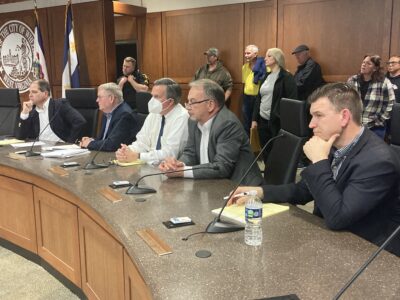 Photo by Joselyn King
Trending
WHEELING – A group of Northern Panhandle residents have filed a lawsuit in Circuit Court, appealing a ruling from the Ohio County Commission - in its capacity as the Board of Review and Equalization - over their mineral rights assessments.
Attorney J. Anthony Edmond Jr. on Monday filed the suit in Ohio County on behalf of Scott Sonda and Mark Sonda of Bethany, Steven Dille of Moundsville, Glenn Dille of Valley Grove and Richard Wood of Bethany. According to the suit, their respective mineral interests were assessed according to the West Virginia Tax Division and they believe their minerals were assessed incorrectly.
The five appealed their assessments to the commission, which also acts as the county's board of review and equalization. According to the suit, the commission denied the appeal, stating "the taxpayer failed to meet the burden by providing clear and convincing proof that the Assessor's appraisal was clearly wrong."
Those assessments have come under scrutiny in recent months after mineral rights owners received a "Tentative Notice of Increase in Appraisal" in their mailboxes, informing them that their mineral rights assessment in the 2023 tax year was three to four times higher than it was in tax year 2022.
Officials with the West Virginia Tax Division have said that, in notices sent out in December and January, the division was using older appraisal data, resulting in incorrect numbers being sent to royalty owners.
In the suit, the five make two arguments - that the standard of proof required in the appeal was incorrect and that the manner of assessment is contrary to what is in the state statues. In the first argument, the five say that, according to state statute, the standard of proof which a taxpayer must meet at all levels of review and appeal "shall be a a preponderance of the evidence standard."
Because the commission used the phrase "clear and convincing proof," the five say that the standard it used was incorrect.
In the second argument, the five claim that, as the Tax Division uses an "income approach to value" with respect to oil and gas royalty interests, that approach is "incorrect and unnecessary with respect to determining value for the natural resources property in question." The five claim the "true value" of a property can be found by "examining dollar amounts paid to acquire such an interest."
The group also argues that utilizing prices paid for royalties doesn't take into account the change in market values relative to depletion of resources with everyday production and relies too much on income reporting numbers provided by the operators themselves.
The group asks for the court to either reassess the ad valorem taxes in question and grant relief to the five consistent with state code, or remand the matter back to the board of review and equalization so it can consider the matter using the correct standard of proof.
Ohio County Solicitor Don Tennant said Tuesday afternoon that the county had no comment on the merits of the case, but to please contact the state Tax Division because "that is the entity that does the appraisment of mineral interests in the ground."