
Lawmakers Praise Deal To Fast-Track Mountain Valley Pipeline
Trending
CHARLESTON -- The deal on the debt ceiling that emerged Sunday included language to speed up completion of the Mountain Valley Pipeline transporting natural gas from West Virginia to Virginia, but who gets credit?
The Mountain Valley Pipeline has been at the center of an overall permitting reform debate in Congress since last summer. Republican and Democratic lawmakers presented competing packages, both of which went down in flames with neither side wishing to give the other a win.
But representatives of both parties came together at the last minute over the weekend on permitting reform.
According to Politico Playbook, permitting reform language and the Mountain Valley Pipeline provisions included in the agreement between President Joe Biden and House Speaker Kevin McCarthy, R-Calif., came together only Sunday morning. The language on permitting reform wasn't finalized until Sunday afternoon, with the full debt ceiling bill posted online Sunday evening.
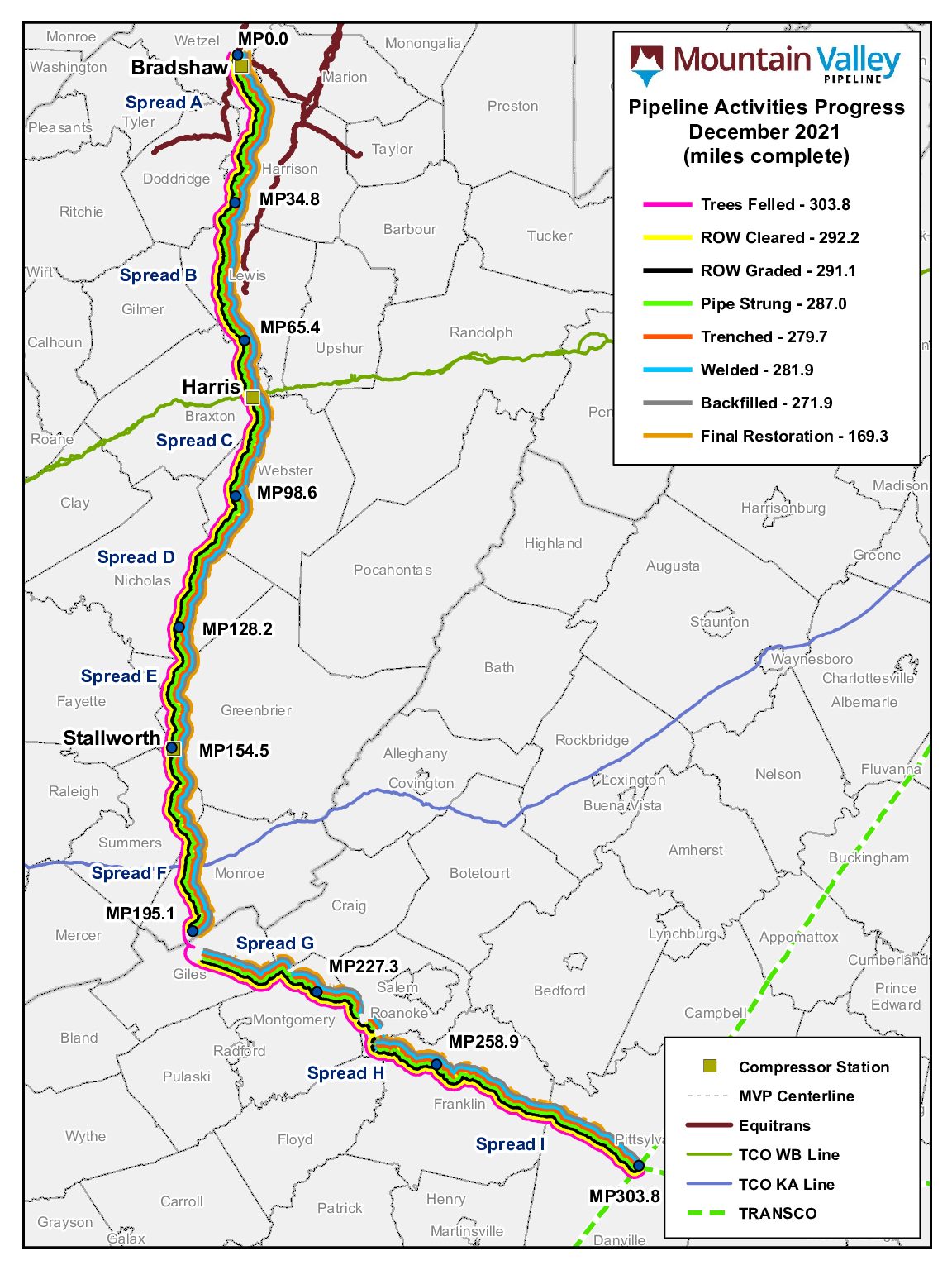
The 304-mile Mountain Valley Pipeline would transport natural gas from Wetzel County, connecting it to the Transco Pipeline in Pittsylvania County, Va. The completion of the pipeline would connect West Virginia's Marcellus Shale gas fields to the Northeast and the South. Language in the debt ceiling bill would direct agencies to issue any remaining permits and shield permits from further legal review.
"We are grateful for the full support of the White House, as well as the strong leadership of Democratic and Republican legislators for recognizing the Mountain Valley Pipeline as a critical energy infrastructure project," said Natalie A. Cox, a spokesperson for the Mountain Valley Pipeline project, a joint venture of EQM Midstream Partners LP, NextEra Capital Holdings Inc., Con Edison Transmission Inc., WGL Midstream and RGC Midstream LLC.
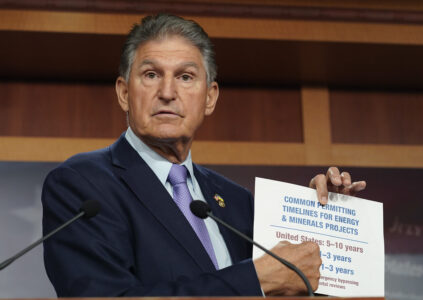
The language includes provisions from U.S. Sen. Joe Manchin's permitting reform package, the Energy Independence and Security Act, which was pulled last September from a continuing resolution to keep the government funded.
"There is not another pipeline or another project in the United States of America that could bring that much energy, 2 billion cubic feet a day, into the marketplace within a six-month period of time if it was completed," Manchin, D-W.Va., said to reporters Tuesday afternoon in a virtual press conference.
"I've talked to all the negotiators on both sides of the aisle, Kevin McCarthy and his team, and the president and his team," Manchin continued. "I said this is something that can put this much production this quickly into the line that quickly. ... It's a tremendous boost as far as the economy of West Virginia and parts of Virginia."
The Simplify Timelines and Assure Regulatory Transparency Act, a failed amendment to the $737 billion Inflation Reduction Act negotiated last summer by Manchin with the White House and congressional Democratic leaders, was the Senate Republicans' permitting reform package that also included expedited completion of the Mountain Valley Pipeline.
The amendment, and later a separate bill, was led by Sen. Shelley Moore Capito, the ranking Republican member of the Senate's Environment and Public Works Committee and the vice chair of the Senate Republican Conference. Speaking by phone Tuesday afternoon, Capito said she had spoken with McCarthy Saturday night about including the Mountain Valley Pipeline in the final debt ceiling package.
"The last time I talked with (McCarthy) was late Saturday as they were inking the deal to make sure it was included, but he wanted to make sure that I knew that he was aware of how much I cared about it," said Capito, R-W.Va. "It was a total team effort. Everyone was talking to as many people as we possibly could.
"We understood the issue, I think, very well because those who are really wanting to have this completed ... spent a lot of time educating members," Capito said. "We helped them get in touch with members that might be kind of fence-sitters or didn't understand. It's been a real process. In the end, it made it in. We're really, really excited about that."
Rep. Carol Miller, R-W.Va., has also led the charge in the state to complete the Mountain Valley Pipeline, including introducing an amendment in March to the Lower Energy Costs Act to complete the pipeline project. Speaking by phone Tuesday afternoon, Miller said she immediately reached out to McCarthy during debt ceiling negotiations.
"Absolutely, I was the first person (McCarthy) called. First, he texted me, then he called me," Miller said. "I've been working on this for months. It's very, very important to West Virginia. It's important to Pennsylvania, Ohio, West Virginia, Virginia, the Carolinas. It's ridiculous how long this has been held up."
If Congress can come together on the debt ceiling bill with the included pipeline and permitting language, pipeline officials believe the project can be complete by the end of 2023. Cox praised Manchin, Capito and Miller for their efforts to help get the Mountain Valley Pipeline over the finish line, as well as McCarthy and Reps. Guy Reschenthaler, R-Pa., and David Joyce, R-Ohio.
"In particular, it was the leadership and unwavering commitment of Chairman Manchin who first recognized the importance of MVP to our nation's energy security and spearheaded the development of broad, bipartisan support for the completion of MVP," Cox said.
Other permitting reform provisions in the debt ceiling deal include imposing deadlines for regulatory agencies to issue permits, speeding up environmental reviews of permitting energy projects, simplifying communications between federal agencies issuing permits for the same project and streamlining the overall review process.
The debt ceiling bill, the Fiscal Responsibility Act, still must make it through the House Rules Committee with a vote by the full House Wednesday. The U.S. Treasury Department has set a June 5 deadline for possible default if Congress doesn't pass a bill raising the debt ceiling.