
Lawmakers Visit Wheeling Rotary Club
Trending
WHEELING -- The West Virginia Legislature moved to reduce the state's income tax this year, and two local lawmakers say it was the best thing the Legislature did during the 2023 regular session.
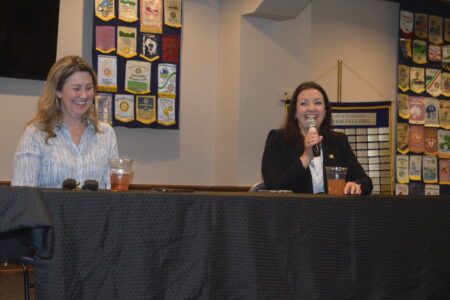
Delegate Erikka Storch and freshman State Sen. Laura Wakim Chapman, both R-Ohio, answered questions before the Rotary of Wheeling Tuesday at WesBanco Arena.
House Bill 2526, signed into law by Gov. Jim Justice, immediately reduces the income tax in tax year 2023 by an average of 21.25%. Additional income tax cuts will occur in 2024 through refundable tax credits equal to the amount of car taxes paid to county sheriffs, and half of the amount of tangible personal property taxes paid to the county sheriff for qualified small businesses.
Storch noted that in Ohio County residents pay a 6.25% income tax rate, which is higher than in surrounding counties.
"To get the money back to the people who pay the income tax is probably the most positive thing we did," she said. "There is a lot of concern, because there has been some speculation that our revenue estimates may be arbitrarily low to give the governor a slush fund to play with.
"At least by tapering out the reduction, we can see if the sky is falling."
The income tax reduction for many people began in March and April, and the state still had positive tax revenues, Storch continued.
Chapman said that in addition to the income tax reduction, the bill signed by the governor also gives disabled veterans a refund on their property taxes.
"In West Virginia, we have the highest amount of veterans per capita," Chapman said. "I think it's great the Legislature decided to help those veterans."
Chapman and Storch also touted the decision by the Legislature to provide a $300 million package to support Form Energy's plan to build an iron-air battery manufacturing plant on the site of the former Weirton Steel property in Hancock County.
Lawmakers from the southern coalfield districts opposed the move, believing it to be an investment in alternative energy sources that would ultimately hurt the coal industry. They also asserted that money for the package largely came from the severance taxes paid by the coal and gas industries in the south and they didn't want the money going to projects in the north, Storch and Chapman explained.
"The legislature appears to be very business-friendly," Chapman said. "I think they will continue to enact legislation to make it easier for businesses to come to West Virginia and employ people.
"In Hancock County, which is part of my district, Form Energy is coming in and that's a good thing -- even clear down here (in Ohio County). Anytime we can get a business in this state, it's a good thing. It employs people, brings in more tax revenue, and I look forward to more legislation like this."
She went on to add that if Form Energy were being proposed for the southern part of the state, she still would have supported the legislation to help fund the project.
As for the failures of the Legislature this session, Storch pointed to the inability of lawmakers to address the controversies surrounding oil and gas assessments, and why many property and mineral rights owners are paying more taxes than they should.
"All of our surplus every month is attributed to a glut that is coming from severance taxes," Storch explained. "There are different tax pools, but that is where the activity is.
"But there are people paying more than they need to pay, and my fear is that at some point they may lose their mineral rights. They can't lose their property, but they can lose their mineral rights because it is a separate tax impact."
Chapman plans to re-introduce next session her bill changing how childcare facilities are reimbursed by the state. The legislation she is proposing bases reimbursement on total enrollment at the school, and not daily attendance by students who often aren't brought to the facility each day.
At present, if a child is occupying a seat at the school just four days a month, the childcare center only receives state reimbursement funds for those four days. Most facilities can't operate like that, Chapman said.
"Childcare costs about $10,000 per child (per year) around here," she continued. "Most families struggle to be able to work and to pay for childcare. It's a development issue. We need to have childcare so people are able to work."