
Motherhood Keeps Eyes on Road to Recovery
Trending
WHEELING -- There are 6,262 children in West Virginia -- 204 of them in Ohio County alone -- who are unlikely to be celebrating Mother's Day this weekend. They are wards of the state -- living with other relatives, foster caregivers or in institutional care.
Two children, however, are not included in this May count from the West Virginia Department of Health and Human Resources.
They are with their mother. And she is a woman who pulled out of the opioid crisis that is behind much of this system-swamping and financially costly parenting crisis to both regain custody and commit to helping other mothers restore the bond that addiction broke.
"Everybody wants their mommy," said Erica Biggers, now a peer recovery specialist and kitchen manager for the soon-to-be reopened Serenity Hills Life Center.
The rural Ohio County center is dedicated to the treatment of substance-addicted women -- about 75% of whom Chief Executive Officer Sharon Travis said are either pregnant or trying to regain custody of children.
ONE FAMILY
Biggers said she became addicted to opioids in the kind of ironic twist that threads through the nation's pharmaceutically launched disaster. She was being treated for severe pain associated with endometriosis, a reproductive disorder.
"For years and years and years, I was prescribed opioids before it was an epidemic," Biggers said.
By the time changing medical policy cut off that supply, she was addicted and began buying another opioid, the illegal street drug heroin. From there, Biggers said, her family fast tracked into the court system. Custody was lost. Biggers was distraught. But, the comeback of a lifetime was just around the corner.
"My kids got me here and, myself, I kept me here," Biggers said of becoming one of Serenity Hill's early success stories as part of her court-ordered "improvement plan."
Biggers said she entered the 72-bed facility as it opened in 2019 and lived on site for 10 months - first in active treatment and later in a sober-living house that included parenting training. Eighteen months from that arrival, her life was on track to the point she regained custody of her children - with whom the Serenity Hills mother's program had allowed her to maintain visitation.
That she wound up with custody of her own life, as well, was a bit of a surprise.
"I never knew that for them (children) to grow that I had to grow, too," Biggers said.
That was then. "I've got a house," Biggers said of now. "(A co-worker) helped me to get my driver's license. Another worker here helped me to get my first car."
A PATTERN, A PATH
CEO Travis - herself in recovery from alcoholism for more than 40 years — said Biggers' path is more like a pattern among addicted mothers. Recovery often begins with a moment of heart-wrenching mental clarity, she noted.
"Some of them will lose their children and they still keep using until they're in jail," Travis said. "They get clean in jail and they want their kids back."
Motherly love, as it turns out, is a major motivator for recovery, Travis said.
This is a good thing, she noted, as about 5% of the women who come to Serenity Hills - often from a detox program or directly from jail — are pregnant and in danger of losing custody of their newborn if they cannot get clean. She said another 70% are actively trying to regain custody of their children from Child Protective Services.
A specific mother's program at the center addresses such needs, which Travis said can be a mix of addiction contributors and a lack of life and job skills. Once the moms complete active treatment, they can move into a sober-living house.
"That is where the real work begins," Travis noted.
The sober-living house combines intense support with the reintroduction of real life, Travis explained. There is child visitation, parenting classes that can include the simulated care of an infant going through drug withdrawal, GED classes, academic classes or trades training through West Virginia Northern Community College, job training, driver's training and on and on.
A to-do list can be daunting, but Travis said the reality of the court improvement plans drive the regimen.
"They give a girl a chance to ... do what the court requires of her to get her children back," Travis said, but noted that requiring a drug addict to get clean and stay clean, get employment and get safe housing can feel like Mount Everest.
MOTHERHOOD, SISTERHOOD
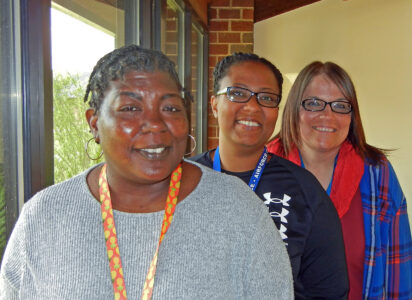
Such thinking resonates with two other peer recovery specialists at Serenity Hills - Jacquetta Harrison and Suzanna Hoffman. Like Biggers, both women struggled with parenting while in the full grip of addiction. They, however, were in recovery for years before the center was established in 2019.
Harrison said she has a good relationship with her two children, both of whom are now adults and one of whom is currently in college. But, she regrets that she was never able to regain custody of her youngest.
It's something that gives special drive to one element of her work. Harrison runs Project Freedom, a center program which interfaces directly with female addicts in the community in an attempt to get them to choose treatment.
Hoffman said her husband shouldered the parenting load for a couple of years while she was struggling to move into recovery in 2011 and 2012.
"I had seven relapses," she noted.
They get it. And, Biggers said that women like Travis, Harrison and Hoffman have surrounded her like a sisterhood.
When Child Protective Services and other involved agencies required her to take frequent and random urine test to prove she remained clean, the Serenity Hills team drove her to testing until she was able to get licensed and secure a car of her own — with their help.
"I was peeing all week long," Biggers said of their time commitment. She believes their help was a critical element in the return of her children. "That's why I was able to finish so quickly and get my kids back."
These women and others who have been through or work for the program continue to contact each other and encourage sobriety, Travis said. They call themselves Serenity Sisters and consider each others' children to be part of an extended family. Proms, baby showers, holidays are cause for group celebration.
Travis sees this connectivity as something more than a feel-good moment in the recovery process. The children of these mothers are real and addiction, she noted, can have a generational component.
"If we can heal the mothers, maybe we can prevent future addicts," Travis said. "It saves the whole system."