Income, Severance Taxes Drive $1.8 Billion Surplus
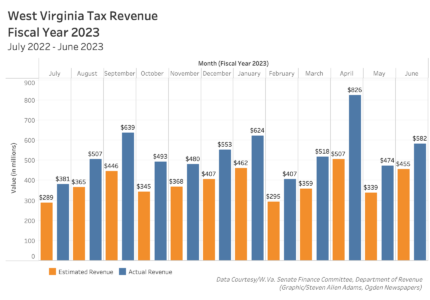
CHARLESTON — West Virginia officially ended the 2023 fiscal year with more than $1.8 billion in surplus funds, driven primarily through increases in personal income tax and severance tax collections.
The West Virginia Senate’s Finance Committee on Wednesday released a report showing the state ended the 2023 fiscal year with $6.483 billion in tax collections for the general revenue fund, which was 40% more than the $4.636 billion revenue estimate from the state Department of Revenue.
“All of us know it was a big surplus,” Justice said Wednesday. “Not only does it exceed anything that the State owf West Virginia could ever imagine … it’s just more money than any of us can comprehend.”
Severance tax collections for the previous fiscal year were $947 million. That was 279% more than the $250 million revenue surplus estimate, resulting in $697 million in tax revenue surplus. The severance tax accounted for only 15% of total tax collections for the fiscal year but accounted for 38% of the total $1.8 billion in tax revenue surplus.
Personal income tax collections of $2.664 billion was 22% more than the $2.19 billion revenue estimate, resulting in $474 million in surplus tax revenue. Personal income tax surplus collections accounted for 41% of total tax collections, and 26% of surplus tax revenue.
The consumer sales and use tax accounted for 27% of total tax collections for fiscal year 2023 but only 13% of surplus revenue. Sales tax collections of $1.75 billion was 16% more than the $1.51 billion revenue estimate, resulting in $240 million in surplus tax collections.
Corporate net income tax collections of $420 million for the fiscal year was 180% more than the $150 million revenue estimate, resulting in a $270 million surplus. Corporate net income taxes made up 7% of total tax collections for fiscal year 2023 and 15% of surplus tax collections. All other sources of tax revenue accounted for 10% of total tax collections.
“Fiscal year ’23 was historic in every sense of the word,” said Dave Hardy, cabinet secretary of the Department of Revenue. “We set six all-time records for revenue in fiscal year 2023.”
Spending in the general revenue budget has remained mostly flat for the last several fiscal years, relying on official estimates from the Department of Revenue. Yet, the Department of Revenue has maintained unofficial revenue estimates over and above their official estimates.
The $6.483 billion general revenue number is 1.3% more than the unofficial $6.4 billion estimate, according to a document distributed at the beginning of the 2023 legislative session.
Fiscal year 2024 began Saturday, with the state operating under a $4.875 billion general revenue budget approved earlier this year. That budget includes another $1.165 billion in one-time funding placed in the surplus section in the back of the budget to be paid out if the state ends the current fiscal year with surplus tax revenue.
With the $1.165 billion in back-of-the-budget surplus spending and $231 being deposited in the state’s nearly $1 billion Rainy Day Fund, that leaves the state with $451 million of the $1.8 billion in available tax revenue surplus to appropriate.
Up until the creation of the general revenue budget for fiscal year 2019, budgets were tied strictly to the actual tax revenue estimates. During Justice’s first term as governor in 2017, that meant filling a projected $500 million hole for the fiscal year 2018 budget, with Justice – then a Democrat — proposing tax increases and the Republican-led Legislature proposing budget cuts.
Justice vetoed that budget on a silver platter of cow dung. The Legislature later approved a $4.2 billion general revenue budget in June 2017 – just prior to the start of the 2018 fiscal year – that became law without Justice’s signature. But since then, the state has kept its base budget relatively flat, creating a cushion of excess tax revenue that can later be appropriated for one-time expenses, additional road funding, economic development, tourism, and deferred maintenance.
Justice and Hardy said it is better to keep the budget flat and end the fiscal year with large surpluses than create tight budgets that are based on revenue estimates that would be more susceptible to economic downturns and result in mid-year budget cuts.
“Why in the world would we want to push it beyond practical and good sense,” Justice said. “Why would we want to risk ourselves getting in a situation where all of a sudden we can awaken to an out-and-out collapse in the stock market or whatever it may be. And then all of a sudden you turn around two or three times and you’ve got an oh-doop moment. We don’t want those moments.
“What we want to do is fund ourselves properly, grow things like pay incentives and pay increases and everything else under the sun, but we don’t want to just frivolously get ourselves in situations where we can awaken to a real problem,” Justice continued.
“Simply put, controlling the baseline budget works, and it has worked very, very well and we’re seeing the benefit of that,” Hardy said. “If you let the baseline budget grow exponentially with good times with revenue, then the baseline budget grows right along with the revenue. The moment you have a downturn, you have what we inherited here in January 2017: you have a budget that is upside down and very difficult and hard decisions have to be made.”
Top Headlines

‘We will pay,’ Savannah Guthrie says in desperate video plea to potential kidnappers of her mother

Cameron Captures Sixth-Straight OVAC Championship

Appeals court affirms Trump policy of jailing immigrants without bond

Police arrest protesters at Minneapolis federal building on 1-month anniversary of woman’s death

Trump aims to hold the first meeting of his new Board of Peace in Washington this month