
Wheeling Police: Crisis Intervention Team Having Lifesaving Impact
 Emma Delk
 Trending
WHEELING -- With the Wheeling Police Department graduating another class of officers into its Crisis Intervention Team, the Wheeling Police Chief Shawn Schwertfeger said the force has already seen lethal interactions between officers and individuals in mental health crises decrease as officers incorporate de-escalation and negotiation skills into their policing.
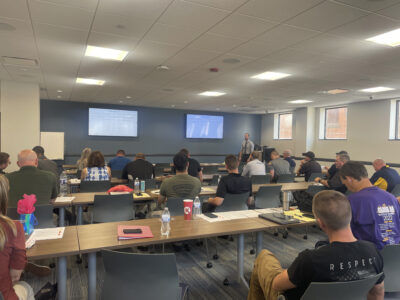
Crisis Intervention Team, or CIT, is a community-based program offered to Wheeling Police Department staff in collaboration with Northwood Health Systems. Over the 40 hours of training, officers participate in role-plays and scenarios that teach them how to navigate interactions between them and individuals in mental health crises.
"CIT allows us to go into interactions with a better understanding and more compassion, so we can get individuals the help they need," said Schwertfeger on why he introduced the CIT program to the department.
During each training session, Northwood Health Systems staff who are trained in specific areas, including psychosis, medication-assisted treatment, mobile crisis response and intellectuals with developmental disabilities, give officers a better understanding of mental health and addiction.
"We want to give officers a comprehensive approach that will allow them to meet the individual needs of these people that we aren't able to reach otherwise," said Kristy Myers, director of crisis services at Northwood Health Systems. "We're able, through the assistance of the Wheeling Police Department, to get the individuals engaged with treatment once again."
Schwertfeger said he is thrilled the training has grown in scale at WPD since he introduced CIT in 2015. The force now has a dedicated team specializing in crisis intervention used to diffuse situations with individuals struggling with mental health.
Northwood Health Systems also has its own dedicated mental health mobile crisis responders and substance use disorder mobile crisis responders that assist officers in these interactions as well.
The leader of the department's Crisis Intervention Team, Cody Schwertfeger, was one of the first graduates of the program.
He recalled using the techniques he learned during a CIT class on Friday that next Monday in an interaction with a subject that was in a methamphetamine-induced state and threatening to jump off the roof of a building in East Wheeling.
"We had to forcibly get the subject down off of that roof, which was terrifying," said Cody Schwertfeger. "But, by the end of it, he saw why we were up there and what we were there for.
"Using our training, we were able to make him realize we weren't there to hurt him, but instead, we were there for his benefit."
Chief Schwertfeger, who witnessed the interaction at ground level, explained that the interaction, for him, reflected "what CIT is all about."
"The three officers in that interaction all said that the things that they learned through roleplaying and the scenarios they engaged in at the training helped them to successfully get the subject into custody and safely off the roof before he killed himself," he added.
The WPD will continue to make mental health a priority in their training of officers, according to Shawn Schwertfeger, as it is the first agency in West Virginia to join the One Mind Campaign through the International Association of Chiefs of Police.
The program's goal is to enhance engagement between law enforcement and those with mental health conditions, with one of the requirements of the campaign being 100% of law enforcement officers at a station participate in CIT training.
With the department holding two to three CIT trainings each year at the station, Chief Schwertfeger said that it will be easy for them to fulfill the pledge, as about 50% of its staff have completed the training as of now.
"It's very important to me to continue these trainings because you can clearly see we're dealing more and more with folks that are in mental health crises," he added. "We want our officers to have every tool they can ever even imagine to make sure that not only they are safe, but the people they serve are safe."