
Defense Questions Evidence in William Carman Murder Trial in Ohio County
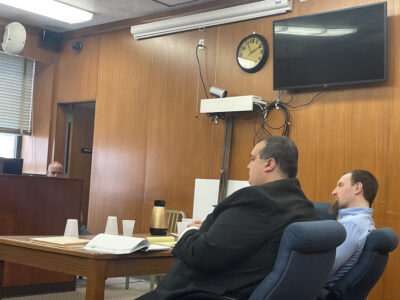 Emma Delk
 Trending
WHEELING -- Prosecutors called on forensic experts on the third day of the murder trial of a Wheeling man to identify his DNA at the scene of the crime. His attorneys questioned why certain pieces of evidence were not investigated and tested by the state.
William Ross Carman is accused of the Sept. 17, 2021, murder of Anorah Schostag, facing charges of first-degree murder, robbery, burglary and gross neglect of a child. Wheeling Police officers arrested him when they caught him fleeing Schostag's home, where her body was discovered.
In her opening statements Monday, Ohio County Assistant Prosecutor Shawn Turak identified Carman's motive for the killing as a way to steal money and drugs from his now ex-wife, Amanda Allison's "rich doctor friend." Defense attorney Martin Sheehan posited that Allison had set Carman up for the murder.
Sergeant Robert Safreed, supervisor of the detective division of Wheeling Police Department testified for the prosecution about videos and photos he took as one of the first responders on Sept. 17. He said they "fairly and accurately" depict the crime scene as he found it.
Safreed said blood spots had been left on the doorframe of the "office room" where Schostag was killed and more were found on the main floor in the downstairs hallway. He noted a cellphone found under a hat that had blood stains on it and a footprint left next to Schostag's body on the hardwood flooring of the office that he described as "larger than 6 inches."
Stephen King, supervisor of the latent print section of the West Virginia State Police forensic laboratory, identified that fingerprint on a cellphone found at the crime scene under the blue hat belonged to Carman's left little finger.
Safreed also said, when prompted by Turak, that the evidence placards identified a pathway of blood that went "from the downstairs hallway to the back door of the house."
Safreed also went on the canine trail that night, where he described finding a small women's Columbia-brand jacket with "blood stains on the right side, interior and sleeves." Anorah Schostag's brother, Ryan Schostag, had identified that as his sister's during his testimony Tuesday.
Safreed also returned to Schostag's house Sept. 18 after Ryan Schostag contacted the Wheeling Police Department to let them know he visited the house and found additional items he thought were evidence. On the day of Ryan Schostag's report, Safreed photographed "jewelry balled up in a little white reusable grocery bag" and a tote bag with jewelry inside of it inside Schostag's bedroom.
On that same day, Safreed also collected a freezer bag that contained knives from a set in Schostag's kitchen with "blood and hair" on them, blood-stained camouflage shorts, and a dark gray T-shirt with blood stains on it.
David Miller, forensic supervisor of the West Virginia State Police Forensic Laboratory, said that male DNA had been found on the left hand and oral swabs taken from Schostag's body when questioned by Turak.
Forensic specialist Brian Clemons, who does Biology DNA and Databasing at the West Virginia State Police Forensic Laboratory, also confirmed for Turak that DNA matching Carman's had been identified on the doorframe of the office room and a blood drop located downstairs.
While these DNA matches were not questioned by defense attorney Martin Sheehan, he disputed whether DNA that matched Carman had been identified on one of the two knives found in the freezer bag of the crime scene. Clemons said that the "primary" result of the DNA found on the handle of one of the knives was found inside the freezer bag.
However, Clemons explained that while Carman had been "excluded as a contributor to the primary results indicated," his DNA still could have been one of the two other DNA contributors found on the knife.
Sheehan also asked whether the male DNA on the oral sample could have been transferred through "the exchange of marijuana cigarettes by multiple people who are inhaling," to which Clemons confirmed that "it could be possible."
In his opening statements on Monday, Sheehan said that Carman, Allison and Schostag had all been "high as a kite" on the night of Schostag's death. Allen Mock, chief medical examiner of the State of West Virginia, confirmed when questioned by Turak on the toxicology report that methamphetamines had been present in Schostag at the time of her death.
Assistant Public Defender Nicholas Yovich then asked why a pair of gray sweatpants found in Schostag's house with suspected blood and the jacket found on the canine trail were not submitted to the lab for testing. Safreed said that there were "protocols and limitations" to how much testing the forensic lab can perform when receiving an influx of items from a crime scene.
"Did you hear yesterday, during the testimony of Miss Allison, that she said that she and Miss Schostag constantly shared one another's clothing?" Yovich then asked Safreed, who confirmed he had heard this statement from Allison.
Safreed confirmed for Yovich that they had not opened the freezer bag during the initial walkthrough of evidence on Sept. 17, but he recalled the bag being zipped.
On the contents of the freezer bag, Ryan Schostag confirmed in his testimony yesterday that the camouflage shorts found inside belonged to him. Yovich wondered "logistically" how Carman would have been able to take and change into Ryan Schostag's shorts before killing Anorah Schostag, then changing out of them and stowing them in the freezer bag before he left the house.
Safreed confirmed when asked by Yovich that "no search or inventory" was done to Allison's vehicle, with Ryan Schostag revealing in his testimony that he removed "a bag that contains various amounts of narcotics" from the car.
Yovich also questioned Safreed on a report from a witness who saw Allison stop in her Mercedes at a pull-off point near Schostag's house. Three days later after this incident, Safreed found three cellphones "approximately half a foot into the weeds" of the pull-off.
Safreed confirmed for Yovich that the steepness of the pull-off point prevented officers from searching for any other items in the pull-off.
"I did look as best as I could through the weeds, searching the areas where I could, but I was not able to locate anything else," added Safreed.
Wheeling Police officers were unable to "obtain additional information" from the three cell phones found at the pull-off, along with the cell phone found under the blood-stained hat at the crime scene.
Safreed informed Yovich that while the cell phone found at the house "could potentially" belong to Schostag, he "doesn't believe so." Schostag's family members told Safreed when he asked what her phone looked like that it had "a girly case with mermaids on it," while the cell phone found at the crime scene did not have a case that matched this description.