
Trending
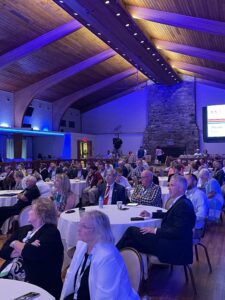
As mayors, city council members and other city officials from all over the state gathered at Oglebay Resort on Tuesday for the West Virginia Municipal League Annual Conference, Wheeling officials took away new wisdom to improve the city from workshops, speakers and government members from other cities.
Mayor Glenn Elliott explained that the event is "always a great opportunity" to get together with mayors and council members from across the state, adding that there is "no copyright law" preventing him from copying their city policies and applying them to Wheeling.
"I come to these meetings with the idea of learning what these other cities are doing," explained Elliot. "I see what cities are having success and then try to follow that model."
Vice Mayor Chad Thalman echoed Eliott's viewpoint on the importance of the conference, as he comes to the conference to get to know other mayors and city council members who can become a "resource for them."
"Here, we are able to meet with officials who can give us ideas, and we can call them in the future if we run into a similar problem," added Thalman.
While concurrent workshops will occur throughout the three-day conference, the resource that all city officials drew from at the conference was keynote speaker Mark Funkhouser, who served as the 53rd mayor of Kansas City, Missouri. Funkhouser's presentation "From Conflict to Conversation" taught city officials how to adapt and grow stronger as a local government through current social upheavals.
Funkhouser stressed that global issues, such as COVID-19 and racial tensions, are only going to worsen as "we are only at the second inning of a nine-inning game." He explained that while these issues may seem far removed from local governments, "it will come home to you" because "everything is more and more connected."
Funkhouser believes local governments officials should use "antifragile governing" to weather the large storms he thinks are coming. This method, according to Funkhouser, is not "taking a hit and keep standing" but instead "taking a hit and changing shape and structure to improve the ability to carry out the mission."
Funkhouser equated antifragile governing to lifting weights at the gym, which is a painful disruption to one's body, but the response from muscles afterward is "what gets you stronger." He added that governments cannot expect to get stronger by avoiding the pains of conflict and unrest.
To carry out antifragile governing, Funkhouser gave four key strategies of "focusing on missions, diversifying, experimenting and integrating." He urged officials to remain focused on what they want to accomplish while also collaborating with other local governments, experimenting with how they govern and also integrating constituents' perspectives on issues.
Funkhouser stressed the last point of working with citizens, as "they are going to take care of things if you let them." He explained that the relationship between government officials and their constituents is very important at the local level as that is the level of government where the "highest percentage of trust between citizens and officials exists at 70%."
Councilwoman Rosemary Ketchum said this statistic was "powerful" to her as it demonstrated "the importance of community and civic engagement." Funkhouser's antifragile governing strategy reinforced for her the importance of elected officials interacting with their constituents "more than twice a month during city council meetings."
"Democracy happens every single day," said Ketchum. "Whether that means we do community surveys, or canvas our neighborhoods, or we clean up trash with our constituents, having that point of contact is crucial."
Thalman also left Funkhouser's presentation with a "renewed focus" on his goals and a reminder to "work with other people to achieve those goals." Elliott said he also left the lecture with an idea of "how to find a common purpose," which he believes is "something everyone from public service could benefit from."
"We should not be focusing on trying to fix people's set-in-place ideologies or we'll be wasting our time," said Elliott. "We need to find areas of agreement and share ideas instead."