
WLU To Construct Conservation Center For Crayfish, Turtles
Trending
WEST LIBERTY -- Endangered crayfish -- and some equally at-risk turtle friends -- soon will have a sanctuary at West Liberty University.
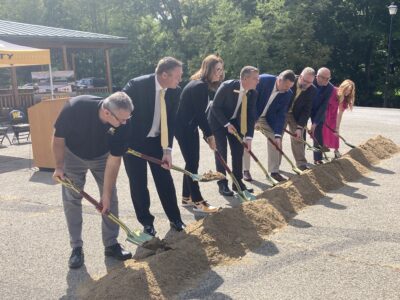
WLU hosted the groundbreaking Wednesday for the future West Liberty University Appalachian Aquatic Conservation Center at the site of the former Road Worthy Tavern and Resort near the main campus.
The $1.5 million project is being funded solely through a federal grant WLU obtained from the Abandoned Mine Lands Pilot Program, explained Zachary Loughman, chairman of Organismal Biology,
Ecology and Zoo Science Departments at WLU.
The interior of the former restaurant will be renovated into classrooms and office space for Loughman, his program, and team. Additionally, a second building is being constructed for labs and the aquatic sanctuary. The Thrasher Group of Bridgeport, West Virginia is the developer for the facility.
Construction work is expected to begin in October, but Loughman added no anticipated completion date has yet to be set.
The goal is to create a habitat for two types of endangered crayfish -- the Guyandotte crayfish and the Big Sandy crayfish.
The Guyandotte crayfish is indigenous to West Virginia and important to the state's ecosystem, Loughman explained. The Big Sandy crayfish is similar in physical appearance, but is mostly found in nearby states such as Virginia and Kentucky.
The future facility at WLU plans to work with the Association of Zoos and Aquariums and their programs to bring back endangered species. And at the top of the endangered list are turtles, he continued.
"Turtles are the most endangered animals on our planet, and us getting to help with their effort with several local species - that's basically a life-long dream. And we're going to be teaching the next generation of biologists while we are doing it," Loughman said.
Like many species of turtles, both the Guyandotte and Big Sandy crayfish are listed under the federal Endangered Species Act.
"When animals get listed we have to be mindful of them when we are developing any type of region or causing any potential harm to the environment they live in," Loughman said.
"With the crayfish, there was a facility needed to serve as a location for the future propagation and headstarting of imperiled crayfish so we could bolster their numbers then release them into the environment."
There is no facility in the Mid-Atlantic region for endangered species like the aquatic conservation center now being constructed at WLU, he continued.
"We are really pushing the envelope when it comes to teaching conservation biology and training the next generation," Loughman said. "Our planet needs some help in getting people trained with the knowledge needed.
"And by having this facility, West Liberty becomes a leader in this effort."
Once the conservation center is operational, additional projects and funding opportunities will open up to the university.
"We will have the space and the dedicated place for propagation of imperiled animals," he said.
At present, the Organismal Biology, Ecology and Zoo Science program is growing at WLU, according to Loughman. There are about 150 students combined in the undergraduate and graduate classes, and it is believed to now be the largest program at the college.
But Loughman indicated to those attending the groundbreaking Wednesday that humanity has a responsibility to try and save its creatures at risk.
"Endangered species need to be recovered. It is just the moral and ethical thing to do," he explained.
Others participating in the groundbreaking ceremony were WLU President Timothy Borchers; Joseph Rodella, chief Information officer, chief operations officer and chief of information technology services; Karen Kettler, dean of the College of Sciences; Cathy Monteroso, interim provost; and David H. McKinley, chairman of the WLU Board of Governors.