
‘Hands-On Ag Day’ in Marshall County Brings Classroom to the Farm
 Emma Delk
 Trending
MOUNDSVILLE -- Making butter is not typically on the agenda for a fifth-grader, but Marshall County students had the opportunity to do that and more at the 13th annual Hands on Ag Day.
Born from the collaboration between the Natural Resources Conservation Service and the Northern Panhandle Conservation District, the program gives all Marshall County fifth graders firsthand knowledge and experience of the different aspects of agriculture in their county.
This knowledge was imparted to students through 11 different stations spread out across the Marshall County Fairgrounds.
At one station, students received a lecture on raising livestock from an instructor holding a chicken. At another, kids got to pet cows while learning about the process that brings milk from the farm to their table.
"This program educates kids on all aspects of agriculture, from what products come from the forest to the role butterflies play in pollination," explained NRCS District Conservationist Katie Fitzsimmons.
"Basically, the whole program is set up so that kids learn that the milk and hamburgers they eat don't just come from the grocery store."
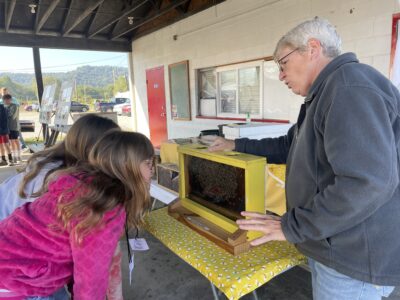
A favorite of students was "The Buzz on Bees" station, run by Barbour County master beekeeper Joyce Frey. The fifth-graders sat attentively while Frey taught them the different roles bees have within the hive, how honey is produced and the benefit of bees.
One Hilltop Elementary School student, Emily Kimberly, was particularly taken with the demonstration, saying her favorite part of the day was getting an up-close look at the bees in the hive Frey brought.
"I loved seeing them up close, and I was able to spot the queen bee in there," said Kimberly. "I've never been scared of bees, so it was a lot of fun."
The fifth-grader added that she learned that honeybees do not pollinate tomatoes, which was "funny" to her, as she did not know that only bumblebees did that job.
"I didn't even know that there was a difference between honeybees and bumblebees," said Kimberly.
Learning the difference between types of pollinators through hands-on demonstrations is the exact knowledge Fitzsimmons wants students to gain through the program. She explained that there is a need in the agriculture industry to "get kids to understand how important and interesting agriculture is."
"There are thousands of acres of farmlands that get lost every year to housing developments," said Fitzsimmons. "People need to understand that farms are important, and the younger we start that education, the better."
She noted that in Marshall County, there is a tradition of "small family farms" that are "passed from generation to generation."
"We want kids to know that they can go back to the farm, and they might not make a full-time living, but they might be able to make a part-time living," added Fitzsimmons. "If this program gets one kid to say I want to be a forester or I want to be a veterinarian, it's a positive."
She explained that the number of farms in the county is "dwindling," meaning the station at the camp that teaches students about the 4-H and Future Farmers of America programs is particularly relevant because the fifth-graders are now old enough to join.
"There won't be as many steers, hogs and lambs to buy at the local county fair in July if the number of farmers keeps going down," added Fitzsimmons. "It really can affect everything, so it's very important to introduce and involve kids in agriculture at a young age."
Beyond boosting the numbers of kids involved in agriculture in the county, Fitzsimmons emphasized the other important aspect of Hands on Ag Day, which is teaching students "the process that brings food from the farm to the grocery shelf."
"There is a process for everything, so if you're talking about the cow, for example, there's the slaughter process, but there's also byproducts that come out of the beef industry," said Fitzsimmons. "Kids need to understand that everything goes back to agriculture in some way, even your plant-based products."
Marshall County School Board President John Miller added that the program also gives students first-time experiences with different aspects of farming. He explained that kids from Central Elementary School who grew up in the city will have less experience with farms than those from Cameron Elementary School who grew up in a more rural area.
"There can be a big difference in kids' agricultural knowledge just between the elementary schools within the county," said Miller. "All our kids should be able to get out and see where their food products come from, from vegetables to milk to honey."
As someone who grew up in a "farming family," Miller stressed the importance of Hands on Ag Day to give all students hands-on education.
"Since it's hands-on, the students can see, touch, communicate, as well as listen and take notes at the stations," said Miller. "It's just a wonderful, wonderful activity that these kids will remember and talk about for a long time."