
Paden City Reports Progress in Water Crisis
 Shelley Hanson
 Trending
PADEN CITY -- Mayor Steve Kastigar informed Paden City residents Monday that the city had three consecutive water test results that showed levels of tetrachloroethylene, aka PCE, are below allowable limits, but the city must wait for state health officials to lift the do not consume/use order.
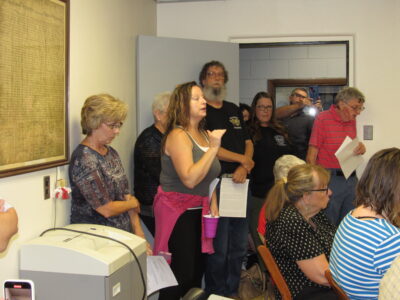
Kastigar made the announcement during Monday's City Council meeting, held in an overflowing council chambers. Every seat inside the room was taken with some standing against open wall space inside, while others stood in the doorways to the room and the hallway as well.
Kastigar said he wanted to tell residents the news before allowing people to speak on the matter. A few people signed up to talk before the meeting started.
Kastigar noted the city had to apply with the West Virginia Department of Health and Human Resources' Bureau of Public Health to have the order lifted. He noted water samples taken Aug, 23, Aug. 26 and Sept. 1 showed PCE were below allowable limits.
The do not use or consume order has been in place for about three weeks with residents receiving bottled water three times a week to use.
Kastigar noted the DHHR is expected to also come up with a plan for residents to flush their own lines.
A few residents talked about the poor communication regarding the water issue, while others wanted to know how it would be prevented from happening in the future.
Kastigar said the city plans to have one of the water system's backup generators tied into the air stripper, which is the device that removes the PCE from the water.
He said on July 19 a water sample was sent to Pace lab in Florida. On Aug. 16, results came back and DHHR informed the city the water was over the limit for PCE.
"Sometime in June we had a storm and a transformer failure down at the water plant," he said. "The air stripper went down because of the transformer explosion. As a result we were running out of water without any ability to fight fires, so the bypass valve was opened.
"Our old stripper is attached to that line but it is not sufficient enough to take out all the contamination that we have in our aquifer," he added. "We got the stripper back up and running and closed the valve. It's a manual valve underground.
"Unbeknownst to us, the valve didn't close all the way and it failed. That allowed contaminants to mix with the pure water that our stripper was taking in to mix in the wet well. That's what drove our PCE levels back up."
Public Works Director Josh Billiter said the underground valve has since been capped off so contaminated water cannot enter the system through it again.
"If the air stripper shuts down because of a power failure, we're going to run out of water," Kastigar said.
However, it was noted that backup power is still needed to run the air stripper so it can continue to work in the event of a power outage.
Resident Mike Turner thanked Kastigar for the update, but noted that he believes people should have been informed about the issue sooner.
"It's unacceptable to expose people for that long," he said.
Turner also encouraged the city to develop an emergency plan for the future, adding trailers containing showers and washers and dryers could be brought in for people to use.
Resident Jerry Koerber also said he wished he knew about the tainted water sooner. He said he unknowingly washed his wife's heart surgery area with the water.
"She had a triple bypass," he said.
Resident Patty Wright held up a couple signs during the meeting and provided a written statement that she asked people to read on their own. It noted that she believes the lack of good communication regarding the tainted water was just as bad as the water itself.
She also requested that people's water bills be credited $55.
Resident Rita Chambers said she hopes in the future that more attention and help is given to senior citizens and young families with children without transportation. She said both need more help in getting access to the bottled water.
"Why wasn't a red flag put out that there could be contamination in our water?" Chambers asked.
Tonya Shuler, a former Paden City resident who started the group "Paden City Water Crisis," said she believed a representative from the state DHHR or EPA should have been at the meeting to help answer questions. She believes issues with how the air stripper works should have been reviewed better by state officials.
"The government isn't coming to save us, we're here on our own," Kastigar said. "Be it the state or the EPA, no one wants to come up and give you a definitive answer because they don't want to be put on the spot.
"We're the ones who have to chew on the crap sandwich."
State officials believe the PCE contamination of the city's underground aquifer, its water source, came from an old dry cleaning business in the city. Kastigar noted all of the city's wells are contaminated with the chemical.
Since Paden City is a superfund site because of the PCE contamination, the United States EPA has set up its own website for it: https://www.epa.gov/superfund/padencitygroundwater.