
West Virginia DHHR Working on Split
Trending
CHARLESTON -- The West Virginia Department of Health and Human Resources is preparing to split into three new departments at the end of the year while also sharing administrative services between the three departments.
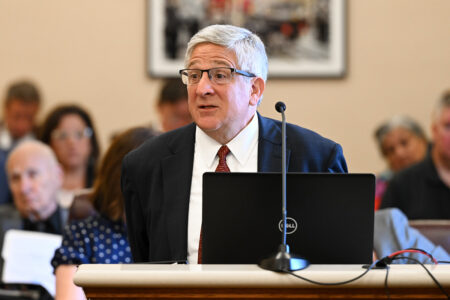
Dr. Sherri Young, the acting cabinet secretary for DHHR and the incoming cabinet secretary for the new Department of Health, gave an update to members of the Legislative Oversight Commission on Health and Human Resources Accountability Tuesday morning on the final day of September legislative interim meetings at the Capitol.
House Bill 2006, relating to reorganizing DHHR, was passed by the Legislature during the 2023 regular session and signed into law by Gov. Jim Justice. The bill went into effect in May.
HB 2006 terminates DHHR and splits it into the three new departments effective Jan. 1: the Department of Health, the Department of Human Services and the Department of Health Facilities. The new cabinet secretaries for the three departments would report directly to the governor.
Justice announced the three new cabinet secretaries in May, including Young, Dr. Cynthia Persily to head the Department of Human Services, Michael Caruso to head the Department of Health Facilities.
Justice appointed Young in June to serve as interim DHHR secretary until the end of December following the departure of interim DHHR secretary Dr. Jeffrey Coben, who returned to his full-time job as associate vice president for health affairs at West Virginia University and dean of the School of Public Health.
Young said the incoming secretaries have been creating new draft organization trees as they split DHHR functions between the three.
"The three new secretaries have been looking at every vacant position in the current DHHR structure," Young said. "We are evaluating the needs and identifying those priority areas where we have had large vacancies. That has given us a tool to look for recruitment, retention, or having the ability to collapse those down within personnel and find a position that can serve one of the new departments as we go forward."
Since August, DHHR had 4,968 filled employee positions and 1,498 vacant positions for a 23.1% vacancy rate. But increases in pay for high-need positions, such as Child Protective Service workers, and the ability to increase pay in regions with high vacancies have seen vacancy rates decrease.
The Bureau for Social Services has seen a 13% decrease in its vacancy rate, dropping from 287 vacant positions in January to 190 vacant positions in August.
The Bureau for Child Support Enforcement's vacancy rate decreased by 24.4%, the Bureau for Behavioral Health's vacancy rate dropped by 18.2%, and the vacancy rate for the Bureau of Medical Services dropped by 16.5%.
"The work that you did last session to increase salaries, to provide regional salary differentials, it has worked," Persily said. "We have reduced significantly the vacancies particularly in (Child Protective Services). When you heard about this last December, the (vacancy) rate was about 30%. Our rate at the end of July was 17%. That has been significant. Those salary changes are very much focused on recruitment in those areas of need."
While independent of each other, the three departments will share one central Office of Shared Administration for administrative support services similar to the current structure of the departments of Commerce, Tourism and Economic Development. The new DHHR departments have until June 30 to create this new Office of Shared Administration, but the incoming secretaries are working on draft organization charts and can be ready to go on Jan. 1.
"We are going to have a model on Jan. 1," Persily said. "One of the things we know is we have to be flexible. We are not going to be wedded to a model. If it doesn't work, we will be constantly improving that model as we move along. Any changes would be for efficiency and functionality."
Committee members raised concerns about the proposed organizational trees for the Office of Shared Administration and the three new departments.
"I'm really concerned about what we pay our frontline workers and I'm seeing a lot of growth at the top," Commission Co-Chair Amy Summers, R-Taylor, said. "That is concerning me as an initial impression."
"I think it is very frustrating for the frontline when they see a lot of things being added to the top when they are really struggling at the bottom to provide services and care to those patients," Delegate Heather Tully, R-Nicholas, said. "I think we have to be very careful about adding a lot of positions into some certain things."