
Ex-Benwood Fire Chief Found Guilty of 3 Misdemeanors, But Acquitted on Felony Charges
 Emma Delk
 Trending
MOUNDSVILLE -- A Marshall County jury on Monday found former Benwood Volunteer Fire Department Chief Garson Taylor guilty on three misdemeanor charges at the conclusion of a three-day trial.
Taylor was convicted on charges of brandishing a firearm, fleeing from an officer in a vehicle and obstructing an officer. He was found not guilty of the felony charges of wanton endangerment with a firearm and strangulation, as well as a misdemeanor charge of domestic battery.
For the misdemeanor charges, Taylor could face up to a year in jail for each. Whether these charges run consecutively or concurrently is to be decided by the court during Taylor's sentencing on Nov. 9.
The charges stem from an April 10 altercation between Garson Taylor and his ex-wife, Taylor Hebb. The fight began when Taylor suspected Hebb was cheating on him again, as he had discovered Hebb had been having an affair in January.
Suspecting Hebb was messaging another man while the couple lay in bed with their 1-year-old daughter, Taylor then grabbed Hebb's phone from her.
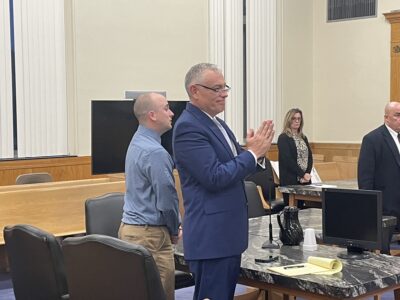
As soon as the first "not guilty" was read by Judge Charles Wilson, Taylor was moved to tears. Those in the gallery who had been there every day of the trial to show support for Taylor, from family and friends to Taylor's fellow Benwood firemen, showered him with hugs and well wishes after the verdict was read.
Defense attorney Robert McCoid described the outcome of the trial as "spectacular," adding that the jury held Taylor accountable "appropriately for the things that he is probably guilty of."
"The thing that mattered was that he was found not guilty of the felony charges, so we're very happy," said McCoid. "Garson Taylor is a good man, and he had a bad day, but having a bad day doesn't make it a crime."
Marshall County Prosecutor Joe Canestraro admitted he was "clearly disappointed" in the verdict but respects the jury's decision.
"If I had to do it all over again, I'd still do it because I truly believe that at least Capt. (Bryan) Handzus's life was in substantial risk of death or serious bodily injury," added Canestraro. "Anytime one of my officers is put in that situation, I'm always going to try to do my best to protect them."
In her testimony last Thursday, Hebb said that Taylor pushed her onto the bed, then held a blanket and pillow over her face with one hand while the other was placed on her neck.
Hebb eventually fled the house with their daughter.
When police arrived at their house on McMechen Street, they found Taylor in his truck. He ignored officers' orders to leave the vehicle, resulting in a chase that ended when police were able to barricade the truck on a gravel road off Route 2.
An hour-long standoff between Taylor and officers commenced, which jurors saw from multiple angles of body camera footage from officers that the prosecution called as witnesses during the trial.
In the videos, officers alongside Taylor's father, Paul Taylor, beg Taylor not to take his life and to step out of the vehicle. In their testimonies, officers confirmed that Taylor raised the gun he had in his car to his head multiple times.
The last officer called to the stand by the prosecution was West Virginia State Trooper Corporal Wiliam Beck, who fired a beanbag round at Taylor while the officers removed him from the vehicle.
Beck explained his reasoning for this action was because Taylor was holding a firearm in his truck.
Shooting Taylor with his AR-15 would have been justifiable for Beck as well, as he explained to Canestraro that Taylor's movement of the firearm to his head created a "safety issue at that point."
"It doesn't matter what his intention was because his actions created the risk of death and injury for everybody," emphasized Beck.
On why he didn't shoot Taylor then, Beck said he had to consider how Taylor's body would react to being shot, including Taylor's gun possibly firing. Beck added that he did not want to shoot Taylor in front of his father.
"I had to be aware of the target he was pointing at and what was beyond it," said Beck. "Anything on the other side of his head would be at risk, which creates a risk of death and injury for everybody on the other side of that barrel."
In his cross-examination, McCoid sought to discern from the officer whether Taylor's actions or words posed a threat.
McCoid first questioned Beck whether Taylor "never affirmatively pointed a gun at an officer or had placed his finger on the trigger," which the officer affirmed.
On whether Taylor made verbal threats to officers, Beck explained to McCoid that he interpreted Taylor saying "I'm not going to jail" as an indirect threat.
McCoid wondered whether this statement could also be interpreted as Taylor saying he would kill himself rather than go to jail, which Beck said was "correct." The officer also affirmed for the attorney he never heard Taylor voice a threat to anyone else.
The only testimony defense called upon on the final day was Marshall County Sheriff's Office Deputy Nathan Klempa. On top of being a friend of Taylor for "better than 10 years," according to Klempa, Taylor also talked to the officer on the phone while in his truck during the standoff.
Upon telling Taylor that he would go there to "talk this out with him," Klempa said that in response, Taylor told him over the phone, "The only way I'm leaving this truck is in a body bag."
In his closing remarks, Canestraro emphasized that there was "no question" Taylor pointed his gun at officers based on the testimony of multiple policemen the prosecution called on during the trial.
Labeling the testimony of West Virginia State Police Sgt. Steven Durrah, the "most telling" of all, Canestraro recalled Durrah shouting an expletive in his body cam footage as Taylor raised the gun from his seat to his head. This action resulted in the barrel being pointed at Handzus for a moment.
"When it was pointed at Handzus, do you remember seeing Sgt. Durrah then?" Canestraro asked the jurors. "He was about ready to cry, and the thought brought me to tears because he knew at that point one of his colleagues could have died."
In his closing, McCoid focused on the four accounts Hebb told of what happened on April 10, finding her story inconsistent.
McCoid outlined that Hebb told officers at the scene and medical personnel that she was "just pushed" by Taylor. Hebb then changed this wording to "strangled" in her written statement and in her testimony at a Family Violence Protective Order Hearing.
"If she can't bring herself to tell the truth under oath, is she believable in any facet of her story?" McCoid asked the jurors.
Noting that the prosecution never mentioned any of Hebb's medical records in the closing, McCoid said this was done to "benefit the government's story."
"There was nothing noted about her throat at the hospital, and she neglected to mention it to medical personnel," added McCoid. "This is a criminal prosecution, not a buffet, and the prosecution doesn't get to pick and choose the parts they want you to know."
After the verdict, McCoid surmised that the difference in Hebb's accounts was the difference.
"I think the jury likely discounted the accuser's story given that the accusations from her kept snowballing and more details kept getting added to make the story worse," said McCoid.