
Mayor Glenn Elliott: Wheeling at ‘Crossroads’ With Homelessness Issue
Proposed Camping Ban Draws Strong Opinions at Council Meeting
 Eric Ayres
 Trending
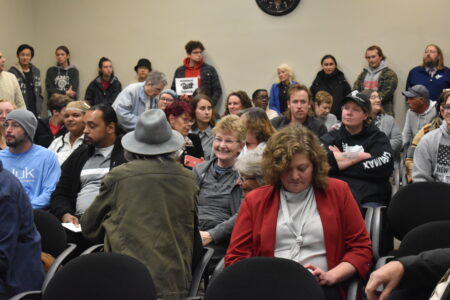
WHEELING -- Tension over the future of homeless encampments in the city of Wheeling boiled over into council chambers Tuesday night, when a standing-room-only crowd gathered as a first reading of an ordinance to ban camping in the city was heard.
A total of 19 people signed up to speak during the meeting. With a strict three-minute time limit for each speaker, the public forum at the end of the meeting took about an additional hour to hear everyone's concerns. The vast majority of the speakers expressed opposition to the proposed camping ban that was modeled after new legislation initiated by city leaders in Parkersburg.
"Homelessness, in my experience on this body, is one of those issues where it's very easy to find opinions, but much more difficult to find solutions," Mayor Glenn Elliott said. "It's something that I know we have struggled with as a council going back seven years. This is an issue that has continued to get worse, not better."
Elliott acknowledged that most of the people in the room were there to express opposition to the proposed camping ban. He and other council members noted that they wished to hear from the community before making any decision -- stressing that the legislation was simply up for a first reading this week and would come back for a vote -- likely with amendments -- during the next council meeting on the first Tuesday in November.
However, the mayor indicated that he was more interested in hearing ideas for viable solutions than arguments that lend to continued stagnation on the dilemma.
"I do think that it's important that we recognize that the status quo as it has been cannot go on," Elliott said, stressing the city leaders aim to balance compassion for unhoused members of the community while protecting the rights and public safety of the rest of the citizens of the city. "Some of the camp sites that we have seen have had a lot of problems -- from crime to trash to personal property being stolen.
"We're at a crossroads now. It's a worsening issue. The status quo to me is not sustainable."
Before the throng of residents got a chance to speak, members of council addressed the issue individually, noting that they understood the fact that homeless individuals cannot just disappear, and most would not be able to pay any kind of fine imposed for violating city codes. Council members made it clear that a proposed amendment to the camping ban legislation is being moved forward to allow for the establishment of a managed camp with rules in place. This would allow individuals to continue to have a place to stay until a solution to the issue is available.
Many -- including the mayor -- said The Life Hub's proposed establishment of a low-barrier shelter at its new location on 16th Street -- is the step toward that long-term solution.
However, that would take millions of dollars in funding, and Wheeling Homeless Liaison Melissa Adams said Tuesday night that even the temporary winter shelter that will be open from Dec. 15 to March 15 is not yet fully funded -- after announcing this week that it had been fully funded.
"I think as a city, we do need to show compassion," Vice Mayor Chad Thalman said, noting that more than $1 million has been awarded to local nonprofits to assist the homeless during his time on council. The full-time position of homeless liaison was also created in recent years, he noted. "With that being said, I do think the rule of law must stand. I think the homeless should not be allowed to camp anywhere in the city, and I think that those who commit crimes should be held accountable. The idea that anybody can camp anywhere at any time for any reason without permission and without rules is something I disagree with. Frankly, it's something that's not working.
"But I also understand that displacing the homeless without any type of plan as to where they're supposed to go isn't a solution. It's a reaction."
Thalman proposed the amendment to the camping legislation to allow for one managed camp for the homeless with rules and consequences for not following rules.
"Ultimately, I think we should help people," Thalman said. "But enabling people is not helping people."
The vice mayor said that compassion in itself is not a solution.
Councilmen Ty Thorngate and Dave Palmer said they wished to hear from the public before commenting on the issue. However, Thorngate proposed eliminating the $100-to-$500 fine for violations of the proposed camping legislation to be amended to a penalty of community service.
"The time is now to get this under control once and for all," Councilman Ben Seidler said. "It isn't getting better -- it's getting worse. It's time for every single organization within this city that's dedicated to this cause to step up their game and push harder to help put an end to a person's homelessness and not just support the status quo.
"It's abundantly clear to me that homelessness is a big business in the city of Wheeling, and some of these individuals who are accusing the city of criminalizing the homeless over this public camping ban are some of the same ones who are clearly monetizing the homeless population to cover their own salaries."
The controversy comes after notices had been posted in an East Wheeling homeless encampment, giving individuals there a two-week notice to leave the premises. A protest was held last Thursday in front of the City-County Building in light of the proposed closure of the encampment. The city administration said the criminal activity, littering and other illegal behavior that prompted the issuance of the notice had since diminished, and the camp was allowed to remain in place until the winter shelter opened, as long as no further criminal activity warranted future action.
"We have a responsibility to not only represent the people of our city, including the homeless, but also to enforce the public safety for those same individuals," Seidler said. "Nobody here on council, nor our city administration is out to just blatantly declare war on our homeless individuals."
Seidler said the city cannot ignore the fact that some citizens avoid using Heritage Trail or go anywhere near Tunnel Green for a "legitimate fear of being assaulted." He noted that people are afraid to take their children to playgrounds, where needles can be found and individuals can be encountered sleeping on benches or under playground equipment.
Councilwoman Rosemary Ketchum noted that the American Civil Liberties Union of West Virginia forwarded a letter to all city leaders on Monday, warning that the camping ban legislation was likely unconstitutional. Ketchum said she is opposed to the proposed ban and urged her fellow council members to consider amendments to the legislation if they continued to consider the measure.
Those speaking in opposition to the legislation acknowledged that a solution to the problem cannot be found without support from the city.
"There are solutions, but we can't come in swinging a hammer in a very delicate situation," said Vincent DeGeorge. "Political figures are taking lazy solutions. There's no shortcut on homelessness. We can't copy and paste a national ban and expect to get results."
Dr. William Mercer said entities and individuals have been working together and making progress on the issue, but the proposed ban would be incredibly counterproductive.
"If you pass it, I feel there is going to be a divide between council and our homeless community," Mercer said, advocating for The Life Hub concept. "We don't want to be like Parkersburg."
City resident Connor Morrison, who works closely with the local homeless population through Northwood Health Systems and the Mother Jones Center, said they do not have the capacity to house individuals if the camping ban was implemented.
"Please do the right thing and vote against criminalizing existence of folks who are already relegated to the margins," Morrison said, urging the city to work on a plan that creates more housing for the community's most vulnerable individuals.
Katherine Ball, a part-time resident of Wheeling, said she is a property owner in Centre Market as well as a tenant rights attorney and affordable housing advocate in Queens, New York, who works with social service agencies to keep people from eviction. She said her Victorian property in Centre Market was vandalized this spring.
"A 100-year-old, irreplaceable door handle was stolen off of the front door by one of the influx of non-resident homeless who have been responsible for the dramatic rise in crime at the Market," Ball said. "I also run on Heritage Trail, where I witnessed an attempted stabbing of a youth on Tunnel Green by a homeless man who informed me that he had traveled from out of state to the desired Wheeling subsidized camps."
Ball said she was shocked when she offered assistance to the man to find affordable housing, and he told her that he preferred to live in Wheeling's homeless encampments and continue collecting Social Security Disability payments.
"In the past 10 years, Wheeling has emerged as a regional destination for persons with drug addiction, traveling or busing from as far away as Chicago, continuing addiction in the subsidized camps with an unprecedented level of enabling services," said Ball, whose statements were cut short by the three-minute time limit.