
Wheeling Eyes Repairs to Sidewalks Along City Owned Properties
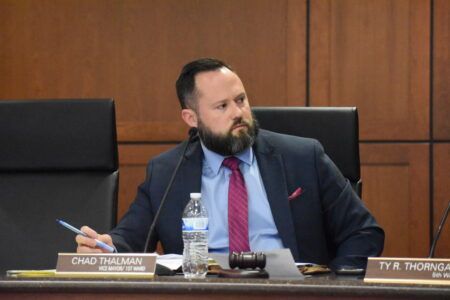 Photo by Eric Ayres
 Trending
WHEELING -- Efforts continue to improve deteriorating sidewalks in the city of Wheeling and city officials hope to take action to repair city-owned sidewalks.
The issue of sidewalks that have fallen into disrepair has been a lingering one among some city leaders who have been pushing to see council take more aggressive measures to at least put a dent in the problem. Under West Virginia law, however, the responsibility of maintaining sidewalks falls on the adjacent property owner.
"The idea that we have city-owned sidewalks that aren't in compliance -- with ordinances that residences are expected to follow -- I think needs to be corrected," said Wheeling Vice Mayor Chad Thalman, who has championed sidewalk repair efforts in the city.
With all of the broken and uneven sidewalks throughout the city of Wheeling, it would be a massive undertaking to uniformly enforce code violations.
Many homeowners simply cannot afford to pay for upgrades to old sidewalks abutting their properties.
Yet, Wheeling officials have been working on incentive programs to help address the problem, and an effort is underway to make sure deteriorating sidewalks next to properties owned by the city are kept in good repair.
Members of the Public Works Committee of Wheeling City Council recently met with other city leaders to discuss a first step toward keeping city-owned sidewalks in shape.
Precision Infrastructure Management Inc. had done a pilot study of sidewalk conditions in a few city neighborhoods, including Wheeling Island, Warwood and Woodsdale. There were 231,000 square feet of privately owned sidewalks identified as in need of being removed and replaced - just in these neighborhoods alone. This does not include segments that only need to be repaired for trip hazards or intersections that need to be upgraded to ADA compliance.
The cost of repairing the privately owned sidewalks - just in these neighborhoods - was estimated to cost millions of dollars.
In addition to broken sidewalks abutting private properties, the study also found portions of sidewalks in disrepair that run through or next to city parks and buildings, as well.
"The pilot study that was done in the three neighborhoods also looked at several city owned properties," Wheeling City Manager Robert Herron said.
Deteriorating sidewalks were noted in the areas of the 36th Street Pool, Edgwood Park, Bridge Park, Garden Park, the city Operations Center, Centre Market, the Wheeling Fire Department Training Facility on Wheeling Island, and Wheeling Fire Department Stations 2, 4, 10 and 11.
Herron said the study estimated that trip hazard repair for city owned sidewalks in these neighborhoods would total $90,175, and curbs that needed to be repaired would cost $3,375 to fix, for a total of $95,550 for those parcels.
Many portions of sidewalks were deemed in too poor of a condition to be repaired, Herron indicated. A total of 8,500 square feet worth of city-owned sidewalks in these neighborhoods were in need of being removed and totally replaced. That estimated cost fell between $102,000 to $128,000 - depending on the total square footage that was to be replaced.
The loose estimate for the city to fix all of the sidewalks that have been identified on those properties was around $199,000.
Officials indicated that the study also considered sidewalks around Wheeling Park and the City-County Building downtown, but those were not included in the initial repair or replacement estimates.
Members of the Public Works Committee of Council - Councilmen Jerry Sklavounakis, Ben Seidler and Ty Thorngate -- and voted unanimously to forward the city sidewalk repair proposal to the full city council for its consideration in the near future. They also voted to direct city staff to come up with a proposal to have Precision complete studies on other sidewalks in the city and prioritize the city-owned sidewalks that are in most need of repair.
"I think we should look at the worst of the worst first," Mayor Glenn Elliott said.
"I'll be concerned to see where it's funded from," said Councilman Dave Palmer, who suggested that council should kick the proposal to the Finance Committee after city staff makes a recommendation. "I agree that it needs to be done. I don't disagree with that at all."
"It certainly gives you the opportunity to start chipping away at it," Herron said of the initial step to repair city sidewalks in the three neighborhoods.
In late August, members of the Development Committee of Council proposed the establishment of a new low-interest revolving loan program to help incentivize sidewalk repairs by private property owners.