
WVU Economist Predicts Slight Economic Growth for Ohio County
 Derek Redd
 Trending
WHEELING -- West Virginia's top economic researcher predicts growth for Ohio County in the next five years, but suggests the data "maybe isn't as good" for other local counties.
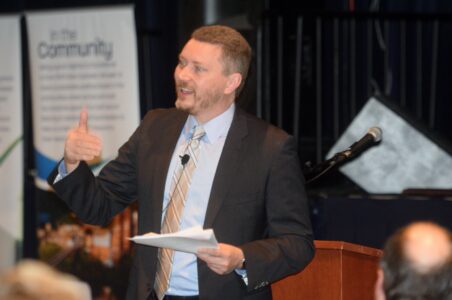
John Deskins -- assistant dean and director of the Bureau of Business and Economic Research within the College of Business and Economics at West Virginia University -- served as one of the featured speakers Thursday at the 2023 Economic Outlook Conference sponsored by the Wheeling Area Chamber of Commerce. The event took place at the Wheeling Island Hotel-Casino-Racetrack, with about 260 people in attendance.
Deskins showed data from the Bureau of Labor Statistics noting West Virginia's top growth counties over the past decade, which largely included counties in the Eastern Panhandle and in North Central West Virginia.
A second map prognosticating growth through 2028, however, does add Ohio County to the list. It shows Ohio County's expected growth over the next five years of about 0.1%, with the state's overall growth expected to be flat.
Marshall County is expected to have economic losses of about 0.1% during the period; Wetzel County, 0.8%; and nearby Belmont County in Ohio at about 0.35%.
Deskins noted Ohio County has a per capita personal income rate of about $60,000 annually, which is greater than the state's average at $54,000 per year.
The yearly per capita personal income rate for Marshall, Wetzel and Belmont counties is just over $40,000.
West Virginia is poised for future economic growth, but more West Virgnians are going to have to join the workforce if the state is going to take advantage of major business investments, according to Deskins.
He provided more Bureau of Labor Statistics data indicating that West Virginia ranks last among states in the percentage of its residents who are eligible to work participating in the labor force.
The national average for labor force participation is 62%, with West Virginia achieving a 55% labor force participation rate. Ohio sits just under the national average, while South Dakota, Nebraska and Washington, D.C. have rates exceeding 70%.
The number of people not joining the labor force remains "the greatest economic challenge" to West Virginia, and has been for more than four decades, Deskins said.
"The statistic hasn't changed. We haven't moved," he continued. "I emphasize this so heavily because we are never going to achieve the level of prosperity we hope for unless we get more of our people in the workforce.
"We've been in 50th place for over 40 years, and it has become a defining mark of West Virginia."
Part of the reason is that West Virginia is a state with many older residents who perhaps choose to retire early, he acknowledged. But even labor force data for those in the prime working age of 25 to 55 show West Virginia as last in the nation.
"This is across the board a problem and a concern, and should be a high economic priority in our state," Deskins said.
Deskins noted that West Virginia has many opportunities to seize upon and grow economically in the months to come.
He pointed to the hydrogen hub announced for the state last week that is expected to create 3,000 jobs.
Other recent announcements when combined indicate another 3,000 jobs will be created in the state
Among these, he noted that locally the Form Energy project in Hancock County is expected to create 750 new jobs.
Other investments with intent for job creation have been announced by Nucor and Fidelis Infrastructure in Mason County, Triton International in Berkeley County, Green Power Motor Company in Kanawha County, OBT Bluefield in Mercer County, and Owens and Minor in Monongalia County.
A second featured speaker was David H. McKinley, president and chief investment officer at McKinley Wealth Services.
He said while some economic indicators lean negative, investors "should take that with a grain of salt."
"The U.S. Reserve is likely done hiking interest rates, and in fact we expect them to start cutting rates by mid-2024," McKinley said. "Despite the headlines about how terrible everything is, the economy is actually reasonably strong."
He suggests the nation is not heading toward a recession, but toward a "soft landing" and slow growth.
There were also three separate panel discussions during the conference.
The first was a presentation by WVU Medicine officials about the hospital system's investment in a regional cancer center in Wheeling. Participating were Albert L. Wright, president and CEO of West Virginia University Health System; and Douglass Harrison, president and CEO of WVU Medicine-Wheeling Hospital and WVU-Reynolds Hospital.
The second panel was a discussion of aviation investments presently happening in West Virginia and their potential economic impact. Participating were Kevin Price, chief development officer for aviation with Regional Economic Development (RED); Tracy Miller, president of Mid-Atlantic Aerospace Complex; and Andrew Gunnoe, chief development officer for West Virginia International Yeager Airport.
Local housing needs were discussed in the third discussion. On the panel were Josh Jefferson, president and CEO of RED; Bob Kennen, broker with Kennen and Kennen realtors; Matthew Gilley, president of operations for Omega Realty; and Bob McGee, chief investment strategist with WesBanco.