
West Virginia DHHR Officials Address Controversies During Interim Meetings in Wheeling
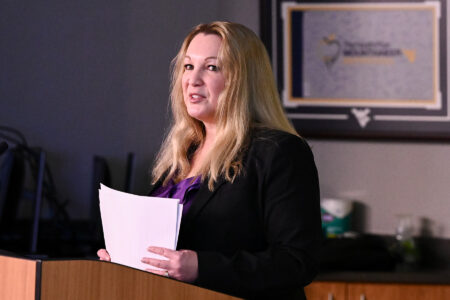 W.Va. Legislative Photography
 Trending
WHEELING -- Officials with the soon-to-be-split West Virginia Department of Health and Human Resources fielded questions Sunday from lawmakers about recent controversies involving an indicted employee, the alleged deletion of emails, actions surrounding an arrest of a couple who kept their children in cages and a recently fired employee of a state hospital.
Members of the West Virginia Legislature are in Wheeling through Tuesday for traveling interim meetings.
The Legislative Oversight Commission on Health and Human Resources Accountability met Sunday afternoon at The Health Plan corporate offices in downtown Wheeling.
The commission received briefings from incoming cabinet secretaries for the Department of Health, the Department of Human Services and the Department of Health Facilities.
Committee Co-Chair Amy Summers, R-Taylor, asked Dr. Sherri Young, interim secretary for DHHR and the incoming secretary of the Department of Health, about issues surrounding the recent federal indictment against Timothy Priddy, director of DHHR's Center for Threat Preparedness.
According to court documents, Priddy pleaded not guilty last month in U.S. District Court for the Southern District of West Virginia to four counts of making false statements to federal investigators and a grand jury during a review of COVID-19 testing invoices between the state and a vendor.
According to the indictment, the company received about $45 million in federal COVID-19 funds for 500,000 COVID test kits while only reporting 50,000 test results during a two-year period between 2020 and 2022. Priddy is free on bond and suspended from employment. Trial was set for Dec. 19.
"Without getting into the details of the federal indictment on that since the director, former ... was having some issues, do you think we're going to have to pay back the $35 million to $45 million that's in question there? And if so, where would that come from?" Summers asked.
"That would be part of the investigation and something far beyond what I would be comfortable with answering at this time," Young said.
Under the current DHHR model, the Office of Threat Preparedness answered to the DHHR cabinet secretary. But under the new mode that splits DHHR into three departments effective by the end of the year, the office will fall under the Department of Health.
Summers asked Young whether she thought that, by having the Office of Threat Preparedness answer to the Bureau of Public Health, that took away potential checks and balances that could have earlier caught Priddy's alleged actions regarding COVID-19 test invoices. Young said given the state of emergency in early days of 2020, it likely wouldn't have made any difference.
"Looking at the volume (of invoices) that they had to take care of, it really was survival mode," Young said. "You went from processing a few hundred grants or accounts payable within a month to several thousand. So there's a lot of vulnerabilities there that I think we need to look at moving forward, saying 'these are the processes to follow.'"
As part of the transition from one large department to three smaller departments, Young said the incoming cabinet secretaries are reviewing all processes for invoices, grants, and contracts.
Summers asked Dr. Cynthia Persily, the incoming cabinet secretary for the Department of Human Services, regarding a pending federal class action lawsuit regarding the state's foster care system and allegations of deleting of emails for former DHHR officials.
Attorneys representing foster children the federal class action suit filed against the state in 2019 are seeking sanctions after it was discovered that the state did not keep emails and other electronically stored documents, including emails from former DHHR Cabinet Secretary Bill Crouch, former Commissioner of DHHR's Bureau for Children and Families Linda Watts and former interim DHHR cabinet secretary Dr. Jeffrey Coben.
According to the Department of Administration, the Office of Technology only maintains the emails of former state employees for 30 days once being notified by a department or agency that the employee has departed. The office gives departments and agencies time within the 30-day period to download and store electronic files before they are deleted, though the office maintains those emails if they receive requests for discovery holds in legal cases.
The state settled a federal class action lawsuit last week over conditions at the Southern Regional Jail after a federal magistrate judge excoriated the state for what he called the intentional destruction of documents after it was discovered that emails for former corrections officials had not been maintained.
"We've heard these issues about corrections and we know that the state's facing the (foster care) lawsuit," Summers said. "We know about the evidence with corrections, and we had that same issue with the DHHR. So was a hold on the evidence and the litigation done in the way that it was supposed to be done?"
"For every time that we received a litigation hold for a lawsuit, we followed the appropriate process and litigation holds were filed with the Office of Technology," Persily said. "Unbeknownst to us, they did have a policy that when someone left the organization that they decommissioned or deleted their emails. We are working very closely with them on making sure that we have systems in place and processes in place to prevent that from ever happening again."
Summers asked Persily about procedures by Child Protective Services during investigations. The question was prompted by an October incident where parents of two children were arrested near Sissonville for alleged child abuse after their children were found in cages in a shed. According to West Virginia Watch, neighbors had called CPS several times. DHHR has avoided answering direct questions about the incident, citing state laws protecting the confidentiality of children.
"A lot of our constituents are talking about this," Summers said. "Do you think there's CPS process breakdowns going on? I mean, are you evaluating that? Can you give us a little update on that so that we can feel confident in the process?"
"All of our bureaus are expected to have continuous quality improvement processes going on," Persily said. "If there's a breakdown in a process, we are delving into what the breakdown in that process is."
Lawmakers also asked Michael Caruso, the incoming secretary of the Department of Health Facilities, about background checks for staff at state-owned hospitals. Last week, DHHR announced it was informed of an arrest of a contract nurse working at William R. Sharpe, Jr. Hospital near Weston. The alleged incident was unrelated to Sharpe Hospital, but DHHR informed the nurse's employer that her assignment to Sharpe was terminated.
According to DHHR, the nurse had undergone both a state and federal criminal background check, mandated for all direct employees and contract staff at DHHR facilities.
"We actually brought in an independent ombudsman to come in and take a review of that case and found that there were no findings," Caruso said. "Everybody goes through a background check. There were no background issues with this individual."