
Homeless Individuals Lost Remembered at Project HOPE Memorial in Wheeling
Trending
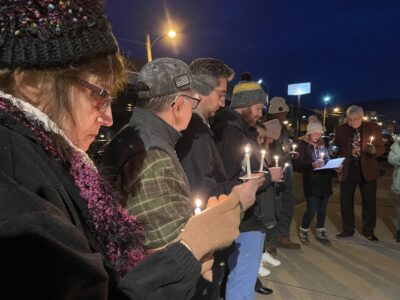
WHEELING – The lives of the five people who passed away while experiencing homelessness in Wheeling this year were commemorated with prayers, anecdotes and poems at Project HOPE's memorial service.
Even with a smaller list of names than in years past, the remembrance was not short on memories shared, both happy and sad, of those lost.
A close-knit group of community members and homeless individuals filled the Catholic Charities Neighborhood Center's courtyard on Thursday. Apart from remembering those lost, the attendees also observed National Homeless Persons Memorial Day.
A prayer led by a physician assistant and volunteer Amanda Cummins began the ceremony. The name of each homeless person lost was then read, followed by a moment of silence. After the silence, the courtyard filled with voices reminiscing on the impact those who had died left on them.
Describing the event as a "humble service," Project HOPE director Crystal Bauer was "pleasantly surprised" to see members of the homeless community in the crowd.
"Many times in years past, we have invited people who are still experiencing homelessness to come and share in the memorial, and many times they don't come," she noted. "I think it's hard because it causes some people to really have to face their own mortality."
Homeless individuals who had lived alongside those who passed shared memories of those lost. Some had light-hearted anecdotes, while others recalled the deeper impact those who had died left on them.
Hearing stories of those who have passed from homeless individuals was powerful for Bauer. She found them speaking up to be a testament to the relationship Project HOPE had developed with the homeless community.
"We try to make them feel safe enough to share without fear of being judged," she described. "What they shared tonight was authentic, and I give them kudos."
Bauer also had her own story to share for each name called that night.
"We as providers need closure and to recognize that their lives meant something here and to be able to move forward as we grieve," she noted.
Other Catholic Charities and Project HOPE employees and volunteers were also touched by those passed. Dr. William Mercer, a physician with Project HOPE who visits the encampments to treat homeless individuals, finds the service gives him a form of closure.
Noting that the life expectancy for homeless individuals is only 50, Mercer explained that chronic illnesses left untreated, such as Hepatitis B and HIV, are the leading causes of death in the community.
"We try to bridge that gap, but you just can't get to everybody," lamented Mercer. "Unfortunately, people fall through the cracks."
With the ceremony also taking place on the winter solstice, Mercer worries about the homeless in the city whose illnesses will be exacerbated by harsh winter temperatures. He also fears the list of names will be even longer in 2024 once the City Council's ban on camping on public property is enacted on Jan. 1.
"We hope this new city ordinance with noncamping on public property doesn’t escalate some of the problems they face," said Mercer. "We’re hoping they can at least find someplace they can go."
While the five deaths this year is a notably smaller number than in the past years, Mercer believes there were more lost that were left behind. Bauer agreed, saying the number speaks to how the demographics of the homeless in the community have changed.
Homeless individuals in Wheeling were largely alcoholics in their 40s to early 60s when Bauer began to work in street medicine in 2014. Now, the biggest substance problem for the homeless community is heroin abuse, which she noted is taking place in a "much younger age group."
Though happy the number is low this year, Bauer fears it is not a "true representation of the loss that has occurred in this community."
"I think that the number probably isn't accurate because we have such a younger population who may have been couch surfing as opposed to full-time in the homeless community," explained Bauer. "We didn't really have a lot of contact with them or our contact with them was minimal."
No matter what addiction or mental health problem the homeless individual is suffering from, Bauer wants to continue to see "beyond the tent" when it comes to addressing the health problems of the homeless community.
"We serve as a bridge to them that can connect them to primary care providers," she explained. "No one out there in the community will judge anyone in the homeless community harder than those individuals judge themselves, so we just need to extend grace because every single person out there has a story."