
Deep Roots: Freeland Farm in Brooke County Named ‘Century Farm’
 Emma Delk
 Trending
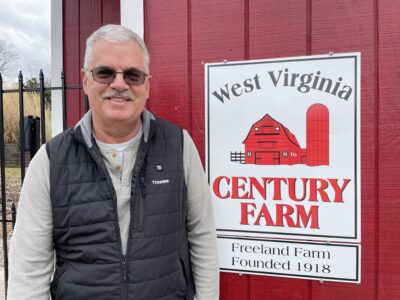
WELLSBURG -- The Freeland family has plowed the same 15 acres for more than 100 years -- a milestone that has earned them the title of "Century Farm" by the West Virginia Conservation Agency.
In 1918, Oscar and Clara Freeland purchased the plot of land in Wellsburg that their grandson Eric Freeland sows today. Since a member of the family has lived and participated in day-to-day operations on the land for at least 100 years, the Freeland farm has acquired the Century Farm distinction.
Eric Freeland jokes he has been working the same plot as his grandfather and father since he was "three days old." To earn the Century Farm title is gratifying for him, as he has observed many small, family farms die out as mega-farming operations take over.
"I'm probably one of the very, very few people farming at least seven months of the year, and I dedicate myself 100% to that," noted Freeland. "That's my way of making a living."
To survive in an industry largely taken over by corporate entities, the Freeland farm had to evolve. Oscar and Clara Freeland originally used the land for cattle and dairy production. Their successors, Eugene and Wilda Freeland, grew produce on the land in their free time while employed full-time as a carpenter and painter, respectively.
Eric Freeland carries on the farming legacy but with a twist. The retired 63-year-old has combined his 40 years of farming knowledge with his sales manager background to transform the family business. Now, the farm that once provided produce for just his parents serves the entire valley.
Tomatoes, potatoes, zucchini and raspberries are a sample of the produce that Freeland sells fresh in the summer. Moving into fall, he then focuses on growing pumpkins in a variety of colors, including orange, black, blue and white.
With so many crops and only Freeland and a couple of part-time employees to tend to them, Freeland has had to adapt the farm's business model. While he still does the planting and pruning, the most time-consuming aspect -- the picking -- is left up to the customers.
"The big thing that has saved us is people come to the farm now and instead of paying $5 for a container of strawberries, they pay me $2 to pick it themselves," said Freeland.
The busy season at the farm begins with strawberry planting in April and stretches until the end of the pumpkin season in October. During the height of the strawberry-picking season, Freeland will see 50 to 70 people roaming the patch in a single day.
"Starting in May, I'm seven days a week for at least 12 to 14 hours a day," explained Freeland. "There's not even a day off on Sunday because that may be my busiest day."
As a self-proclaimed "jabberer," Freeland believes his outgoing nature and welcoming attitude have attracted more customers.
"Historically, farmers are usually that quiet type, so they just want to put their head down and work on the tractor," explained Freeland. "I think we've reached a moderate level of success here because we cater to people and give them a good experience. No one leaves here thinking they've inconvenienced us by coming to visit."
While his background in sales gave him the wherewithal to market his farm, Freeland believes what he does in the fields every day cannot be learned in school.
"Even if you had gone to school and gotten a degree in agriculture, that doesn't mean you know much about how to farm," noted Freeland. "You might know what the book says to do, but that's a different story than the reality."
Part of this reality for Freeland is years of wear and tear on his body from bending over crops out in the sun. Still recovering from a recent knee replacement, Freeland noted that health issues have become a difficulty he must face every growing season.
Freeland estimates that he can work a couple of more years before he has to call it quits. With his only daughter accustomed to city living in Pittsburgh, Freeland will be the last in his bloodline to work the plot of land.
Though his family's farming legacy ends with him, Freeland does not want the groundwork his family has laid to go to waste. His dream for the future of the farm is that a young married couple purchases the land so he can lend them his expertise as they get started.
"All that knowledge and wisdom I have comes from years of experience, which can be a steep learning curve if you didn't grow up in the business," he said.
While there is no family member left to take up his mantle, Freeland is proud of the farming legacy he has carried to its end.
"People always say, 'Your grandparents must be really proud of you and what you do on the farm,'" said Freeland. "That means a lot to hear from old timers who knew my grandparents personally."