
Justice budget proposals come under scrutiny in Senate committee
Trending
CHARLESTON - The budget proposal handed to lawmakers Wednesday night by Gov. Jim Justice raised several questions for the leader of the Senate Finance Committee Thursday morning.
Members of the Senate Finance Committee heard a report Thursday on Justice's budget bill for fiscal year 2025 beginning in July from representatives of the West Virginia Department of Revenue.
Justice presented the budget bill Wednesday during his State of the State address. Justice kept the fiscal year 2025 general revenue budget flat at $5.265 billion, a 7.8% increase, or $381 million, from the $4.884 billion FY 2024 budget that went into effect in July.
The governor is asking the Legislature to approve more than $300 million in supplemental appropriations out of the current fiscal year general revenue budget. Requests include $200 million for the School Building Authority to approve remaining school construction requests and $5 million for the SBA for public charter school seed funding, $53 million for the two state-owned psychiatric hospitals, $10 million for the Posey Perry Emergency Food Fund, and $30 million for the state's nursing workforce expansion initiative.
The budget bill includes more than $629 million in the surplus section. Surplus tax revenue remaining at the end of the current fiscal year at the end of June would be used to pay for these on-time expenses in the order they appear in the budget.
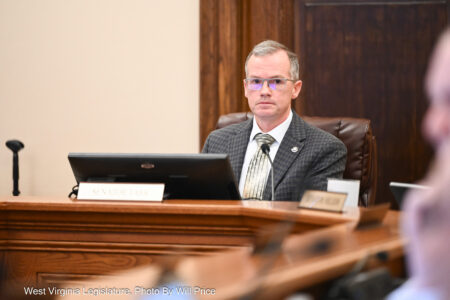
But Senate Finance Committee Chairman Eric Tarr, R-Putnam, questioned Justice's supplemental appropriations requests and his surplus budget requests, raising concerns that these one-time expenditures could become recurring expenses and grow the state budget.
"It looks to me like many of those items have the propensity to become base-building items," Tarr said. "When you have those expenses that are operational that are sitting there because the ask gets really, really hard, it goes in the front of the budget and grows that base. There also are things there that certainly look to be base-building that are in the surplus section for what the governor is recommending."
Tarr focused on a $40.6 million Department of Human Services Medical Services line item for Medicaid at the top of surplus budget requests and an additional $114 million for Medicaid should legislation be offered on behalf of Justice to create a managed care tax to fund projected shortfalls.
"One of those things is that $140 million surplus...for Medicaid, or we can do an MCO tax by growing Medicaid and potentially then have instead of that $40 million another $100 million that we would have grown Medicaid and then had federal strings associated with that we would have had to go back, then that becomes part of our base budget," Tarr said. "So, that $40 million is really a $100 million risk."
According to the state Bureau of Medicaid Services, the state will face a $114 million deficit next fiscal year in the Medicaid Reserve Fund caused by several factors, including the end of COVID-19 pandemic assistance, higher prescription drug prices, and changes in the state's Federal Medicaid Assistance Percentage. More than 36% of West Virginians are enrolled in Medicaid.
"If we don't have that money, then probably we've got to react," said Larry Pack, interim cabinet secretary of the Department of Revenue. "We could reduce the amount of money they're paying to healthcare providers and/or come back to (the Legislature) and ask you for permission to reduce services."
Tarr believes that the one-time funding requests for a Military Ascend program ($5 million), Communities in Schools ($10 million), crisis pregnancy centers ($3 million) and EMT training ($10 million) could potentially be items that add to the total base of future budgets requiring ongoing funding.
In the case of the EMT training program, Tarr said he was told by others in the EMT industry that the program was not meeting expectations and had few participants. The Legislature discontinued funding for the program after its first year.
"Part of their complaint was that the volume of students was small and a big portion of those ended up going out of state when they came out," Tarr said. "Instead of taking a pause, it was not becoming effective."
"I think from the administration's standpoint we think it was a successful program," Pack said. "I don't have the numbers in my head, but we trained a lot of EMTs...in regard to people moving out of state, we can have that discussion on any kind of training."