
State Auditor McCuskey makes case for W.Va. Attorney General nomination
Trending
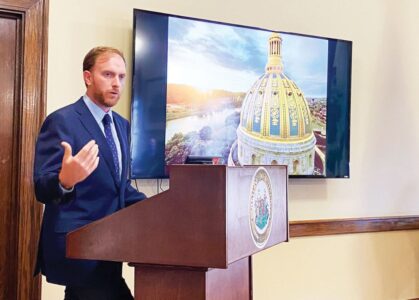
CHARLESTON - J.B. McCuskey has spent nearly eight years as State Auditor, but after briefly exploring a run for governor, he wants a shot as West Virginia's next top attorney.
After announcing a Republican campaign for governor last February, McCuskey announced in July that he would seek the GOP nomination for attorney general, joining a field that includes state Sen. Mike Stuart, R-Kanawha, who also served four years as the U.S. Attorney for the Southern District of West Virginia.
"I have spent my entire adult life practicing law, including the last eight years here in the Auditor’s Office. And I have been able to combine my legal skills, my legal education with a lot of government experience," McCuskey said. "I believe that I will bring a really, really great perspective to the Attorney General’s Office on how we both protect us from the federal government’s overreach, but also how we start to truly reform our own bureaucracies to make sure that they are effective and accountable to the people of West Virginia."
While both McCuskey and Stuart filed precandidacy papers last year allowing them to fundraise, neither candidate has filed their official candidacy paperwork for the May 14 primary ballot. The winner of the primary and the November general election will succeed three-term Republican Attorney General Patrick Morrisey, who is himself seeking the GOP nomination for governor of the state.
An attorney by trade - including for his family's law firm and the national American Center for Law and Justice - McCuskey has been focused on monitoring taxpayer dollars and making government more transparent. Prior to his time as State Auditor, McCuskey was a member of the House of Delegates representing Kanawha County.
Between his legal background and his time as State Auditor, McCuskey believes he has the right set of skills to take the reins in the Attorney General's Office, and his travels across the state have led him to believe others feel the same.
"I have a very strong record of accomplishment over the last seven years in the Auditor’s office," McCuskey said. "And West Virginians are very, very excited to see what my perspective and my goals in government ... to continue Patrick Morrisey’s incredible work in the Attorney General’s Office."
A priority for McCuskey is maintaining the current staff and lawyers at the Attorney General's Office and maintaining the institutional knowledge those attorneys bring, as well as work with the West Virginia University College of Law to recruit new lawyers.
"The reason that our state under Attorney General Morrissey is so effective at leading on huge issues - be it Waters of the United States or being the EPA case or right now the Trump case keeping him on the ballot - is because we have lawyers who are at the absolute top of their field, full stop," McCuskey said. "I would love to make sure that we are ensuring that those lawyers, as much as humanly possible, are coming from West Virginia and are coming from my alma mater, West Virginia University College of Law."
McCuskey would like to work with the next governor, whether it is Morrisey or someone else, to help shrink state bureaucracy when it comes to attorneys. While the Attorney General's role is to represent the state and provide legal advice to state departments and agencies, many state offices use their own in-house attorneys.
"The next attorney general is going to have to work with the next governor in ... reforming the entire state’s bureaucracy," McCuskey said. "What we see is that our government gets bigger and bigger and bigger and more expensive every year. And we do not see, in my opinion, the kind of results that should be resulting from that kind of investment ... what I see then is that it is not a spending problem, but it is a process problem."
For larger civil cases, it's near impossible for the in-house staff at the Attorney General's Office to handle them alone. These cases are often put out for competitive bid to law firms who receive a capped percentage of successful settlement awards. McCuskey said he would like to see more in-state law firms take these cases.
"We will always spend a lot of time bidding out work from the Attorney General’s Office," McCuskey said. "What I would love to do is to start building a coalition of in-state firms that are both conservative and like-minded as we are to start to bid most of this work to, if not all of it.
"I think we need to work with (WVU) to start finding people who are interested in building those kinds of firms, to take the work on of the Attorney General so that when we are paying these lawyers, the money is staying inside of West Virginia and we know that the people representing us represent our values," McCuskey continued.
A fight has broken out over the last several months between Morrisey and West Virginia Citizens Against Lawsuit Abuse over attorney fees in the most recent civil litigation with major prescription opioid manufacturers and distributors totaling nearly $1 billion. The Mass Litigation Panel approved recommendations in October for outside counsel representing counties and cities to receive 15% of the more than $940 billion in tentative settlement award.
The fee percentage for outside counsel representing the Attorney General's Office was negotiated at a 7.8% cap, but that cap does not apply to the law firms representing cities and counties, which could see more than $51 million in fees. McCuskey said that outside attorneys representing cities and counties in major civil litigation should be subject to the same state law that limits the percentages of attorney fees for cases brought by the state, though McCuskey cautions that it is unlikely the state sees a similar case like the opioid case.
"The biggest step we need to take is to put the cities and counties under the same requirements that the state has," McCuskey said. "One of the things that we have to be very careful here is changing the law based on a generational lawsuit.
"We’re talking about $1 billion in a pill-pushing case where the drug companies targeted specifically Appalachians to make an enormous amount of money and destroy both our culture and our economy," McCuskey continued. "That is something that’s likely never going to happen again. You have to be very careful to change laws based on very specific fact patterns, because they don’t always apply the same way when the fact pattern is a little more common or a little more general."
The Attorney General's Office was instrumental in negotiating the memorandum of understanding between local governments in the opioid litigation and legislation creating the West Virginia First Foundation, a private foundation that will distribute 72.5% of the nearly $1 billion settlement. McCuskey and Morrisey announced a few weeks ago a partnership to ensure the funding will be used for substance abuse avoidance, research and education; funding for law enforcement; and substance abuse treatment and recovery.
"This foundation’s number one goal, in my opinion, is to make sure that this next generation of West Virginia teens and young people has a different outlook, different perspective, and a different understanding of why these drugs are so incredibly harmful, not just to them, but to their communities in general," McCuskey said. "We are installing systems and processes that enable counties and cities to be confident in spending this money on solving those...issues, issues simultaneously, and doing so in a way that their constituents can see it and they can be confident that what they’re doing complies with state law and the memorandum of understanding."
McCuskey said he would continue the work of Morrisey in taking the federal government to court when heavy-handed regulations hinder the state's economic, industrial, and constitutional interests. He would continue efforts already under way by the State Auditor's Office and Attorney General's Office when it comes to consumer protection.
But while Stuart - McCuskey's Republican opponent - would like to see the Attorney General's Office take on a criminal justice role, McCuskey was more skeptical of the office receiving these powers. The Attorney General's Office has very narrow criminal justice authority, with county prosecuting attorneys handling nearly all criminal matters in the state.
"The best way to do this is for the state to handle its job and to allow our prosecutors to do the prosecuting," McCuskey said. "They are the professionals. They understand their jurisdictions, they understand their judges, they understand their grand juries. And I do not believe that the Attorney General needs any further power. And furthermore, I am incredibly confident that our 55 county prosecutors are both doing the job they need to be doing now and will continue to do so in the future."