
U.S. Attorneys Host Human Trafficking Seminar in Wheeling
Trending
WHEELING - There's a correlation between West Virginia’s drug addiction problem, its growing number of child neglect cases, and human trafficking incidents happening in the state, according to both federal prosecutors in West Virginia.
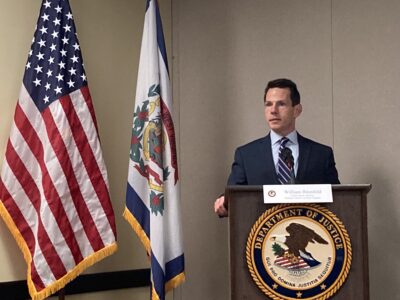
William Ihlenfeld, U.S. attorney for the Northern District of West Virginia and Will Thompson, his counterpart in the Southern District, jointly hosted a seminar on human trafficking Thursday at separate locations and streamed online throughout the state.
Ihlenfeld addressed those gathered at the St. Angelus Center at St. Michael Church in Wheeling, while Thompson spoke from the Charleston Diocese.
Ihlenfeld noted that January is "National Human Trafficking Prevention Month," and a time when law enforcement seeks to raise awareness about human trafficking.
He defined human trafficking as someone "compelling another person to provide labor, services or commercial sex and someone else benefits."
"It is a crime that is vicious, but that produces profits that are spectacular for the traffickers, but causes tremendous pain for its victims," Ihlenfeld said.
Human trafficking generates $50 billion annually worldwide, and affects about 50 million victims, according to information provided by the federal prosecutors.
Often human trafficking "is an invisible crime," Ihlenfeld added. He said it is often very hard to detect because its victims are reluctant to come forward
Some of the reasons for their reluctance include drug addiction or poverty, and they are promised drugs, food or shelter for their compliance, he explained.
"It's hard for victims to break free," Ihlenfeld continued. "If their trafficker goes to jail, who is going to take care of them? Who is going to provide food? Who is going to provide shelter if she turns on him?"
Prior to being appointed U.S. attorney in 2021, Thompson served as Circuit Judge in Boone and Lincoln counties for 14 years. He said over time he became very familiar with human trafficking issues in the state, what causes them and how some social programs actually take advantage of drug addicts and those with other vulnerabilities.
The concepts of human trafficking and substance abuse actually "feed one another," he explained.
Abuse of such drugs as methamphetamines, fentanyl, cocaine, heroin and prescription drugs is rising in the state, Thompson continued.
In addition, "at least 90%" of child neglect cases in West Virginia concern substance abuse issues, and the result is the state now has 6,200 children in foster care.
The result is a "very fertile ground" for human trafficking issues, according to Thompson.
"We've got these children whose parents suffer from drug addiction, whose parents aren't able to take care of them, so what happens to them?" he asked.
If they are "lucky," their situation is reported and they are removed from their home and placed in the foster care system, he continued.
The overwhelming majority of families in the foster care system "are doing it for the right reasons" and provide children a safe and nurturing home - "but some don't," according to Thompson.
Too often, children are actually recruited into addiction human trafficking through the foster system, and they feel the pain for years to come, he explained. This leads to additional problems later on when they have their own families and their children continue down their path.
Some social service providers known as "sober living homes" also have been linked to human trafficking, Thompson said.
"Human traffickers take advantage of those with addiction," he continued.
Ellen Duffy, special agent with the FBI, spoke of a recent case she investigated that involved a mother regularly driving her teenage daughter across state lines into Maryland to have sex at a hotel with a man from Florida in exchange for money. The mother struck a plea deal and will serve 40 years in prison.
Andrew Cogar, assistant U.S. attorney for the Northern District of West Virginia, explained some of the red flags the public should look for that will alert them to human trafficking situations.
Victims often have diminished health, are fearful and anxious and avoid all eye contact, he said. They also may show signs of abuse and malnourishment, and won't appear to be free to speak for themselves.
Ihlenfeld said the U.S. Department of Justice "can't be everywhere," and he asked the public to contact his office if they see what they think are signs of human trafficking in their neighborhoods, in hotels or at worksites.
Locally, his office can be contacted at 304-234-0100, or by mail at P.O. Box 591, Wheeling, WV 26003.
Thompson's office may be contacted at 304-345-2200; or 300 Virginia St., Suite 4000, Charleston, WV 25301.