
Attempt To Amend Mineral Valuation Bill Fails in West Virginia Senate
 W.Va. Legislative Photography
 Trending
CHARLESTON -- An amendment meant to provide fairness for royalty owners when it comes to natural gas property valuations by the West Virginia Tax Division failed Thursday, with a bill to eliminate a sunset provision for the current valuation formula set for passage today.
House Bill 4850, removing the sunset clause from the oil, natural gas, and natural gas liquids property tax valuation formula, will be on third reading this morning in the Senate and if approved, the bill's next stop will be the desk of Gov. Jim Justice.
HB 4850 would remove a sunset provision for a formula to determine the value of personal property that produces oil, natural gas and natural gas liquids.
The formula has a sunset of July 1, 2025, requiring the Legislature to either keep the current formula in place or develop a new formula by that deadline.
House Bill 4336, passed by the Legislature in 2022, requires the state Tax Division to calculate oil and natural gas property valuations using an income-based approach based on what the value of the interest would be if sold at market value. Instead of using a three-year average to value wells, the new formula looks back over only the previous tax year and requires individual wells be valued instead of multiple wells being lumped together.
Most lawmakers from natural gas-producing counties have opposed the new formula, which some believe benefits large natural gas producers to the detriment of county governments and school systems that rely on property tax revenue, and royalty owners who believe the formula is weighted to make them pay more in taxes.
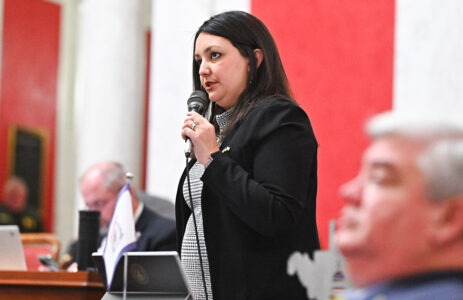
Opponents of the bill have called for it to be amended to provide assistance to royalty owners. On Thursday, state Sen. Laura Wakim Chapman, R-Ohio, attempted to offer an amendment to HB 4850, stating that "... in no case may the appraised value of the royalty interest exceed the average actual sales price of similarly situated and like royalty interests."
The amendment failed by voice vote.
"I've gotten dozens of calls from concerned constituents regarding the manner in which the minerals are valued," said Chapman. "This amendment would do nothing to harm oil and gas producers. What it would do is value the mineral rights at fair market value. This gives mineral owners a benchmark to go by when contesting the appraised value by using similarly situated and like properties as the benchmark, just like every valuation of real estate."
Chapman's amendment is similar to a bill offered last year by former Ohio County delegate Erikka Storch. During a public hearing for HB 4850 last week, several royalty owners also called for amending the bill to require the Tax Division to value royalties based on the average sales price of similar properties.
Senate Finance Committee Chairman Eric Tarr, R-Putnam, opposed Chapman's amendment. Tarr argued that requiring the Tax Division to value royalty interests on the average actual sales price of similar royalty interests placed an unintended cap on the amount the assets could be taxed.
"This goes and puts a cap on it, which would significantly reduce the opportunity for counties to receive those taxes," Tarr said. "The amendment, I think, is well intended for what she's trying to do for those people that she's looking to help. But at the same time, I think it creates a whole lot more problems and risks for these same people."
The valuation formula has come under fire the past two years due to its implementation by the state Tax Division. This year, state tax officials sent out notices informing oil and natural gas-producing property owners that the appraised values on their property increased, but the notices did not say what the dollar amount appraisal was. Taxpayers had until Tuesday to appeal their appraised values -- whatever that amount might be -- to the Tax Division.
Officials with the Tax Division have been holding meetings since last week with commissioners in eight counties in the Ohio Valley and North Central West Virginia after the Tax Division informed county assessors late last year that a "clerical error" by a third-party vendor in calculating the new formula for natural gas property tax valuations caused newly producing natural gas wells to be undervalued by approximately $30 million.
The mistake was found in March 2023, but the eight counties were not informed until September 2023 - six months later. Two of the eight counties -- Tyler and Marshall counties -- have already rejected requests by the Tax Division to send out amended assessments to taxpayers after the Tax Division undervalued first-year producing wells in those counties by a combined $21.1 million.