
Building Owner Questions Enforcement of Wheeling’s Vacant Structure Ordinance
 Eric Ayres
 Trending
WHEELING -- The city of Wheeling's vacant structure code came under fire last week after a recent enforcement drew the ire of several individuals in the community. City officials have defended the code, saying it does what it is intended to do.
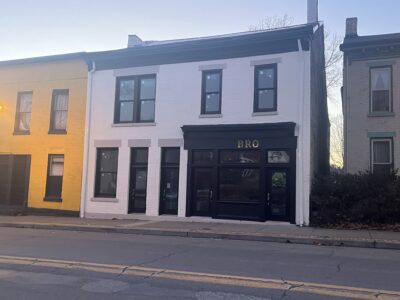
The fine in question stemmed from a pair of adjacent buildings owned by area artisan Lambros Tsuhlares that were being renovated at 2331-2333 Chapline Street, a block away from Centre Market. Tsuhlares intended to open a studio there, but issues went awry with contractors, and progress on the renovations got derailed.
Tsuhlares said one contractor put a new roof on the complex, but it leaked and damaged upper floors. An electrical contractor also ran into problems and work stopped.
"I was being delayed at no fault of my own," Tsuhlares said.
Because of the city's vacant building code, properties that stand unoccupied often end up on the city's registry for vacant buildings are subject to fines. During the rehab of the buildings on Chapline Street, the city's vacant building fines had been waived on a number of occasions.
The Chapline Street buildings had been vacant since 2018, city officials said. Under the code, owners of structures on the vacant building registry may get a notice from an inspector during the first year with no fine assessed.
However, if progress is not being made on getting a vacant building renovated and occupied, fines are imposed yearly -- and the amount of the fine increases depending on how long the building stays empty. Initial fines can be $500 per structure, while those remaining vacant for several years can get fines of up to $4,000 per year, per building.
If progress is being made on renovations, the fines can be waived. Tsuhlares said he worked with Wheeling City Council members Jerry Sklavounakis and Rosemary Ketchum in previous years to help him through the process of getting the vacant structure fines waived. However, after progress on the renovations stopped after the snag with the contractors, fines of $3,500 per side came - totaling $7,000. Once those came, on top of the dilemma with the roofing and electrical contractors, he sold the buildings.
"I just said 'I can't do this,'" Tsuhlares said. "I had easily put $250,000 into that building when the electrical contractor stopped working. Financially, I was out a lot of money."
Tsulares said that the fines would have gone up to $4,000 per side in March, but he was able to sell the building instead of dealing with further headaches.
"It was a nightmare," he said. "But I've moved on."
A Short Creek resident and a former adjunct professor at West Liberty University, Tsuhlares is a popular area ceramics artist whose works can regularly be found everywhere from the Wheeling Artisan Center to the Stifel Fine Arts Center, at the annual Oglebayfest and other venues that showcase local fine art.
"Wheeling is a great place to showcase art," he said, noting that he had every intention of becoming a resident and a brick-and-mortar investor in the Friendly City.
In 2021, Tsuhlares appeared before the Wheeling Planning Commission to request a permit to allow him to use 2331-2333 Chapline St. as an art gallery and in-home art studio for his pottery and ceramic artworks. The space was intended to be available by appointment only, and be open primarily for wholesale clients. The planning commission supported the plan.
The city also supported Tsuhlares' plan to renovate the building, voting last February to award $15,000 to him through Wheeling's popular Facade Improvement Program.
While this redevelopment plan was met with support from many angles, the fines associated with the vacant building code proved to be another stressful obstacle.
Last week, Tsuhlares shared on social media that he had sold the building. However, friends and associates of the local artisan shared the frustrating circumstances surrounding the collapse of his plan.
Outrage over the fines spilled over to social media, with individuals characterizing the city's action as adding insult to injury. A number of prominent local people and business owners went as far as to paint Wheeling as a city that is "unfriendly" to small businesses.
Wheeling Building and Planning Director B.J. Delbert on Friday explained that the vacant building code is in place so property owners don't let their structures sit empty and deteriorate. Structures that are unoccupied for years actually become hazardous.
"Vacant buildings aren't good for the health, safety and wellness of the community," she said, citing the code that has been in place for many years and was recently updated by an ordinance passed in 2022. "It's not new. The idea is to encourage people to keep up with their buildings."
There are buildings throughout the city that "fall through the cracks" -- remaining vacant but not getting reported for placement on the city's vacant building registry. Tsuhlares' building was on the registry, and the fines related to the vacant building code were waived on several occasions before he sold the building.
"You have to show progress that improvements are being made," Delbert said of the process of getting the fine waived on a vacant building. "We truly try to hold property owners accountable. It is a solid program."
Like all city codes, however, they are subject to change if city council finds it is in the best interest to do so, she said.
Tsuhlares said he hopes the city does reexamine its codes and regulations that may hinder property owners who are acting in good faith and trying to invest in the city.
"I love Wheeling," he said. "My beef is with the timeline. I just think they need to be more sensitive to people like me who are really trying to do the right thing."
Some buildings sit vacant for years without efforts to get them renovated or occupied, officials noted, and a process has to be in place to prevent property owners from neglecting these structures.
"Our vacant building program serves an important need in this community, which is to create incentive for individuals to move forward with repairs and not sit on empty buildings as we've seen the Hallmark building and TCI Cable building are two very relevant examples," Councilman Ben Seidler said on Friday. "The goal of the city is always to work with people to help make their dreams come to fruition and not punish hard-working individuals for trying to create positive change.
"I know Councilman Sklavounakis worked closely with this individual to address his concerns. We're always here to help navigate some of these pains. We live here, and we are invested here. We're not the bad guys -- we're your neighbors."