
Wheeling City Council Seeks Action on Bus Levy Renewal
Trending
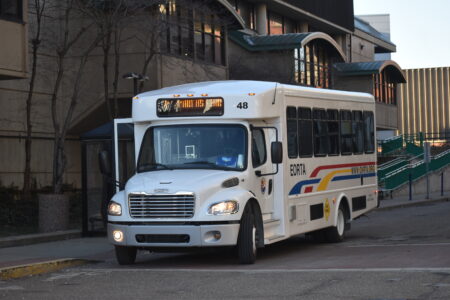
WHEELING - Members of Wheeling City Council are scheduled to meet tonight to hear first readings on new legislation and to vote on an ordinance to place a bus levy renewal issue on the ballots in May for the city’s share of Ohio Valley Regional Transit Authority funding.
A second and final reading of the bus levy ordinance is slated to take place during the council meeting, which is scheduled to begin at 5:30 p.m. today in council chambers.
If approved, the ordinance will authorize City Clerk Jessica Zalenski to publish a notice about the additional levy ahead of the May 14 election. The ballot issue will be for the next four fiscal years beginning July 1 of this year and continuing through June 30, 2028.
"The ordinance before city council is for the OVRTA operating levy - commonly referred to as ‘the bus levy,’" City Manager Robert Herron explained. "It has to be renewed every three to five years. It is at the same rate as the current levy."
The city of Wheeling shares the costs of operating - as well as maintaining equipment and facilities - for OVRTA with other municipalities in the area where the urban transit buses are utilized.
"This levy has been approved by the voters of Wheeling, Benwood, McMechen and Bethlehem for over 30 years or longer," Herron said. "It provides a very significant part of the transit authority’s operating budget and thus, provides a local match for federal transportation funds."
Because it is an excess levy, it requires voter approval, the city manager noted.
According to the ordinance, the maximum levies for current expenses authorized by state code will not provide sufficient funds for the payment of the current expenses. The proposed additional rate of levy in cents on each class of taxable property in the city per $100 of current assessed value would be 4.08 cents for Class I property, 8.16 cents for Class II property, none for Class III property and 16.32 cents for Class IV property.
Based on current assessed values, the amount of additional funds to be generated - less uncollectible taxes and tax discounts - would be $1,529,160.
Council is also expected to hear a first reading on a new ordinance authorizing the city manager to spend $557,000 with Filmtec Corporation of Edina, Minnesota, for filter modules for the city’s water treatment plant.
In other action during tonight’s meeting, council is expected to hear first readings on a handful of new ordinances. They include legislation to spend $159,656 with Hill International Trucks LLC of St. Clairsville for the purchase of a 2025 HV 607 dump truck for the Water Distribution division to be charged to the city’s Water Distribution Vehicle Replacement Fund. Hill International submitted the low bid for the truck. By comparison, Fyda Freightliner bid $168,424 and Hunter Truck Sales submitted a bid of $184,708.
Also tonight, an ordinance is being introduced to amend the Wheeling Police Department’s table of organization to reduce the number of sergeants by one from 15 to 14 and increase the number of lieutenants on staff by one from four to five.
Another first reading scheduled for tonight’s meeting will be for an ordinance authorizing the expenditure of $48,687 with Amchar Wholesale Inc. of Rochester, N.Y., for Glock pistols to be charged to the city’s Asset Forfeiture and Public Safety Account and the RCIP (Restricted Capital Improvement Program) Fund.
An ordinance set for a first reading is to fix the assessment for the cost of razing dilapidated structures at 88-13th St. in the amount of $15,800 and at 2615 Eoff St. in the amount of $12,000. Once approved by council, the assessments will become liens on the property where the structures were located before the city took action to inspect, perform abatement, demolish and remove the dilapidated structures.
A resolution is also scheduled for a vote by city council tonight to approve invoices related to the cleanup and remediation of the city’s 19th Street property. Portions of a loan and a grant received through the West Virginia Department of Environmental Protection are expected to be used to pay vendor Environmental Standards an amount totaling around $8,200.