
Budget Battle Could Push Legislative Session Into Overtime
 W.Va. Legislative Photography
 Trending
CHARLESTON -- One of the constitutional requirements for the West Virginia Legislature is to pass a balanced budget for the upcoming fiscal year, but disagreements Friday on bills between the House of Delegates and the state Senate put that goal in doubt.
"I don't know. I'd tell you if I knew," said House Finance Committee Vice Chairman John Hardy, R-Berkeley, following the adjournment Friday night of the House referring to where negotiations are with the state Senate on the budget.
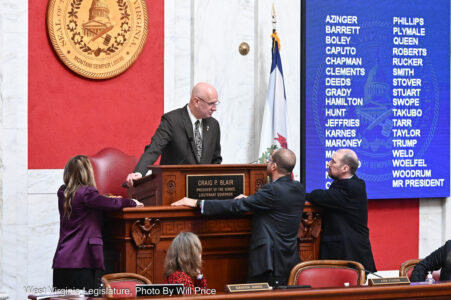
The Senate attempted to put pressure on the House to vote on Senate Bill 841, making changes to the state unemployment benefits system, by withholding a vote on House Bill 4883, relating to increasing annual salaries of certain employees of the state, and recessing until the evening.
Instead, the House placed SB 841 on its inactive calendar.
SB 841 would increase what employers pay into the state's unemployment trust fund, increase the dollar amount of weekly benefits for the first four weeks of unemployment and drop the dollar amount every four weeks thereafter, reduce the number of total weeks of unemployment from 26 weeks to 24 weeks, increase the number of work search requirements, and allow for an unemployment recipient to work part-time and maintain benefits.
Similar bills from the Senate the last couple of years tried to index the amount of weekly unemployment benefits and the number of total weeks based on the rise and fall of the state's seasonally adjusted unemployment rate, but the House has shown no interest in those bills. Even with the changes to SB 841 to make it more palatable, a majority of the House Republican caucus met Friday afternoon and did not support the bill.
Senate Finance Committee Chairman Eric Tarr, R-Putnam, said they are waiting to move ahead with the budget bill until the House decides to put SB 841 on the floor, even though the bill itself has no fiscal effect on the state budget itself.
"With the unemployment bill kind of stalled, that has a whole lot to do with what we can do budgeting for long-term here, so it affects the budget quite a bit," Tarr said. "We're still giving the House a chance to think about that some before we move ahead."
HB 4883 as it came over from the House was Gov. Jim Justice's fifth pay raise proposal for teachers, school service personnel and West Virginia State Police troopers and employees. The bill would have provided these categories of state employees a 5% pay raise at a cost of more than $80 million.
The Senate version of HB 4883, however, lowering the raise percentage to 4% and linking a raise to a trigger in HB 2526 passed during the 2023 session that cut personal income tax rates by 21.25% across all six personal income tax brackets beginning last tax year. That bill included a trigger formula for further reducing personal income tax rates after Aug. 1, 2024,
The formula compares general revenue collections in a previous fiscal year minus severance tax collections compared to the base year of fiscal year 2019 and tied to the non-seasonally adjusted consumer price index. If the general revenue collections minus severance tax collections exceed the adjusted base year, a reduction would be triggered. Personal income tax rate reductions would be limited to no more than 10% during a fiscal year.
Sources within the House Republican caucus said there was no support within the House GOP for linking teacher/staff/trooper pay raises to the personal income tax trigger.
Raises for other state employees paid through the general revenue budget were included in Justice's budget bill for fiscal year 2025 beginning in July. While the House version of the budget included state employee pay raises, the Senate version of the budget did not.
If a budget makes it out of the session by midnight Saturday, it could very well be a skinnier budget than recent years. The state is awaiting the outcome of negotiations with the U.S. Department of Education regarding $465 million the state was required to spend on education to avoid a potential clawback of some of the $1.1 billion that county school systems received from the department for COVID-19.
Several parts of the budget, such as pay raises for educators, and other supplemental appropriations, such as $150 million for the School Building Authority, are designed to help satisfy the state's maintenance of effort requirements through the three tranches of funding the state received between 2020 and 2021 through the Elementary And Secondary School Emergency Relief (ESSER) program.
The state was required to maintain a certain percentage of its education spending compared to overall spending in order to remain eligible to use the ESSER funds, but it fell short over the last two fiscal years due in part to keeping education funding the same while maintaining a flat budget and ending the fiscal years with $1.3 billion and $1.8 billion in surplus tax dollars.
The state received a waiver from the U.S. Department of Education covering the first instance of not meeting the maintenance of effort provisions, while the state applied for a second waiver in February. The state has until Friday, March 15, to present data showing the state is spending to close the monetary gap to meet the federal maintenance of effort and receive a waiver.
Once a waiver is in hand, lawmakers plan to return to Charleston in May for a special session to amend the budget in order to make further appropriations with the nearly $800 million in surplus tax dollars the state is expected to end the current fiscal year with on June 30.
But negotiations between the House and Senate towards a budget framework could move into next week. The legislative session is traditionally extended a week to complete work on the budget, but since the Republicans took the majority in 2015 they've completed work on the budget by day 60 – something that Senate President Craig Blair, R-Berkeley, has pushed for since he was Senate Finance Committee chairman.
"I would tell you that I don't think the Senate President would want to go into budget conferences," Hardy said. "He's always prided himself on being done in 60 days."