
House committee approves bill removing remaining marital rape exceptions
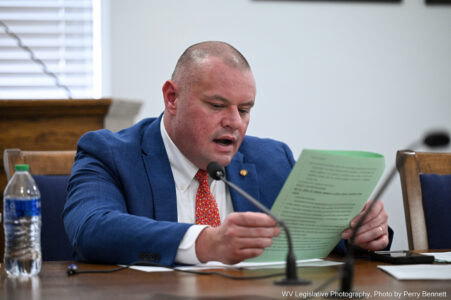
Photo courtesy of WV Legislative Photography Del. Brandon Steele, R-Raleigh, speaks during Tuesday's House Judiciary Committee meeting.
CHARLESTON – The House Judiciary Committee moved quickly Tuesday to send a bill to the full House of Delegates to remove the remaining exceptions in State Code that marriage is a defense against charges of sexual assault.
The committee recommended Senate Bill 190, modifying the definition of sexual contact, for passage Tuesday morning.
SB 190 removed “marriage” from the definition of terms in the State Code sections dealing with sexual assault and sexual contact and marriage as an exception for sexual assault charges in the first and third degrees.
Committee members heard testimony Tuesday from the bill’s lead sponsor, Senate Judiciary Committee Vice Chairman and Senate Majority Whip Ryan Weld, R-Brooke. Weld is an attorney and former assistant prosecuting attorney in Brooke County. He said the bill helps remove the remaining marital rape exceptions after an overhaul of the state’s sexual assault laws in the 1970s.
“The marital exception to sexual assault was removed from State Code in 1976,” Weld said. “There was a major overhaul of our sexual crimes of violence that year, and that marital exception was removed when it came to sexual violence. The marital exception to sexual abuse was then allowed to persist in State Code as it appears today. As it stands now, it would be – we’ll say – an absolute defense to the crime of sexual abuse if you were married to the victim.”
A person charged with sexual assault in the first degree is one who has engaged in sexual intercourse and intrusion and who has inflicted physical injuries or used a weapon to coerce sex. The crime is a felony with penalties of between 15 and 35 years in prison and a fine anywhere between $1,000 and $10,000.
Third-degree sexual assault is when someone engages in sexual intercourse and intrusion with someone who is mentally defective or mentally incapacitated; or someone older than 16 who engages in sex with someone younger than 16 who is at least four years younger than the defendant. The penalties for a felony conviction include between five and 10 years in prison and up to a $10,000 fine.
Del. Brandon Steele, R-Raleigh, was the lead sponsor of an amendment to the House’s version of the Women’s Bill of Rights Act that also ended the marital rape exception. The Senate chose last week to pass its own version of the Women’s Bill of Rights Act and removing the marital rape exceptions in separate bills.
Speaking Tuesday, Steele said he is still hearing concerns from some lawmakers that removing the exceptions might lead to an increase in complaints and charges brought by feuding spouses that might not rise to the level of sexual assault or contact. Steele asked Weld to allay those concerns.
“You kind of have checks and balances along the way,” Weld said. “Those determinations are made every day by law enforcement and by prosecutors around the state when they decide to either move forward with criminal charges or not to move forward with the criminal charge.”
“This is not going to be something brand new to our criminal justice system because we’ve already been dealing with consensually cohabitating adults that are not married,” Steele said. “This is a fact pattern that has come up before. We’re just taking the word marriage out of it.”
Top Headlines

Trump Says He’s Enacted A 10% Global Tariff By Executive Order
Trump Pledges $10M To East Palestine For Economic Recovery
President Donald Trump said his administration will provide $10 million to East Palestine toward its ongoing ...

Supreme Court strikes down Trump’s sweeping tariffs, upending central plank of economic agenda
Trump Announces Gaza Relief Pledges, Troop Pledges at First Board of Peace Meeting

YWCA Wheeling To Observe ‘NO MORE’ Week
Trump Directs Government To Release Files on UFOs, More
WASHINGTON (AP) — President Donald Trump said Thursday that he’s directing the Pentagon and other government ...