
Kara Boczek Tells Story Of Addiction, Recovery
Trending
GLEN DALE – Kara Boczek was a former all-state girls basketball player and member of the Fairmont State women's basketball team. Like many college students, she admits, she drank and smoked marijuana.
Then, one night at a party, two friends and a friend's boyfriend were crushing and snorting pills. They asked her to join. She decided to give it a try. It was at that moment, Boczek said, that her life changed forever.
"Those two girls never did it again," the Morgantown native said. "That guy never did it again. They did it that night and walked away. Me, I was off to the races after that one time."
What started as pills became a three-year heroin addiction that she said became "like a job" to her searching for her next high. Boczek has been sober for nearly 13 years now, and while there's a struggle every day to maintain that sobriety, and that life can often get tough, she said her life now has never been better.
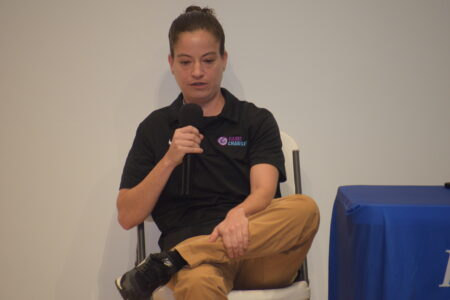
Boczek was one of three guests at the latest Looking Out for Our Kids (LOOK) program sponsored by Marshall County Schools and held Tuesday at John Marshall High School's Center for Performing Arts. Joining Boczek was her father Joe Boczek, the former sports information director at West Virginia University and now founder and executive director of Gamechanger, which addresses opioid and substance misuse in West Virginia, by helping build school environments that prevent that misuse before it starts. Also attending was Meg Bulger, the WVU Sports Hall of Fame women's basketball player who is now Gamechanger's education and community relations liaison.
Once Kara Boczek started using heroin, her slide came quickly. She quit the Fairmont State basketball team, then quit school. She allowed drug dealers to use her car to transport drugs, because that meant free drugs for her. She started dealing herself to feed her addiction.
Her parents convinced her to undergo outpatient treatment, but she admitted that, at the start, was just for show. She continued using at the start of that treatment. Yet there came a moment of clarity when she finally decided to take her treatment seriously.
"I was just in a really bad place," Kara Boczek said. "I remember telling my outpatient counselor, when he was going to get me help to send me away, that I was just sick and tired of being sick and tired. I was in a deep, dark state."
The light started shining through after undergoing inpatient treatment at Mountainside Estate in Pennsylvania. That came on March 17, 2011. She has been sober ever since.
Joe Boczek, a Shadyside native, said he'd be lying if he said he didn't worry about his daughter. Sobriety isn't a Hollywood ending. There are ups and downs, good days and bad. And a bad day could include the ingredients for a relapse. That hasn't happened with his daughter, he said, because she works at her sobriety every day.
"It's one day at a time," he said, "not one week at a time or one month at a time. Even at 13 years, you worry about when you have a bad day.
"She has a heart of gold," Joe Boczek continued. "We're a lot more fortunate than most."
Bulger said Kara Boczek's story is an important one to tell, because the specter of drugs can haunt anyone, even straight-A students and college athletes. Substance misuse does not discriminate, and Bulger said it's important for parents and families to understand that.
It's also what makes a program like Gamechanger important to a state like West Virginia, which has been affected so severely by the opioid crisis.
"The struggle is everywhere," she said. "It's not just with some southern county down here or some county here. It's everywhere. It's on the campuses. It's in the high schools and middle schools.
"So it's something that everyone is seeing," Bulger added, "and the fact that Gamechanger was not only created but has had such an immediate impact is so important, because it's related directly to the kids."
Kara Boczek is happy to offer her story, because it shows what one can become through sobriety. She now works with children with special needs, and finds it fulfilling to be that type of mentor to others.
"I've met a lot of wonderful people and made friendships that will last a lifetime," she said. "Life is good. I get up every day and go to work and try to make a difference. I'm very happy."