
Maroney Laments Passage Of Bill Curtailing Vaccination Requirements
Trending
Editor’s note: This story has been updated to reflect that Sen. Mike Maroney, a medical doctor, no longer works for WVU Medicine.
GLEN DALE - West Virginia Sen. Mike Maroney has major concerns if the state sets a precedent by relaxing some childhood immunization requirements for children.
The Marshall County Republican - a radiologist who also serves as chair of the Senate Health and Human Services Committee - urged lawmakers to reject House Bill 5105 before it was passed into law.
If signed by Gov. Jim Justice, SB 5105 will eliminate vaccine requirements for students in virtual public schools, as well as private and parochial schools, unless the student participates in sanctioned athletic events.
"(If all vaccination requirements were eliminated) there is no question we would revisit some sad times," Maroney explained. "There would be some morbidity. There would be some adults and kids sick. There would be some adults and kids who would die."
Not only would unvaccinated children be more apt to get such diseases as measles and rubella, but adults with diabetes and cancer whose immune systems are compromised would be apt to contract the diseases from them, he continued.
"It won't happen the first year, but you'll drop off a percentage of immunity each year," Maroney said. "After a few years of dropping off a percentage, you'll really lose immunity."
The state of California relaxed their childhood immunizations requirements about 15 years ago. But after about a decade, officials saw signs of health decline and increased deaths, and the state has now reversed its policy, according to Maroney.
"I'm very passionate about it," he continued. "If you take the politics out of it and read the facts - it would be impossible to come to the conclusion that vaccinations don't save lives."
Maroney noted that experts have concluded the two most important inventions to benefit mankind are vaccinations and antibiotics.
"They have saved more lives than anything in medicine has, and yet we're looking the other way and going down the ugly road again," he said. "It's hard for me to wrap my head around it."
What particularly upsets Maroney is that his warnings against relaxing vaccination requirements were largely being ignored by fellow lawmakers. There are too many attempts through legislation "to tell doctors what to do" when it comes to treating their patients.
"I hate it. I get very perturbed," he said.
He explained the Legislature is "specialized" in many ways in that those with experience in a specific field are called upon to provide their insight in that area. For example, bankers and those with financial expertise typically are called upon to chair the banking and finance committees.
That is why Maroney was appointed chair of the Senate Committee on Health and Human Resources.
"The problem is that people need to stay in their lane in terms of driving policy," he said.
"Every year it (vaccination requirements) gets challenged. I get bills, and I never run them."
But this year it was different. The legislation to eliminate vaccination requirements for those in virtual public school and parochial and private schools first passed the House with a vote of 57-41.
Northern Panhandle legislators voting "yes" included delegates Patrick McGeehan, R-Hancock; and Jeff Stephens and Charles Sheedy, both R-Marshall. Voting against were delegates Mark Zatezalo, R-Hancock; Jimmy Wilils, R-Brooke; Diana Winzenreid, R-Ohio; and Shawn Fluharty, D-Ohio.
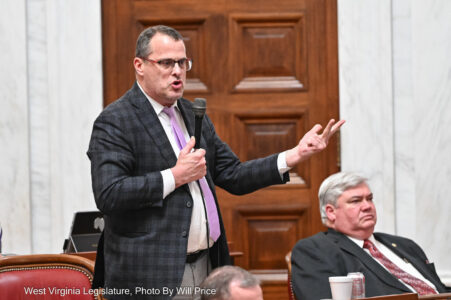
Maroney spoke out against the bill in committee, and did so again when as committee chairman he was required to present it on the Senate floor. The measure nevertheless passed 20-12 in the chamber.
Sen. Laura Wakim-Chapman, R-Ohio, voted in favor. Joining Maroney to vote against were senators Charles Clements, R-Wetzel, and Ryan Weld, R-Brooke.
According to numbers from the World Health Organization, measles vaccinations averted 56 million deaths between 2000 and 2021.
The organization also reports that even though a safe and cost-effective measles vaccine is available, in 2021 there were still an estimated 128,000 measles deaths globally - mostly among unvaccinated or under vaccinated children under the age of 5.
In 2022, about 83% of the world’s children received one dose of measles vaccine by their first birthday through routine health services. That number was the lowest since 2008, according to the WHO.
In the U.S., there are very few deaths attributed to measles and rubella because of vaccination mandates, Maroney explained.
He called out the Right To Life organizations for not getting involved with attempts to eliminate vaccination requirements for children, and instead focusing on eliminating abortion options for women. Maroney suggested the group was reluctant to get involved in the vaccination argument because stem cells from aborted fetuses have been used in the manufacture of older vaccines.
SB 5105 is now awaiting the signature of Gov. Jim Justice. At his administration briefing last week, he said he had to look closely at the bill before signing it, and didn't indicate which way he was leaning.
"I've asked, but he never lets you know," Maroney said. "The last few years, he hasn't really communicated very well with either body - the House or the Senate. ... There's a chance he won't sign it."