Peer Liaison To Work With Wheeling Police in Getting Help for Those Struggling With Substance Abuse
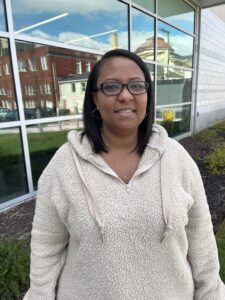
ERICA BIGGERS
WHEELING — As someone in addiction recovery since 2019, Erica Biggers will provide a personal connection for individuals struggling with substance use disorder and mental illness as the Wheeling Police Department’s peer recovery specialist.
By working closely with officers, Biggers will have access to individuals struggling with substance abuse the WPD encounters often and make referrals to get them the treatment they need.
First Choice Services provides Biggers’ services to the WPD through funding from the West Virginia Bureau for Behavioral Health. The WPD is the first law enforcement agency to add a FCS peer recovery specialist to its squad.
Biggers will primarily be involved with the WPD Crisis Intervention Team, whose members are called to diffuse situations with individuals struggling with addiction or mental health.
Wheeling Police Chief Shawn Schwertfeger noted that CIT members can mitigate crises but do not have the “training, experience or time” to focus on the referral aspect of addiction treatment. This is the gap Biggers will fill.
“Whether it’s an overdose or someone struggling at a homeless encampment, giving officers the ability to call Erica to get these individuals the attention they need is important,” said Schwertfeger. “The officers have already started making referrals to Erica, so she’ll be called out 24/7.”
Apart from responding to officers’ calls to assist individuals, Biggers can also self-initiate cases and assist during overdose investigations.
Biggers has a background in mental health and addiction counseling as a peer recovery specialist in rehabilitation facilities.
Before she joined the WPD, Biggers also underwent two weeks of training in Charleston with FCS. This training included becoming certified in crisis training, suicide training and substance use disorder training.
Biggers’s most important resource as a peer liaison will be her own experience with addiction.
The impact a peer specialist had on Biggers while she was in recovery is something she wants to replicate with those she encounters as the WPD peer liaison.
“My peer liaison was so important to me because they helped me get through the simple things,” said Biggers. “I did the rehabilitation and detox myself, but once I completed that that’s when the real journey started for me.
“My peer specialist is the one who helped me find an apartment and showed me how to make court dates when I was trying to get my kids back,” continued Biggers. “They were always there to answer the phone when I wasn’t sure if I should go right or left.”
Schwertfeger finds Biggers’s “energy, values and motivation” perfect for the role.
“She’s already out in the community making an impact, and she’s only been here four days,” noted Schwertfeger. “I’m super excited about the possibilities here, and I think we’ve made an excellent choice with Erica.”
Since her start on Monday, Biggers has been getting to know WPD officers and informing them about her background and what services she can provide.
Schwertfeger believes Biggers sharing her story with WPD members can help eliminate any stigma officers may have towards individuals struggling with addiction.
“I want officers to recognize that the individual that you may be dealing with three, four or five times a week could maybe be like Erica in the future,” he noted. “That’s important.”
Biggers added a ride-along she did with WPD Patrolmen John Wolf, who is a CIT member, was “eye-opening” for both parties.
“He gave me his perspective and what he saw as an officer encountering these individuals struggling with addiction, and I gave him the perspective of what I saw,” said Biggers. “I get the frustration officers have from answering these calls and encountering the same person again and again. It can seem like a neverending cycle. I just want to make it clear to the officers what creates this cycle, why the cycle is continuing and what we can do to try to end the cycle. That’s my purpose and my role.”
Apart from assisting WPD officers, FCS Director of Communication and Marketing Sheila Moran believes Biggers and other peer liaisons will help fulfill the “larger purpose” of the 988 Suicide and Crisis Lifeline.
“The larger vision of that line is to have a more coordinated response to crises, whether on a phone or in person,” noted Moran. “I think many people may be surprised to see a civilian with the police force, but Erica knows the resources we can provide well.
“If she encounters someone who’s having a crisis or needs addiction treatment, she is going to know better than anyone how to quickly assess the situation and get them the treatment that they need,” Moran added. “It’s going to save a lot of time as far as a police department. The patrolman doesn’t have to stop and try to access all of these resources him or herself.”
For Schwertfeger, adding a peer liaison to the WPD speaks to a principle he strives for as Chief — “not just throwing cops at problems.”
“I’ve always been someone that believes in a little more progressive approach,” described Schwartfeger. “If you can think outside the box, you can still solve the drug problem in the area.”
Top Headlines
Hancock County Schools Reviewing Levy Rates
Update: Harrison Co. Sheriff Says Incident With Shooting Suspect Is ‘Over With’

Government Shutdown Impacting Grant Awards for Safety Equipment

Birthright Citizenship Case Hits Close To Home For This Immigrant Mother
Toys For Tots Seeking Permanent Home