
Justice declares state of emergency over FAFSA issues
Trending
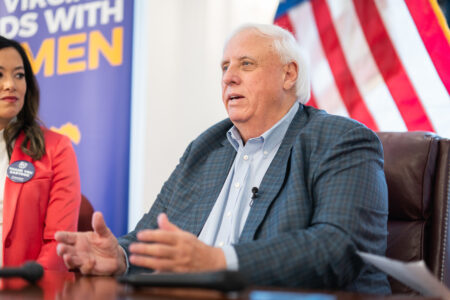
CHARLESTON - Citing ongoing issues at the national level with the applications for federal student aid for colleges and universities, Gov. Jim Justice announced Tuesday that he is declaring a state of emergency in order to speed the delivery of state student aid.
"Today, I'm declaring a state of emergency for education in West Virginia," Justice said Tuesday afternoon during his weekly administration briefing from the State Capitol Building. "We have to find a way to bypass this FAFSA requirement that will provide eligibility to our high school kids and everything, especially in regards to their scholarships."
The U.S. Department of Education rolled out a new process for students and families to submit the Free Application for Federal Student Aid (FAFSA), which determines what kinds of need-based federal student aid to provide for college and university attendees and how much. More than 13 million students submit FAFSAs annually, with approximately $120 billion in grants, loans, and work-study awards handed out every year.
But the rollout of the new FAFSA system has created numerous delays, with computer glitches and inaccurate information causing students and families to receive incorrect calculations for how much families are to provide towards their student's education and the amount of potential grants and loans. Richard Cordray, the chief operating officer for the Federal Student Aid program, announced last week he will step down effective at the end of June.
The FAFSA glitches are affecting every state and creating unease and concerns among students and parents, who in turn are delaying applying to public colleges and universities. In West Virginia, Justice said there has been a 40% drop in applications to in-state higher education institutions.
"The reason for that is our kids don't know what to do," Justice said. "I hate to throw people under the bus, but what (the federal government and President Joe Biden) are doing here is ridiculous beyond belief ... a lot of kids are sitting on the sidelines wondering not if the funding can come; they're wondering 'am I going to be able to go to college.’"
Sarah Armstrong Tucker, the chancellor of the West Virginia Higher Education Policy Commission, joined Justice for Tuesday's briefing and laid out the plan for how West Virginia students can still receive state higher education funding while the federal government works on the FAFSA issue. She encouraged families to continue to fill our FAFSA forms, but Justice's emergency proclamation would help provide certainty for families.
"We can't let our kids suffer," Tucker said. "Your leadership in allowing students to access these funds is such a blessing for students. I don't believe any other governor has been this proactive in making sure our students and state get what they deserve.
Students who apply and qualify for the PROMISE Scholarship by Sept. 1 will receive an award up to $5,500 for the 2024-2025 academic year. If a student submitted a FAFSA last year and qualifies for the need-based higher education grant, they will receive an award of up to $3,400 for the fall semester.
If a student does not have a previous FAFSA on file but is eligible for specific programs through the state Department of Human Services, students can present their eligibility letters to their college/university's financial aid office to receive the higher education grant.
Qualifying programs include the Supplemental Nutrition Assistance Program (SNAP), Temporary Assistance for Needy Families (TANF), Medicaid, the Children's health Insurance Program (CHIP), the Women, Infants, and Children (WIC) program, and the childcare subsidy program. If a student or family needs a replacement eligibility letter to provide to the financial aid office, they can call 1-877-716-1212 to request a new one.
"To the students and families, I want you to know that we have your back," Tucker said. "We want you to know that if you qualify for PROMISE and/or the higher education grant, you will get that money for this fall regardless of your FAFSA status ... this is a huge step in the right direction for our students."