
Medicaid Advocates in West Virginia Express Concerns
 Steven Allen Adams
 Trending
CHARLESTON -- Advocates for a strong and robust Medicaid system in West Virginia say the program is healthy, but changes and cuts being considered by the Legislature could put the program at risk of not meeting the needs of state residents.
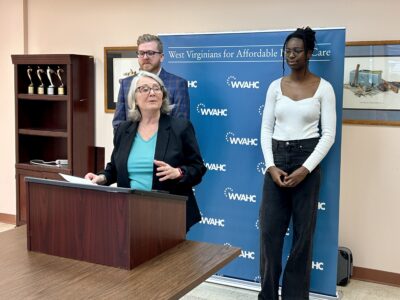
Advocacy organizations gathered in Charleston on Monday morning to kick off the start of Medicaid Awareness Month in April. The federal program -- first signed into law in 1965 by President Lyndon Johnson -- provides access to affordable health care for low-income individuals and families.
Medicaid Awareness Month is meant to celebrate the program and also draw attention to potential actions that could put the program at risk.
According to the Kaiser Family Foundation, there were more than 548,000 West Virginians on Medicaid as of November -- nearly 31% of the state's total population.
"There's never been a better time to raise awareness about Medicaid's importance for our communities here at home and really, frankly, across the entire nation," said Ellen Allen, the executive director for West Virginians for Affordable Healthcare. "Medicaid is working for West Virginia families today and every day, not just during Medicaid Awareness Month."
According to Allen, Medicaid represents more than $5 billion in total federal and state funding. According to the Kaiser Family Foundation, more than $2 billion went towards managed care and health plans in fiscal year 2022, and more than $1.6 billion went towards fee-for-service long-term care.
Rich Sutphin, executive director for the West Virginia Rural Health Association, said the Medicaid and the Children's Health Insurance Plan (CHIP) are a large part of the state's funding for rural healthcare.
"Medicaid largely supports rural populations," Sutphin said. "In West Virginia, Medicaid helps fund all of the infrastructure that we see, from our community clinics to our hospitals. People access care thanks to dollars that flow through Medicaid."
West Virginia expanded its Medicaid program through the federal Affordable Care Act in 2014, growing Medicaid's enrollment numbers. Eligibility was increased during the COVID-19 pandemic, with enrollment growing to more than 650,000 at one point. But the COVID-19 Medicaid expansion expired last April, with more than 180,000 enrollees leaving the state Medicaid system.
"Last year, we started the unwinding process wherein the state needed to review over 500,000 cases of Medicaid to see who was still eligible and who was over income," said Rhonda Rogombe, a health policy analyst for the West Virginia Center on Budget and Policy. "Some of those folks have gone to other sources, like employer-based coverage or the Affordable Care Act marketplace. But there are a lot of unknowns and a lot of people who simply are uninsured in our state right now."
Another concern for Medicaid advocates is the cuts made to Medicaid within Senate Bill 200, the budget bill for fiscal year 2025 beginning in July. Lawmakers passed what they call a "skinny" $4.996 billion budget with plans to return in a special session possibly in May once the state receives word about a federal waiver that could decide whether the state has to put $465 million of surplus tax dollars into education spending.
The budget also made major cuts to the Medicaid program, including a general revenue budget cut of $79 million and $12 million in administrative cuts. With the failure of a bill to increase the tax on managed care organizations that would have raised $56 million in revenue in the next fiscal year, the total cuts to Medicaid come to $147 million. When combined with the potential losses in federal matching dollars, the state could be hit with a potential loss of $628 million.
Gov. Jim Justice has threatened to call lawmakers into special session as early as later this month in order to restore Medicaid cuts, including $97 million that was cut from the state's intellectual and developmental disabilities (IDD) waiver program. During a press conference Monday afternoon, members of the House Democratic Caucus pointed out that there was bipartisan opposition to the budget over the Medicaid and IDD waiver cuts.
"It passed with bipartisan opposition, not bipartisan support," said Del. Mike Pushkin, D-Kanawha. "I believe a big part of that was the drastic cuts to the IDD waiver program. That's money from Medicaid. Remember, when you cut that, you're cutting it four times as much, because it's three-to-one federal match."
"I didn't come to this body ... to kick children off their healthcare insurance," said Del. John Williams, D-Monongalia. "I'll have a really hard time supporting any budget that doesn't have fully funded Medicaid programs."
Allen said she doesn't believe the state Medicaid program is at risk yet. But she believes it is important for lawmakers to understand what the state is losing out on by making cuts to Medicaid.
"We think they want to do the right thing in the end, and we're confident of that," Allen said. "I think part of our role, particularly working with people like Rhonda and the Rural Health Association as well, is helping people understand how (Medicaid) is interwoven in our daily lives ... We hope with continued education, that it won't be something that happens on a consistent basis."