
Trending
CHARLESTON -- The deposition of a former West Virginia Department of Health and Human Resources deputy secretary in a foster care class action lawsuit made public last week shined new light into issues facing child welfare officials. But it also brought down the scorn of Gov. Jim Justice.
Last Thursday, attorneys representing 12 children in the state's overloaded foster care system in a case that's been before the U.S. District Court for the Southern District of West Virginia since 2019 filed a motion to compel discovery after attorneys represented the state had tried to object to certain questions posed during an April 18 deposition of Jeremiah Samples, the former deputy secretary of the now-split up Department of Health and Human Resources (DHHR).
During the April deposition, attorneys asked Samples questions about his time at DHRR, specifically his time serving under Justice and former department cabinet secretary Bill Crouch. Samples, the number two official in DHHR, was fired by Crouch in April 2022 due to policy differences between the two. Attorneys for the state objected several times during the questioning of Samples, citing deliberative process privilege to prevent Samples from testifying about internal discussions regarding policy.
Samples served as DHHR deputy secretary between 2013 and 2022 under former governor Earl Ray Tomblin and Justice, now in the final year of his second four-year term.
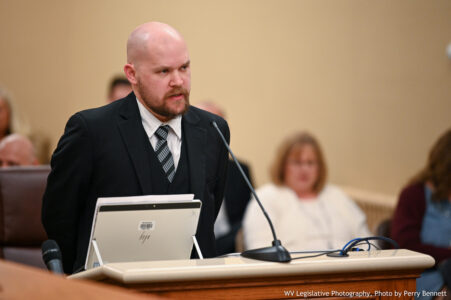
Samples now serves as a senior advisor to the West Virginia Legislature's Joint Committee on Government and Finance, advising lawmakers on matters of health policy and insurance policy.
Since leaving DHHR, Samples has mostly remained silent regarding his concerns about DHHR and the three new departments that sprung up in its demise: the Department of Health, the Department of Human Services, and the Department of Health Facilities. Samples' deposition given under oath is the first time he has laid bare his concerns, particularly when it comes to foster care and Child Protective Services (CPS).
In his sworn deposition, Samples told attorneys that he had an agreement with the Governor's Office following his firing to not disparage each other.
"...There was just a general understanding that ... I wasn't going to specifically criticize, you know, the governor or the secretary publicly, and they were going to not trash my character in a way that then would result in me having to defend and tell my side of the story," Samples said.
That agreement appears to be out the window, with Justice - speaking Wednesday on his weekly administration briefing at the State Capitol Building - throwing Samples under the bus.
"Jeremiah Samples was the man second in charge for a decade plus, and now he runs through the building, saying everything in the world was wrong," Justice said. "Why in the world didn't he fix it if something was wrong?
"The next thing I know, he was running through the building, screaming 'fire, fire, fire.' Then the next thing, we're on a quest to divide (DHHR) up," Justice continued.
However, Samples' testimony shows someone who was trying to address DHHR's failings in CPS, foster care, and child welfare, while dealing with a bureaucracy that was intent on avoiding transparency and more worried about public image than addressing serious problems.
Despite Justice's comments Wednesday, Samples released a statement that evening that encouraged both the legislative and executive branches to remain focused on children.
"It has been over two years since I left the Justice Administration. I pray for the Governor as he manages West Virginia's many critical issues, including fixing our child welfare system," Samples said. "We need to remain focused. Anything that distracts from that is a detriment to it, and I am not going to participate in a back and forth that is a distraction."
HE SAID, HE SAID
Samples was fired by Crouch one month after the end of the 2022 legislative session. Samples believes he was fired for talking directly with lawmakers about DHHR's failings, working with the Governor's Office on the appointment of former House Health and Human Resources Committee Chairman Jeffrey Pack as commissioner of the Bureau of Social Services in 2021, and working with lawmakers and the Governor's Office on a plan to fund pay raises to retain and recruit CPS workers.
House Bill 4344, the 2022 foster care bill gutted by the Senate Finance Committee, would have included a foster care placement database, a data dashboard to provide greater transparency of the foster care program, and increased pay for CPS. Instead, the Governor's Office allowed DHHR to fund those raises by collapsing some of the more than 1,400 vacant positions within DHHR at that time. But it was a plan that Crouch was not happy with according to Samples.
Samples also believed that Crouch - who resigned at the end of 2022 after coming under fire for alleged abuse and neglect issues at the state's two psychiatric hospitals and alleged pressure on West Virginia Public Broadcasting over critical reporting - had fired him eight months earlier in order to scapegoat him.
"I think he was trying to ... cover himself," Samples said. "The system was in dire straits and has continued ... to struggle. But especially at this time, it was just broken in a thousand ways, that he needed a scapegoat.
"But luckily ... I had talked to enough people over the years and enough policymakers about these issues that ... I don't feel like people in positions of decision-making agreed, which is why (Senate President Craig Blair, R-Berkeley, and House Speaker Roger Hanshaw, R-Clay) immediately reached out to me," Samples continued.
Attorneys representing the foster care children asked Samples about his concerns with DHHR's handling of individuals with intellectual and developmental disabilities (IDD), the foster care system, and CPS. Much of Sample's testimony focused on the lack of transparency and accountability within DHHR, particularly in how the department dealt with the Legislature.
"...I believe from a policy perspective, and just philosophically, that ... if you have a thousand problems and the public or policy makers only see 900 of them, then that is what will get the focus. You don't fix what you can't see," Samples said. "And there were so many issues in ours still that the department faces. How are you going to get the attention, the resources, the ideas from the broader realm of policy making?
"(If) you close everything off, your good stuff and ... the bad stuff because you are afraid of getting criticism, well, you are not fixing the problem. And then those problems linger," Samples continued.
Samples told attorneys that DHHR officials were not happy with news stories about incidents -- even deaths -- of IDD patients at state-run hospitals, or lawmakers being informed about children running away from foster care placements.
"...We had kids running away ... and that it just brought bad press and that ... even though it resulted in legislation that I think helps the state find these children as quickly as possible and ... hopefully prevent that from happening, there was just blowback on that," Samples said. "If it was negative, there was ... just this lack of transparency ... There was just not a desire to be forthcoming with the Legislature."
Under both DHHR and the new Department of Human Services (DoHS), Samples said he agreed with findings in a 2021 report by the Foster Care Ombudsman's Office that laid out concerns from families and providers about lack of communication and fears of retaliation, including threats by CPS workers to remove children. Samples said he continues to hear about similar retaliation threats in his position at the Legislature.
"There were certainly reports at the time that CPS workers were using their authority to retaliate against foster parents (and) biological families," Samples said. "The department had and has a culture of retaliation that goes back some time. And that culture had worsened in a lot of ways in this period of time."
In emails between Crouch and Samples after the report was presented, the two disagreed about whether to acknowledge the issues raised in the report.
"I talked to (Foster Care Ombudsman Pamela Kaehler-Woodman) about how we need to own this report," Samples told Crouch in a May 19, 2021, email. "There is no two ways about it -- the report reflects badly on child welfare and re-enforces what we hear from multiple stakeholders."
"Jeremiah ... we will not own the Ombudsman Report," Crouch wrote back. "She is autonomous, separate and distinct from (the Bureau for Children and Families), and for the most part, only hears and deals with the bad stuff. We have a lot of BCF employees out there that do a great job and take great care of our kids. We need to say that."
"What do you understand him to be saying from the clear reading of what he said," an attorney asked Samples about Crouch's email.
"That we were not going to as an agency agree with or publicly or politically own the problems outlined by the ombudsman," Samples said. "I believed the ombudsman report to be accurate."
The job of foster care ombudsman was created by legislation in 2019. Kaehler-Woodman, the first foster care ombudsman, announced her resignation effective Thursday, June 6, to pursue a new job opportunity. Samples testified that the Foster Care Ombudsman Office was under pressure in how it talked with lawmakers and released information.
Samples also testified about CPS cases not properly being screened or investigated, an issue that has received significant attention from advocates and media due to the recent death of 14-year-old Kyneddi Miller in April after being found by Boone County deputies in a "skeletal state." Miller's mother and grandparents have been charged with child abuse causing death.
It has been learned since that CPS had responded to Miller's home in 2009 and 2017. Last year, the West Virginia State Police conducted a welfare check of Miller's home, with one trooper driving the referral directly to the regional CPS office, though DoHS maintains that it has no CPS referral for last year.
NOTHING BUT THE TRUTH
Litigation in the federal foster care lawsuit continues. And despite the dividing up of DHHR, many of the same issues raised over the last several years remain. Justice called Samples' role as a legislative advisor disingenuous given Samples' 11 years as a deputy secretary.
"He had everybody's ear in the Legislature, and everybody just jumped up and they went crazy, saying 'let's do this and that,'" Justice said. "We'd be silly to deny that Jeremiah was in front of the Legislature saying, 'this is wrong, this is wrong, and you need to do this and this.' Is it not fair for me to say that Jeremiah was here for a decade-plus. Why didn't Jeremiah fix it? He was here way before Bill Crouch was here. He was here way before Jim Justice was here."
As for Samples, he said he plans to keep his head down and keep working with lawmakers on new legislation to improve the new departments of Health, Human Services, and Health Facilities. But he said he will always answer honestly when asked under oath about what the issues are.
"I stand by my previous public statements and my sworn deposition," Samples said. "I have been informed that I will continue to be deposed on these serious matters. Everyone that testifies should tell the truth. I have done that and will continue to do so."