
VOICES OF VALOR: Looney Helps Fellow Veterans Manage PTSD
 Emma Delk
 Trending
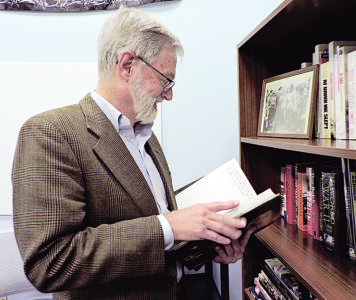
WHEELING -- Veteran John Looney, social worker and counselor at the Wheeling Vet Center, came to work there for the same reason many veterans visit: post-traumatic stress disorder.
Looney's PTSD from his Vietnam War service caused him to switch his major at West Virginia University from education to social work. Every time he helps a fellow veteran come to terms with and manage their PTSD, Looney knows he chose the right career.
Looney was drafted in 1967 during his sophomore year at West Virginia University. He was called to serve while sitting out a semester after the school asked him to do so. Looney admitted that his college career at that point was "more party than it was study."
Looney headed to Fort Benning in Georgia for basic training, then Augusta, Georgia, for advanced infantry training and then back to Fort Benning for the U.S. Army Airborne School, or "jump school."
After completing his training, Looney was sent to Vietnam as a paratrooper and given the choice between two companies. Initially, Looney thought the first company, whose role was to handle dogs, would "at least get him a good night's sleep."
"I thought at first, 'That sounds nice because I'm out in a jungle, so the dogs will be alert to everything while I sleep,'" Looney recalled. "Then I learned the dog walks out in front of everybody and I would be on the 15-foot tether away from the dog. After that, I thought, 'Now that's a little more dangerous than what I wanted.'"
Looney's other option was to join the Long Range Reconnaissance Company, or LRRPs. When he asked an LRRP what their job was, he was told they headed out in six-man teams to perform reconnaissance and avoid contact with the enemy.
"I thought that sounded pretty good and was better than being in the infantry and just slugging it out every day," Looney said. "I decided to be a LRRP."
As the "new guy" of the LRRPs, Looney recalled being "a little more than teased" by company members. To ward off their taunts, Looney asked, "Do you know who Joe Don Looney is?"
"I told them, 'Joe Don Looney is a famous football player and my brother, so you don't want to get him upset about how I'm being treated,'" Looney said
Despite having the same surname, Looney was not related to the NFL star, which the other company members soon realized.
"They came back to me and said, 'You're not Joe Don Looney's brother,'" Looney said. "I told them, 'I could have been, who knows?'"
From then on, Looney was known as J.D., or Joe Don, in the company.
Looney's role in the company was to carry the radio and communicate with the rear of the team while on missions. Looney joked that another aspect of his role was "just to run" when they made contact with the enemy, as his only goal was to keep the radio protected for communication.
There were several instances when Looney's team made contact with the enemy. He noted he was lucky as none of his team members were killed while on missions in the jungle, even while performing ambushes on the enemy.
One moment from these missions that has stuck in Looney's mind was when he relayed radio messages for a team performing reconnaissance work a few weeks before the Battle of Hamburger Hill. While keeping watch on the trail in the jungle, lightning struck the team's supplies.
At the time of the strike, Looney's friend, Gary Linder, was sitting on his rucksack that had a concussion grenade in it, which Looney compared to a "quarter stick of dynamite." The grenade exploded, and Linder was thrown into the air and over the hill the team was on.
"Everyone was stunned, so I started asking the radio operator whether they were receiving rounds and how everybody was doing," Looney said. "They told me afterward Gary was in the fetal position with his face down in a mud puddle. An officer picked his head up and said, 'Gary, are you OK?' Gary responded, 'Tell my wife I love her.' The other officer says 'OK,' and puts Gary's head back down in the puddle."
Looney was left with more than anecdotes from his time in the jungles of Vietnam when he returned to WVU in June 1969. Looney had acquired PTSD from his service but did not know it at the time as he was unaware of PTSD symptoms.
While taking the calculus classes required for his major, Looney had trouble concentrating but was not aware this was a symptom of his PTSD.
"PTSD taxes your concentration, so I had to give up detail-oriented things, which is when I went into social work," Looney said. "I didn't understand why I had to leave education at the time, and I felt as if I was stupid or less than since I didn't understand math problems. That was part of the PTSD symptomology, but I didn't know that at the time, so I didn't feel good about myself."
After receiving his master's degree in social work, Looney was hired to work at the Pittsburgh Vet Center but spent one day a week in Wheeling working with local veterans.
When former U.S. Sen. Jay Rockefeller got wind of the Wheeling veterans group, he acquired the funding to create the Wheeling Vet Center in 1989.
Looney was one of the three founding members of the Wheeling Vet Center, admitting they were "making it up" as they went along.
"There weren't a whole lot of restrictions on what we were doing," Looney recalled. "Our mission was to go out, get veterans, and get them into treatment, and that's what we did. We got more veterans, so we brought in more therapists to do that."
The center, which began in 1989, is still thriving today and has served more than 4,000 veterans in the area. Looney, who recently stepped down as director and became a therapist/counselor, said the center initially had to teach both veterans and the general community about PTSD.
"In the beginning, no one had any idea what PTSD was, so it's been a very positive experience for us to teach the community about PTSD because they've been very open to learning," Looney. "The community is very accepting of our mission."
While the community has welcomed the center, Looney noted the veterans who walk through its doors can sometimes be standoffish. He said the phrase "big boys don't cry" has made many veterans reluctant to seek treatment for their trauma.
However, Looney said once they meet fellow brothers-in-arms who have sought treatment and can handle their PTSD, they become more open to getting help.
"Once a veteran comes in and finds other guys like them, they can have fun and tease each other," Looney said. "No one gets angry with each other because we're all brothers. We can laugh with each other because helping these veterans get better is never about confrontation."
Seeing veterans become open to acknowledging and treating their PTSD is "joyous" for Looney, who noted that was the center's purpose "from the very beginning."
"I want this to be a place where veterans take care of themselves and learn that PTSD is a condition that you can learn to live with," Looney said.
Looney also had to learn to live with his own PTSD. He noted that once he accepted his life was changed due to PTSD, he no longer felt inadequate about his inability to do calculus or concentrate for an extended period.
"I find it hard to concentrate sometimes, so I need to take a break and get to a quiet place," Looney said. "Realizing that I couldn't do calculus was what was really difficult. I've accepted that it's OK, and I can find other things and purposes. I've changed, my life has changed, and I'm just accepting that. That's what PTSD is about -- accepting change."