
Marshall County Officials Agree to Settlement With Former Prosecutor’s Office Investigator
Trending
An undisclosed settlement has been reached between defendants Marshall County Prosecutor Joe Canestraro and the Marshall County Commission and former Marshall County Prosecutor's Office Investigator Bryan Gaus following a civil trial at the Marshall County Courthouse.
In the original complaint filed on Dec. 20, 2021, by Gaus's attorney, Patrick Cassidy, Gaus alleged he was relieved of his duties as a "quid pro quo" for current Marshall County Prosecutor's Office Assistant Prosecuting Attorney Brent Clyburn's to withdraw his candidacy for Marshall County Prosecuting Attorney in the June 2020 primary election.
Gaus was employed as an investigator in the prosecutor's office from February 2019 to February 2021. Canestraro and the Marshall County Commission were named as the defendants in the civil suit as the employers of Gaus.
In the original complaint, Gaus alleged Canestraro and the county commission are guilty of "wrongful discharge in violation of public policy of West Virginia" and claimed defamation against Canestraro and the commission.
Defense attorney Thomas Buck represented Canestraro and the commission. The defense claimed Canestraro eliminated the investigator position at the Marshall County Prosecutor's Office not as a "vengeful firing" of Gaus, but instead as a method for Canestraro to become closer to law enforcement officers after he entered the Prosecuting Attorney position. The defense claimed Canestraro also did "not feel comfortable" with a police investigator being in the prosecutor's office.
A six-person jury trial began for the case on Wednesday, Dec. 4. Before closing remarks were delivered to jurors on Thursday, Dec. 5, Marshall County Circuit Court Chief Judge Jeffrey Cramer announced the two parties had reached a mutual agreement settlement in the case, meaning jury deliberations would not be necessary.
The prosecution and defense declined to comment on the settlement.
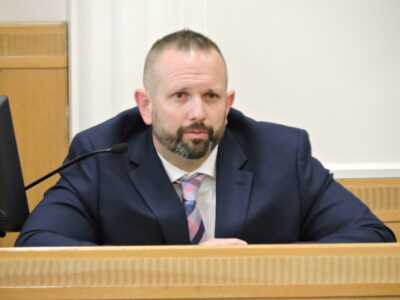
During the second day of the trial, Gaus took to the stand to recount the events leading up to and following being relieved from his duties as the prosecutor's office investigator.
After former Marshall County Prosecuting Attorney Rhonda Wade announced she would not run for re-election in 2020, Canestraro and Clyburn subsequently announced their candidacy for the prosecutor's position and filed as Democrats for the June 2020 primary election.
Gaus alleged that, prior to the June 2020 primary election, Canestraro and Clyburn had "numerous closed-door meetings" in the prosecuting attorney offices. Gaus alleged these meetings concerned Canstraro and Clyburn's respective candidacy for prosecutor and the ensuing primary and general election.
Gaus alleged that subsequent to Canestraro's closed-door meetings with Clyburn, Clyburn dropped out of the prosecutor's race and withdrew from the June primary election.
Gaus said that Canestraro met with him during the fall of 2020. During the meeting, Gaus said Canestraro verified for him that Gaus would keep his position as investigator.
On Feb. 10, 2021, Gaus was informed by Canestraro that he would be terminated effective Feb. 28, 2021. On March 3, 2021, Clyburn became a full-time assistant prosecutor in Marshall County.
During his questioning by Cassidy, Gaus said he was told he was relieved of his investigator duties because he was "withholding information" from Canestraro after he became the prosecuting attorney. Gaus said the allegation made him "look dirty and crooked."
In response to a question from Cassidy, Gaus said he was contacted by a Marshall County law enforcement officer who related to him that Canestraro informed a "few people in the hallway" outside of the prosecutor's office that Gaus was withholding information from him.
Gaus said his last evaluation as an investigator was performed in the late fall of 2020 in front of Wade and Canestraro. Gaus said it was "apparent" at the time that Canestraro would be the next prosecutor, as it was either after the election or past the filing deadline.
When Cassidy questioned Canestraro regarding the evaluation, Canestraro said he would not call the meeting between the three "an evaluation." Canestraro said he "did not recall" using the word "evaluation" to describe their outing that day and did not remember giving Gaus any pros or cons about his performance.
"That day, we went and bought a television for the office," Canestraro said. "I believe, the same day, we went to an office warehouse about a new desk for the prosecutor's office because the one that we had was beat up. Then we went to Market Vines for lunch, and we may have discussed how things were going in the office, but I don't think that was an official evaluation. We were having lunch and talking."
Cassidy also questioned Gaus regarding the damages in connection to the case, including his $58,500 yearly salary and the health insurance provided for himself and his family as investigator. Gaus said he now pays $1,000 a month for a family health insurance policy through his business, 10-42 Tactical, which provides gear and equipment for law enforcement and public safety officers.
Gaus said the total loss he calculated for the loss of the annual salary from the investigator position he has not occupied for three years and nine months plus the monthly health insurance payments he now makes totals "around $264,000."
Cassidy questioned Gaus regarding the "intangible damages" being claimed by Gaus in the case, including "inconvenience, humiliation, emotional distress and loss of personal dignity." Gaus said it was "very inconvenient" to lose his job and livelihood.
"It's definitely humiliating to be terminated," Gaus said. "It's further humiliating that everyone in the [Marshall County Prosecutor's] office knew that I was being terminated before I was told that I was going to be terminated the morning I came in for my exit interview."
Gaus recalled a conversation had had with Marshall County Prosecutor's Office Legal Assistant Dana Mele before he was relieved. He said Mele informed him that Canestraro had told her that Gaus was going to be terminated.
"To hear that you're withholding information in criminal cases is, in my opinion, just about the lowest thing that you could say about a police officer," Gaus added. "It makes me look corrupt. It's a pretty big gut punch to anyone who, in my opinion, worked really hard to build a good reputation."
During the defense's cross examination, Buck questioned that since Gaus was not present for the closed-door meetings between Canestraro and Clyburn he had "no idea" whether a deal was being made or if they were just discussing criminal cases. Gaus confirmed he was "not in the room" for these meetings.
In response to a question from Buck, Gaus confirmed that matters in criminal cases can be "sensitive," meaning that when a defense attorney wants to talk to the prosecutor about the facts of a case they could "speak behind closed doors."
Buck questioned whether Gaus had "no idea" and could only "guess what happened" as to whether a deal was being made during these meetings or whether they were talking about criminal cases. Gaus responded the meetings struck him as "very unusual and out of the ordinary."
Gaus confirmed for Buck he stated in his deposition that Canestraro was a "strong candidate" for becoming a prosecutor. Gaus confirmed he also recognized in the deposition that Canestraro had already won an elected office multiple times in contested elections and was "well-liked by the people."
In response to a question from Buck, Gaus said it was "never expressly" said to him by Canestraro that Canestraro did "not want investigators in the prosecutor's office."
"One of my conversations I had with him was that as long as he was there as prosecutor, my job was safe, and that I would always be there," Gaus said.
Buck also had Gaus read sections of the transcript from the recording Gaus took of the exit interview between Canestraro and Gaus when Canestraro relieved Gaus of his duties. Gaus confirmed for Buck that he secretly recorded the interview.
Gaus said he did so because West Virginia is a "one-party consent state," meaning he was legally permitted to record the meeting without Canestraro's permission.
In the exit interview, Canestraro informed Gaus he was "aware of his concerns" and that the reason he did not want to have an investigator is because Canestraro believed he "needed to get closer to law enforcement." Canestraro told Gaus he had been in the position for a month and "did not think" he was getting closer to law enforcement.
Gaus confirmed for Buck that in the exit interview, Canestraro told Gaus he was "eliminating" the investigator position.
"It wasn't some vengeful firing of you," Buck stated, which Gaus confirmed.
"If you think that is something I take lightly and you think I just said, 'Well, I'm going to get rid of Brian and I don't care about Brian,' well, you're wrong," Canestraro said in the exit interview. "The bottom line is, I want the lawyers doing things and I need to get to the point where officers, before they call anybody else, run things through me."
"Every one of those comments, every single thing he [Canestraro] told you, is completely consistent with the position he always had," Buck said. "He didn't feel comfortable with the police investigators being in that prosecutor's office."
In response to this statement from Buck, Gaus said he believed Canestraro's comments during the exit interview were "inconsistent" with what Canestraro had told him prior to having a position at the office as long as he was prosecutor.
The defense called one witness to the stand, Eric Gordon, part-time assistant prosecuting attorney for the Marshall County Prosecutor's Office. In response to a question from Buck, Gordon confirmed Canestraro had asked for his opinion as to whether Gordon thought there should be an investigator position in the prosecutor's office.
"My opinion had always been the same: that I didn’t really think that we needed an investigator," Gordon said. "I thought we should have an attorney or somebody else handle getting the different materials that we needed for purposes of discovery and other methods."
Gordon said he expressed this opinion to Canestraro prior to him becoming prosecutor.
After both the prosecution and defense rested their cases, Cramer had the jury take a break while the parties discussed the charges in the case. Following a prolonged break, Cramer announced the parties had come to settlement in the case. Cramer called the jury back into the room and dismissed them.