
Foundation Doling Out West Virginia Opioid Settlement Funds Celebrates Grant Recipients
 Steven Allen Adams
 Trending
SUTTON, W.Va. -- The private non-profit foundation dedicated to distributing opioid settlement dollars held a celebration Tuesday for the awardees of the first series of grants aimed at further curbing West Virginia's substance use crisis.
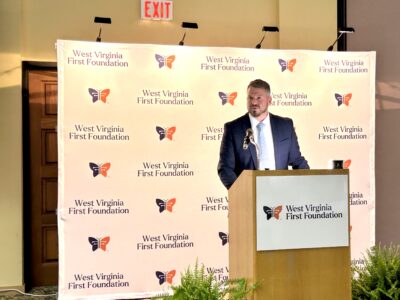
The West Virginia First Foundation held an Initial Opportunity Grant Celebration Tuesday afternoon at the Day's Inn near Flatwoods, honoring the 94 projects awarded through the foundation's first grant program.
The foundation approved the creation of the Initial Opportunity Grant program last September, receiving more than 174 applications by the close of the Oct. 5, 2024, deadline. The awardees were notified by the end of last year.
The goal of the Initial Opportunity Grant program was to distribute $19.2 million to six regions of the state. The 94 projects awarded represent approximately $17 million. Supplemental funds were awarded last month, with the first round of funds likely available by the end of May.
"Today is more than a ceremony. It's a milestone," Matthew Harvey, Jefferson County prosecuting attorney and chairman of the West Virginia First Foundation, said. "It marks the beginning of a new era in how West Virginia prevents substance use disorder, supports recovery, and saves lives."
"To our grant recipients, you are proof that bold ideas grounded in community and compassion can drive real change," said foundation Executive Director Jonathan Board. "You're setting the standard for what's possible in prevention, treatment and recovery. And we're all so proud to stand alongside each and every one of you."
Funding approved through the Initial Opportunity Grant program will be used in four areas dealing with the state's substance use disorder crisis: 32.4% of funding is going to drug diversion programs and interdiction programs, 23.5% is going towards youth drug prevention and workforce development, 21.8% is going towards child advocacy centers and pregnant/parenting women neonatal abstinence syndrome programs and 22.3% is going toward transitional and/or recovery housing expansion.
The regions with the largest number of Initial Opportunity Grant recipients includes North Central West Virginia and Southern West Virginia.
Region 5 (Cabell, Clay, Boone, Kanawha, Lincoln, Logan, Putnam, Mason, Mingo and Wayne counties) received 21% of funds. Region 4 (Monongalia, Braxton, Lewis, Harrison, Marion, Preston, Taylor, Tucker, Barbour, Randolph, Gilmer, Doddridge and Upshur counties) received 20.7% of funds. Region 6 (Fayette, Monroe, Raleigh, Summers, Nicholas, Webster, Greenbrier, Pocahontas, Mercer, Wyoming and McDowell counties) received 20.4% of funds.
Region 3 (Wood, Tyler, Pleasants, Ritchie, Wirt, Calhoun, Roane and Jackson counties) received 15.5% of funds. Region 2 (Grant, Hampshire, Hardy, Mineral, Berkeley, Jefferson, Pendleton and Morgan counties) received 15.3% of funds. Region 1 (Brooke, Hancock, Ohio, Marshall and Wetzel counties) received 7.2% of funds.
Eligibility for the Initial Opportunity Grant program was limited to nonprofit organizations with a 501(c)(3) tax-exempt status and other kinds of nonprofits and organizations that fulfill a charitable or public purpose.
Representatives of the cities and counties involved in opioid litigation, as well as the Attorney General's Office, agreed to a memorandum of understanding in 2023 to create the West Virginia First Foundation. The agreement included all 55 counties and more than 220 cities.
Johnson and Johnson, Teva, Walgreens, CVS, Kroger, Walmart, Allergan and Rite Aid agreed to a $940 million settlement with the state and local governments for their part in manufacturing and distributing prescription opioids in West Virginia, feeding a substance use crisis. So far, the state has received $290 million through the settlement.
"We all hear the number, that $1 billion is coming to West Virginia...It's based in a fact, but the fact is we don't have a billion dollars right now," Harvey said. "We have about $290 million that has to last a lifetime. This problem isn't going to go away if we spend that money right now. We'll still have the same problem tomorrow. So, we are dedicated to ensuring that these funds last beyond our own lives and for our children and my children's children."
Gov. Patrick Morrisey, who was the three-term attorney general who helped negotiate the MOU creating the West Virginia First Foundation, challenged the foundation to work to bring more organizations, business and industry and others to the table to work toward reducing the substance use disorder crisis.
"There is a chance for this foundation to really be the glue that brings everyone together to solve big picture issues of the day," Morrisey said. "The best way to do it is to bring all the people together in the room and to really listen to people and then take action."
Attorney General J.B. McCuskey took the reins of the office from Morrisey in January after serving two terms as state auditor. McCuskey told grant recipients that the Attorney General's Office would assist them in their work on substance use.
"It is really inspiring and kind of unbelievable to be standing with a group of people who, for the first time, are going to have a requisite level of funding to actually make their ideas a reality," McCuskey said. "I think this foundation is really going to take an enormous leap in showing the rest of the world that not only do we have the best people in the world, but we have the best system of doing that. And what I'm super hopeful for, and what I think our number one mission here is, is how do we make sure that this doesn't happen again."
According to the U.S. Centers for Disease Control, West Virginia's drug overdose death rate was 80.9 people per 100,000 residents, the highest death rate in the nation in 2022. According to the state Office of Drug Control Policy's Data Dashboard, fentanyl makes up the majority of West Virginia county-level fatal overdoses, with 1,134 fentanyl overdoses recorded in 2021.
The Department of Human Services reported in April that West Virginia continues to see decreases in overdose deaths from a peak during the COVID-19 pandemic, reporting a 40% decrease from January to October 2024 compared to the same period in 2023. West Virginia had a 37.7% decline in year-over-year overdose deaths for a 12-month period ending in November 2024, surpassing the national average.