
John Marshall Graduate Zara Zervos Shoots for the Stars During Her Time at WVU
Trending
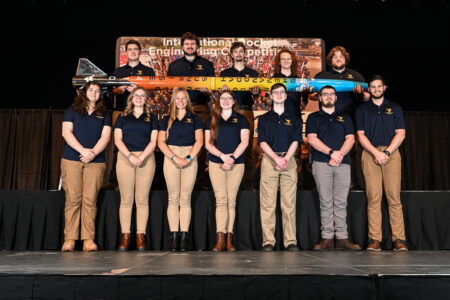
MORGANTOWN -- John Marshall High School and 2025 West Virginia University graduate Zara Zervos has earned an "out of this world achievement" with the West Virginia University Experimental Rocketry Club as a first-place finisher at the International Rocket Engineering Competition.
The event held in Midland, Texas, brought together students from more than 150 universities to compete in a design-build-fly rocket-making competition. Teams launched rockets from 8 a.m. to 8 p.m. from June 11-13.
The competition had eight categories based on rocket type and required altitude. The WVU Experimental Rocketry Club competed in the 30k SRAD Solid Motor category, which required the team to launch their 12-foot rocket "Shenandoah Sunrise" as close to 30,000 feet as possible.
SRAD stands for Student Researched and Developed, with the WVU Experimental Rocketry Club designing and building their rocket from scratch. The club has 35 members divided into five subteams: propulsion, aerostructures, avionics, payload and recovery.
Zervos, a three-year member of the club, served as the team lead for recovery, which involves creating the rocket's parachutes and other design aspects to ensure it lands safely.
She noted that this was an important aspect of rocket creation, as the structure of the rocket after it lands is considered in a team's score.
"A portion of judging is making sure that everything comes down safely, which is where the parachutes and such come into play," Zervos said. "Once your rocket hits the ground, you have to be able to take it to the judging tent and basically show that no portion of it was broken during the flight. You do not want to have a fin snap off or part of the tube split in half since everything should be completely flyable again."
The team's rocket used three parachutes -- a drogue, main chute and pilot chute. When the rocket hits its highest point, or apogee, it splits into two pieces. The drogue parachute emerges from the gap between the two pieces to slow the rocket's descent.
Zervos was responsible for the electronics of the drogue parachute, ensuring it deployed at the correct altitude.
At 1,400 feet above the ground, the main parachute comes out. Zervos said adding this piece to the rocket was a "similar process" to the drogue, involving the addition of more electronics. The pilot parachute is smaller and helps open the main parachute. It must also be timed properly to release correctly.
"By the time the rocket hit the ground, the parachute was only coming down at about 20 ft per second," Zervos said. "The rocket itself, with the motor in it, is about 120 pounds, so that's a pretty fast fall. The parachutes let our rocket hit the ground without any broken parts."
To ensure the rocket's safe landing, Zervos decided to step outside the box for parachute design for this year's competition. She hand-sewed the drogue parachute using templates, a task the club had never attempted before.
"That was really exciting for me because hand-sewing the drogue worked," Zervos said. "We had never done that before, so it was really exciting to have this new aspect to the rocket that worked well. Hopefully that's something the club can improve upon in the future now that it's been proven to work."
Zervos' dedication to the rocket's safe flight earned the team a perfect score for the recovery aspect of the competition.
"The recovery portion was completely perfect," Zervos said. "We had no mess-ups at all and everything was intact and flyable."
Zervos said another factor that contributed to the team's first-place finish was how close the rocket came to the target altitude, as the rocket reached about 31,241 feet in its flight.
"We were about 1,200 feet over our target altitude, which isn't that bad," Zervos said. "Our target height was roughly 6 miles, give or take a bit, so we had to get the rocket pretty high up."
The WVU Experimental Rocketry Club successfully launched its rocket on the first day of the competition. After the successful flight, Zervos said they were able to enjoy the rest of the competition watching other rockets fly.
Zervos is thrilled that the "hundreds and hundreds" of hours the club spent designing and building the rocket paid off during the competition. She was also happy to go out on a high note, as she will be heading to Embry-Riddle Aeronautical University in Daytona Beach, Florida, for a master's degree in aeronautics.
"The rocketry club has influenced me in that I want to keep learning about aerospace, and definitely want to work with rockets in my future," Zervos said. "I'm thankful that I found the club and it has given me a great group of people to learn and work with."
While she knew during high school at John Marshall that she wanted to pursue a career in aerospace, Zervos admitted that she did not realize she would have the opportunity to launch rockets in college. She said she was thankful to learn about the club and start going to meetings as a sophomore.
"When I was in high school, I never would have thought I could do this," Zervos said. "I hope that any students from the Moundsville area can learn about the club and hopefully join it earlier than I did because I wish I had joined by my freshman year. The memories from this competition are ones that I'll keep with me for life."