
Trending
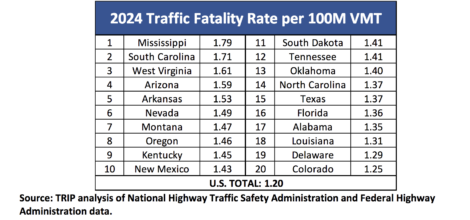
WHEELING -- West Virginia's traffic fatality rate ranked third highest among others in the nation this past year, according to a recently released 2024 report, placing the Mountain State's rate of motor vehicle-related deaths significantly higher than the national average.
Figures released by TRIP, a national transportation research nonprofit based in Washington, D.C., included summary data based on traffic fatalities per 100 million vehicle miles traveled (VMT). The data shows that last year in West Virginia, 1.61 traffic fatalities were reported for every 100 million VMT, compared to the 2024 national rate of 1.2 traffic fatalities per 100 million VMT.
While many other states have much higher numbers of fatal crashes reported each year, the recent data puts into perspective the rate of fatalities when gauged by miles being traveled on the roadways within each state.
The report -- Addressing America's Traffic Safety Crisis: Examining the Causes of Increasing U.S. Traffic Fatalities and Identifying Solutions to Improve Traffic Safety, documents trends in traffic fatalities from 2014-24 at the national and state levels.
The study examines causes for the increase in traffic fatalities and prescribes a broad, comprehensive approach to reducing traffic fatalities across the country.
Although West Virginia shows a 13% increase over the past decade in the rate of fatalities based on this formula considering miles traveled, the trend in recent years is showing progress. During the COVID-19 years, the number of traffic fatalities and the rate of the fatalities based on miles traveled increased dramatically. The numbers peaked in 2021 with 282 reported traffic fatalities in West Virginia that year, with an average of 1.75 people killed in traffic accidents per 100 million VMT.
"Fortunately, this region typically has fewer fatal crashes than other regions in the state, but that doesn't stop us from continuing to work to reduce the fatalities we have -- through high-visibility enforcement, media and education," said Melissa Pajak, West Virginia Governor's Highway Safety Program Region 4 coordinator.
The National Highway Traffic Safety Administration numbers bear that out. According to the NHTSA, from 2019-23, there has been an average of about 24.3 traffic fatalities per county in West Virginia. Only Ohio County at 23 fatalities comes close to that average in the Northern Panhandle. In the same span, there have been 11 fatalities in Wetzel County, 10 in Marshall County, nine each in Brooke and Tyler counties and six in Hancock County.
In comparison, there have been 125 fatalities in Kanawha County, 74 in Berkeley County and 57 in Cabell County.
Based in Wheeling, Pajak's office covers seven counties in the state's Northern Panhandle region, including Brooke, Hancock, Marshall, Ohio, Wetzel, Tyler and Pleasants counties, and works in conjunction with about two dozen agencies within the region.
The mission of the agency is to reduce crashes, injuries and fatalities on the region's roadways by encouraging, promoting and supporting highway safety throughout the region.
In West Virginia, the total number of annual traffic fatalities has continued to decline each year since the most recent peak in 2021, according to the TRIP study, indicating that progress is being made in the efforts to reduce the number of traffic fatalities in the state. There are a number of programs in place in West Virginia and throughout the Northern Panhandle that focus on these efforts.
"Most vehicle crashes are preventable," Pajak noted. "Highway safety is everyone's responsibility. It will take a collective effort from all of us -- the public, government, law enforcement, vehicle manufacturers, insurance companies, media, everyone across the state -- to get us to our overall goal of zero fatalities and serious injuries."
The National Highway Safety Administration uses information from the Fatality Analysis Reporting System (FARS) to calculate data about fatal crashes across the country. This database also keeps records pertaining to the leading causes of fatal accidents in each area.
"According to FARS data for 2019-2023, some of the top factors are speed, distraction and impairment," Pajak said of the main contributors to the region's traffic fatalities. "I believe my departments in Region 4 are very proactive and work very hard to keep our roadways safe. It's not about a quota, because they don't have quotas. It's about doing their job and doing it right."
One of the programs in the state that focuses on increasing highway safety aims at protecting roadside crews in work zones. The Slow Down, Move Over law, which has been in effect since 2003, was expanded late last month. Under a new West Virginia law, drivers must now take the same precautions for maintenance vehicles and disabled vehicles displaying warning signals as they do for emergency responders, the TRIP report noted.
This new law broadens coverage to include any stationary vehicle performing public service on highways as well as disabled vehicles displaying flashers or other warning signals. It requires drivers to slow down, and if safe to do so, move over one lane -- away from the disabled vehicle. If drivers cannot change lanes or if the roadway has fewer than four lanes, they are required to reduce their speed.
"With vehicles passing by at high rates of speed, the side of a road is an extremely dangerous place for anyone to be," said Lori Weaver Hawkins, public and government affairs manager for AAA Blue Grass. "As a strong traffic safety advocate, AAA is pleased to see that protection under West Virginia's Move Over Law is now extended to motorists in disabled vehicles as well as road maintenance vehicles, while continuing to protect all first responders."
According to figures from 2019-23, motor vehicle crashes that occurred in highway work zones resulted in 4,470 fatalities nationwide. In West Virginia, highway work zone crashes resulted in 25 traffic fatalities during that same period.