
Wheeling Eyes 38% Water, Sewer Rate Increase To Tackle $65 Million in Projects
 Eric Ayres
 Trending
By ERIC AYRES
Staff Writer
WHEELING -- The city of Wheeling has more than $65 million worth of prioritized water and sewer system improvements on tap, and in order to tackle them, utility customers could face a proposed 38% increase in water and sewer rates in the near future.
Members of the Public Utilities Committee of Wheeling City Council met this past week to discuss the prioritized list of wastewater and sanitary sewer system projects that are looming. City leaders already met with officials from the Water Department to review the key projects targeted for water system improvements.
City leaders plan to issue 30-year bonds to finance the projects. But ultimately, the costs associated with handling the debt will come by way of an increase to customers' monthly bills.
Overall, the list of priority water system projects is estimated to cost around $21,495,000, and sewer system improvements are projected to cost about $43,850,000, for an estimated total of $65,345,000 worth of utility improvements.
While the debt for these projects is expected to be paid over the course of 30 years, the work itself will be done much sooner.
"It will take us probably three years to complete everything," Wheeling City Manager Robert Herron said. "In order to do these projects as proposed, it would require a rate increase. In order to accomplish all that, we are proposing a 38% rate increase."
That proposed rate increase would include debt service on new bonds, Herron said, noting that it has been a while since the city implemented a rate increase for water and sewer services. The last water rate increase was 12%, and the last sewer rate increase was 45%, Herron noted.
"Typically, the city increases rates every five to six years," he said. "I think the last rate increase was in 2021."
After meeting with Water Pollution Control Superintendent Andy Harris, Water Superintendent Lori Siburt and several consultants from Verdantas Engineering (formerly CT Consultants), members of the Public Works Committee of Council this week agreed to forward the matter on to the full city council for consideration.
"This is our obligation and our responsibility," said Vice Mayor Jerry Sklavounakis, chairman of the Public Works Committee of Council.
However, it will take some time to get the ball rolling on any proposed rate hike. There will be a rate ordinance that will have to be presented to city council, then a bond ordinance will be brought forth after that. Before any legislation is considered on a rate increase, a required public hearing must be held.
City leaders broke down the impacts the rate increase will have on customers and presented a perspective by way of the list of rates at all other municipal service providers across the state.
The standard benchmark when measuring typical monthly water and sewer usage is around 4,000 to 4,500 gallons. Herron noted that this amount is slightly high for most customers with average household usage, but stressed that the city charges the same for every 1,000 gallons. For example, the bill for a customer who uses 4,000 gallons in a month would be the same for a customer who uses 4,999 gallons in a month.
Currently, Wheeling's water rate for 4,000 gallons is $30.63 per month. It would go to $42.26 if a 38% rate increase were to be implemented. On the sewer side, the current rate for 4,000 gallons is $42.76 per month. It would go to $57.62 if the proposed increase goes through.
Officials noted that the process of bringing this legislation forward, holding a public hearing and getting the new rates approved and implemented could take until the end of this year or even early next year.
"I know that it's a tough pill to swallow for all of us," said Councilman Dave Palmer. "But I go back to the needs -- we're required to provide this for our citizens. All of our citizens use this. So it's something we have to keep up to date and keep modern. It needs to be done."
Out of more than 300 public service districts in West Virginia, the city of Wheeling's water service rates currently ranks as the 31st lowest. The city's sewer rates are currently the 67th lowest in the state. If the 38% rate increase were to be implemented, Wheeling's rates among other districts throughout the state would move it down to 82nd lowest for water and 160th for sewer.
City officials said this is something to note, as the utility rates would still be significantly lower than most areas of the state.
"That's out of a total of 329 neighboring districts - cities, towns and public service districts," Wheeling Mayor Denny Magruder said. "We would be in the lowest 25%, quite frankly, in water and we would be lower than 50% of the average in sewer. I think that's a significant thing to look at."
Palmer noted that even with the proposed increase, Wheeling's rates would still be lower than the rates in a number of neighboring districts. Currently, the Ohio County Public Service District ranks 200th for water rates in the state and 226th for sewer rates.
"Our rates are considerably lower," Palmer said.
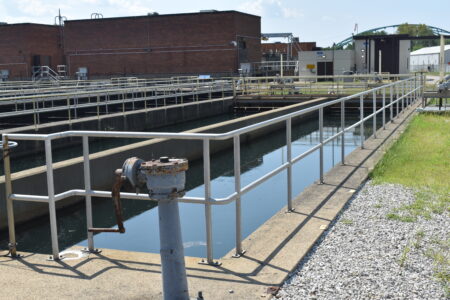
Among the top priorities for projects remains needed improvements to the city's wastewater treatment plant.
"The plant was built in the early 1950s," Herron explained. "I think it was one of the first wastewater plants in West Virginia. It is aging. The city has invested probably $35 million to $40 million into the facility over the last 25 years. It needs to be updated."
Herron explained that the city has to stay current with its water treatment system in order to keep permits with the West Virginia Department of Environmental Protection in compliance with current standards.
In the spring of 2024, the disastrous April flooding caused the need for more expedited replacement of aging components to the plant's treatment system and equipment. Although a federal disaster declaration was issued during that flooding event and the city has been itemizing each and every improvement project associated with upgrades at the plant, officials indicated that only about 30% of the needed improvements at the plant are expected to be considered damage related to the flood that can be reimbursed by the Federal Emergency Management Agency.
"We've been systematically updating the sewer plant for years," Herron said. "There's stuff in the plant that's just worn out. We just did an $8 million renovation down there with the '21 bond. This is just keeping it up to speed. This is the next phase of a major investment in the wastewater treatment plant. We have to meet environmental standards because we discharge treated wastewater into the Ohio River."
The Wastewater Treatment Facility improvements are expected to cost around $30.6 million. Other prioritized wastewater projects include the Warwood area infiltration and inflow reduction estimated at a cost of $6.5 million; Mt. DeChantal and Dorman Road area sewer and drainage improvements project at $1.7 million; GC&P Phase 2 sewer improvements estimated at $1 million; siphon replacement near WesBanco Arena projected with a cost of $3.8 million; and sewer improvements for the Dimmeydale-Oakmont area estimated at $2.3 million.
Water projects on the list - as announced last year - include Mozart and Clearview booster stations and water main improvements estimated at $3,226,226; Atlas, Carmel, Grandview and Oglebay-Leewood/Pogue Run water main improvements projected at $6,323,888; Boggs Hill booster station and water main improvements valued at $7,346,472; and the Wheeling Water Treatment Plant sludge dewatering improvement project estimated at $3,333,686.