
Local Students Hear From West Virginia Supreme Court Justice
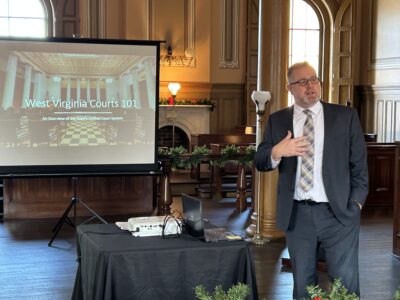
photo by: Joselyn King
West Virginia Supreme Court of Appeals Justice Thomas H. Ewing speaks to local high school students during the court’s Judicial Scholars Program Friday at West Virginia Independence Hall.
WHEELING — West Virginia Supreme Court of Appeals Justice Thomas H. Ewing said he really does enjoy sharing knowledge and teaching today’s youth.
He just didn’t want to be a teacher.
Ewing was among those addressing local high school students during the court’s Judicial Scholars Program Friday convened at West Virginia Independence Hall.
He noted the current court seeks to bring transparency to their legal system, as well as to educate the public. They are being visible and going out into the public to provide knowledge about the court and what it does.
“It is important — especially when speaking to high school students and students in general — to be willing to teach about the court system,” Ewing said.
“I have worked in it as an attorney, a circuit court judge and as a Supreme Court justice. I know there is a mystery about this process among our citizenry. I think it’s just part of our role as the stewards of the judicial system.”
A native of Fayette County, Ewing grew up in Hico. He attended Glenville State College, where he was captain of the basketball team.
Ewing achieved his law degree from West Virginia University in 2004. He was appointed circuit court judge in Fayette County in 2018.
Ewing left high school with a goal of being a teacher and athletic coach. He later discovered it wasn’t the vocation for him.
“At some point, while I was doing my student teaching I thought this wasn’t going to work out. I applied for law school while I was doing my student teaching,” he said.
Ewing acknowledged he didn’t even know an attorney before entering law school. But since high school and college, he has learned a lot since high school about the work world.
“I wish I would have known and understood career options better – especially on the legal side,” Ewing said. “There are different options like probation officers and other options I didn’t know even existed until I became a circuit judge. There are a variety of opportunities for students in the criminal justice system and the court system in general.
“For me, I wish I would have understood how the law clerk process worked at the Supreme Court. Early on, I might have been more inclined to do that than be a civil litigator.”
Ewing added he never actually wanted to do trial work in the courtroom, but after becoming a circuit judge he found himself hearing multiple trials a year.
He pointed out to the students that the current Supreme Court consists of members who haven’t been on the court for a lengthy time. The senior member of the court is Chief Justice William Wooton, who was first sworn in in late December 2020.
Justices Haley Bunn and Charles Trump were elected in November 2024, and took over the job in January 2025. Ewing next was appointed to fill the seat of the retiring Justice Beth Walker in August 2025.
The future fifth member of the court, Gerald M. Titus III, has been appointed to fill the seat left vacant following the death of Justice Tim Armstead in August.
It was eight years ago that four of the five justices on a totally different West Virginia Supreme Court faced impeachment over extreme expenditures and other administrative issues. The fifth member opted for retirement.
“I don’t think it’s necessarily a detriment to the state that we have a newer Supreme Court,” Ewing said. “When you think about where we were coming out of 2017, we were going to have newer justices, anyway.”
Top Headlines
Getting the USS West Virginia’s Mast to Morgantown Was a Tall Order
WVU Remembers Pearl Harbor Attack With Solemn Ceremony
Local Students Hear From West Virginia Supreme Court Justice

No More Exempted Camps, Wheeling Officials Say
Koroneos’ Record-Breaking Night Leads Wheeling Central To Class A Football Title
