TOP STORIES OF 2025: City of Wheeling Closes Homeless Encampment
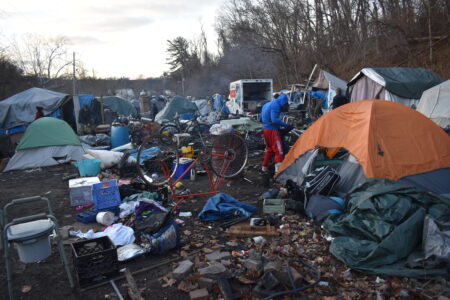
photo by: Eric Ayres (file)
The exempted homeless encampment that had been located on the Maintenance Trail along Wheeling Creek near the entrance of the Peninsula Cemetery was closed by the city of Wheeling late in 2025 after conditions continued to worsen at the property and the camp continued to grow.
WHEELING — The issue of homelessness in the city of Wheeling came to the forefront again in 2025 when city leaders late in the year took action to close its only exempted homeless encampment.
Nearly two years after implementing a camping ban on public property but allowing for an exempted camp for homeless people in the city, council members and the city administration in Wheeling initiated a move to pull the exemption for property along the Maintenance Trail near the entrance to the Peninsula Cemetery, just north of the Interstate 70 overpass along Wheeling Creek.
The exempted camp was officially closed on Dec. 1, and the site was cleared on Dec. 2.
Wheeling Mayor Denny Magruder described the exempted homeless encampment a “failure,” noting that the conditions of the camp had deteriorated to the point where conditions were unsafe and unhealthy. Several neighboring residents and business owners — particularly those in the nearby Fulton and East Wheeling areas — had mounting complaints about problems related to their proximity to the camp.
In the past two years, the exempted camp continued to grow, and because of the availability of the camp and other social services in the city, officials have said that other communities in the region had been sending homeless individuals to Wheeling.
Many advocates and activists protested the camp’s closure, asserting that the “sweeping” of unhoused individuals was not a productive way to address the issue and maintaining that the city was basically criminalizing homelessness. Those opposed to the closure noted that homeless people who had been living in the camp basically lost all of their possessions with the exception of valued items they could carry or place in a tote to be stored elsewhere.
Several noted that, although an estimated 70 people who had been living in the encampment were evicted, the displaced homeless individuals were not going to go away.
In light of the camp closure, The Life Hub collaborated with the Salvation Army in Wheeling to reopen the Salvation Army’s shelter facility on 16th Street, which had closed earlier in the year. Through this partnership, a new 30-bed shelter for women provided additional nighttime beds for those in need. These are in addition to the 50-plus beds available at The Life Hub’s facility at the former First English Lutheran Church downtown and the residential treatment program offered to clients at Northwood Health Systems in East Wheeling.
Wheeling City Council agreed to provide $75,000 from its pool of opioid settlement funds from the state to help finance the operation of the new shelter at the Salvation Army facility for six months. That contribution was estimated to be about half of the projected cost to operate the facility, and The Life Hub was expected to raise funds to pay for the rest of those costs.
Following the cleanup of the encampment, the city publicly shared photos and video footage from drone flyovers at the site. The images showed the unsanitary condition of the camp with mounds of trash and debris scattered between tents throughout the property and even over the wooded hillside above Wheeling Creek. Officials said dumpsters and portable toilets had been provided at the camp, but they were obviously not being utilized by everyone there.
City leaders have stated that they want the homeless people in the community to get the help they need, and officials have stressed that allowing people to live in the hazardous “hellhole” that the camp had become was not helping anyone. The city’s camping ban had set forth a provision that would allow for a managed camp to exist, but no social service agencies stepped forward to take on the task of managing a homeless encampment that met the city’s criteria.
The mayor noted that the closure of the camp in a way will “force the hands of society to get these people the mental help and counseling they need” and will force social service agencies that work with the homeless to take a new approach to helping them break the cycle of homelessness.
“It’s not a ‘we versus they.’ We all want to see these people get help,” Magruder said. “Yet we have an expectation that they have to obey the law.
“My fondest wish is that in the end, these people will find and be provided the help that they’re entitled to long-term, and they’re not going to find it living on the creek bank in a hellhole camp.”
Wheeling City Council also cracked down on panhandling in 2025, with a new Pedestrian and Vehicle Safety Ordinance that was passed by a majority vote late last year. Wheeling Police began enforcing the new ordinance on Jan. 1.
The new ordinance prohibits exchanging items from motorists to pedestrians on public roadways in the city. The exchange is considered a public safety hazard as stopped vehicles in an otherwise moving lane of traffic could result in a crash that could seriously injure pedestrians, motorists or vehicle passengers involved. Both pedestrians and motorists are subject to the enforcement and could face citations and fines after multiple violations.
Top Headlines

Full Bellies, Warm Hearts: St. Luke’s Episcopal Church on Wheeling Island Serves Christmas Meal
TOP STORIES OF 2025: City of Wheeling Closes Homeless Encampment

TOP STORIES OF 2025: Catastrophic Flash Flood Devastates Ohio County

West Virginia First Foundation Awards $18 Million in Grants to Anti-Drug Programs

Laupp Florist Is For Sale, But Not Closing