Wheeling Council Urged To Enforce Design Review Guidelines in Historic Areas of City
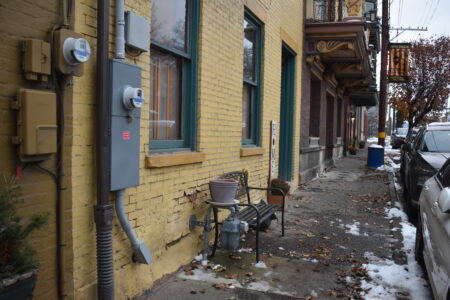
photo by: Eric Ayres
Utility meters are positioned outside the front of historic properties on Main Street in historic North Wheeling. Representatives of the Victorian Old Town Association say rules are on the books to prohibit construction and utility work in designated historic neighborhoods, but oftentimes these guidelines are ignored or are not enforced.
WHEELING — Friendly City residents who are invested in Wheeling’s historic properties are urging city leaders to crack down on violators of design review guidelines intended to help protect the character of their neighborhoods.
This week a number of residents who have been involved in the preservation of properties in the historic North Wheeling neighborhood appeared before Wheeling City Council to draw attention to issues they say are becoming a “systemic problem.” The concerned citizens gave examples of work being done by other property owners or contractors that do not honor the necessary guidelines outlined for improvements in Wheeling’s historic districts.
“I moved into my house eight years ago, excited about living in an historic home around 175 years old located on the historic National Road,” said Maria McKelvey of Main Street in North Wheeling. “I always dreamed of owning such a home in an historic Wheeling neighborhood.”
McKelvey said that in December of last year, a crew from a local company jackhammered away the sidewalk near the front of her home to replace a gas line at a neighboring property. A few weeks later, a gas meter was found to be installed in front of the historic home. McKelvey said she was told the landlord wanted the meter to be placed there so he did not have to be on site to let a meter reader inside if they needed to access it.
This matter was brought to the attention of Wheeling’s Historic Landmarks Commission during a number of meetings over the past year.
McKelvey said she was eventually informed that the commission had no authority to compel the neighboring landlord to remove the gas meter, and was told to bring the issue before city council.
The new meter not only detracts from the historic facade of the Victorian homes, but also creates an obstruction on the sidewalk, McKelvey noted.
Art Burnside, also of Main Street in North Wheeling, also provided an example of a similar incident that took place at another property in October of this year. Burnside is the vice president and treasurer of the Victorian Old Town Association and has worked to preserve properties in the historic neighborhood.
Burnside said he contacted Ward 2 Councilman Ben Seidler, who was prompted to request that the city work on correcting “what appears to be a systemic problem of allowing work to be done without necessary permitting.” Burnside said he fully supports that request.
“I cannot stress the need to have first-line defense to see that our preservation guidelines are followed,” he said, noting that it sets a “concerning precedent” when these violations continue to occur without consequences. “The use of the term ’emergency repair’ cannot be allowed to be justification for making permanent change not in compliance with our preservation guidelines.”
Homeowners doing things the right way and following correct protocols spend tens of thousands — if not hundreds of thousands — of dollars on improvements to their properties, Burnside noted. These homeowners who follow the rules could save tens of thousands of dollars on their investments for improvements simply by absorbing a $100 fine for doing things the wrong way and violating guidelines, Burnside said, but their “pride, honor and reputation” prevents them from taking that easy path.
Concerned residents asked city leaders to look at strengthening the city code that outlines these regulations and to work on improved enforcement of these rules.
Jeanne Finstein, president of Friends of Wheeling and member of Victorian Old Town Association in North Wheeling, noted that most of the North Wheeling Historic District is a Design Review District in the city — along with Chapline Street Row and Centre Market Square. This designation was created to help protect the historic nature of these neighborhoods, she said, setting forth specific criteria for exterior changes and additions to buildings. Owners and contractors are required to obtain a certificate of appropriateness from the Historic Landmarks Commission before being able to get a building permit from the city.
Finstein said that according to the review protocols, utility meters should be located indoors, and if it is deemed to be necessary to position them outdoors, they should be positioned in the rear or on the side of a building. Either way, the installation must be approved by the commission.
In the past, improvements done in violation of the review regulations were deemed “emergency” cases or assessed small fines, Finstein said. Property owners found to be in violation of the design review guidelines can be ordered to correct these problems, but no mechanism seems to be in place to make sure that they do.
“It appears that the landmarks commission does not have the authority to enforce this correction and that only city council has authority,” Finstein said.
Councilman Tony Assaro, who is council’s represenative on the Historic Landmarks Commission, said he supports the three speakers and their request.
Top Headlines

SLIDESHOW: Symphony on Ice 2025

Evidence Hearing in Mangione’s Murder Case Sheds New Light on Arrest
Admiral Says There Was No ‘Kill Them All’ Order in Boat Attack, But Video Alarms Lawmakers
WASHINGTON (AP) — A Navy admiral commanding the U.S. military strikes on an alleged drug boat in the Caribbean ...

Pentagon Watchdog: Hegseth Put Troops at Risk by Sharing Yemen Plans on Personal Phone

FBI Arrests Man Accused of Planting Pipe Bombs Before Jan. 6, 2021, Attack on U.S. Capitol