Companies Learn About Benefits of Second-Chance Employment
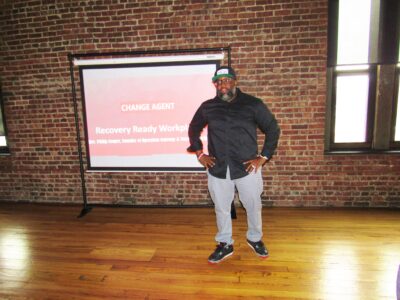
photo by: Shelley Hanson
The Rev. Philip Cooper, an Asheville, N.C. resident, and the founder of Operation Gateway and Voices of Affrilachia, talks to Wheeling area organizations and companies about the benefits of becoming a second chance employer on Thursday during a gathering at Waterfront Hall in Wheeling.
WHEELING — The message on the Rev. Philip Cooper’s baseball cap sums up his goal and message regarding addiction recovery — “Stigma Slayer.”
Cooper, a recovering drug addict who has been sober for many years, brought his message and ideas to a group of local agencies trying to help Ohio Valley residents deal with their own addictions. He also talked to employers about how and why to hire those in recovery.
Cooper, an Asheville, North Carolina, resident, is the founder of Operation Gateway and Voices of Affrilachia.
The gathering, sponsored by West Virginia Economic Development, Regional Economic Development, Youth Services System, Jobs and Hope, and the Ohio County Family Resource Network, was held at Waterfront Hall in Wheeling.
Cooper asked those who are in recovery to raise their hands, and a handful did.
“Where are my proud recovery people at? Give them a hand,” Cooper said while clapping. “We aren’t anonymous like we used to be. There’s too many people dying to keep my recovery in the closet.”
Cooper noted many companies are facing workforce shortages and second chance employment can help fill those positions if done correctly. Companies that plan to hire people in recovery need to make sure they are letting their direct supervisors know of their plans.
Companies should also consider using or hiring individuals with “lived experience” related to addiction to help vet these potential employees — instead of relying on human resource professionals alone. Those with lived experience can include those in recovery themselves or those who have loved ones in recovery.
When hiring someone in recovery, employers must also make sure the employee is taking time to attend to their health and recovery efforts. This includes taking time to attend meetings such as Narcotics Anonymous, keep doctor appointments and more.
If an employee is working too much overtime, he said, that means they are not taking the time to take care of themselves and their recovery.
“Recovery is happening. Workplaces just need to catch up,” he said. “I don’t know about West Virginia, but where I’m at, people are dying. They’re going to get meth, they’re getting fentanyl. They’re going to get weed, they’re getting fentanyl. They’re going to get crack, they’re getting fentanyl. And they are dying, right? So the time is now to talk more about recovery. You can try to run from it but you can’t. … Somebody at your workplace, I guarantee you, right now is struggling. And you might not even know it, or maybe you do know it but their productivity is on point.”
Cooper noted there are federal grants and tax incentives for companies who want to be second chance employers for those in recovery or those who have been jailed in the past.
Cooper, who refers to himself as a “change agent,” said part of his ministry is to make sure people know it is OK to talk about their struggles and recovery.
“We recover out loud so people stop suffering inside,” he said. “Let’s overrule stigma with healing. Let’s overrule stigma with education.”
For more information about Cooper and his programs in North Carolina, visit https://www.operationgateway.org/.
Top Headlines
Companies Learn About Benefits of Second-Chance Employment
West Virginia House of Delegates Gets To Work on ‘Jobs First’ Agenda

Northern Panhandle Hydrogen Hub Stalls Amid Lack of Market

CDC Studies Show Value of Nationwide Wastewater Disease Surveillance as Cuts Loom

Senate Passes More Spending Bills, But Dispute Over Homeland Security Looms