Democratic Minority Unveils Agenda With West Virginia Legislative Session Set To Begin Wednesday
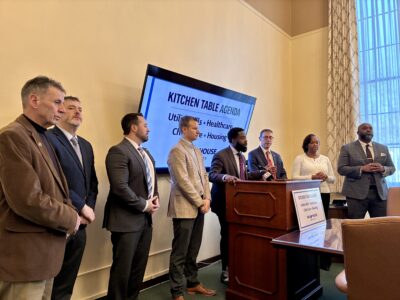
photo by: Steven Allen Adams
House Minority Leader Sean Hornbuckle, D-Cabell, center, joined at the podium by fellow Democratic lawmakers, tells reporters Monday about the policy priorities for the 2026 legislative session.
CHARLESTON — A few months ago, members of the Democratic caucuses in the West Virginia House of Delegates and state Senate went to people’s kitchen tables to learn about the issues facing residents.
Now, Democratic lawmakers want to bring the Republican supermajority to the table to find agreement.
Members of the Legislature’s Democratic caucus held a press conference Monday afternoon to unveil their “Kitchen Table” agenda, developed after 11 stops in cities all across the state between September and December.
“Last year, we set out across the state on our Kitchen Table tour and we listened,” said House Minority Leader Sean Hornbuckle, D-Cabell. “We found out just exactly what West Virginia’s were wanting, where they’re hurting, and where we need to significantly impact their lives. And that’s how we have arrived at our Kitchen Table agenda this upcoming legislative session.”
The Kitchen Table agenda focuses on four key issues surrounding affordability in West Virginia and nationwide: utilities, health care, child care, and housing.
“We have solutions ready to go to help be a part of solving these issues,” Hornbuckle said. “As you see behind me today, again, we’re going to have laser focus … These are the key factors to making sure that we can have a vibrant state in a place where people want to live and play and work.”
According to the U.S. Energy Information Administration, the average price of electricity for residential ratepayers increased by nearly 34% between 2019 and 2024. Del. Evan Hansen, D-Monongalia, said his caucus supports a temporary freeze in electric utility rates through 2027; a Public Service Commission reform package that includes tougher ethics requirements and elected PSC members; and an embrace of an all-of-the-above energy platform.
“Another thing we need to do here in West Virginia is embrace an all-of-the-above energy strategy so that we’re not dependent on a single fuel to generate our electricity,” Hansen said. “We should also embrace (natural) gas, nuclear, wind, and solar. That’s what other states have done that have seen their electric rates increase slower than our rates. That’s really essential here in West Virginia.
Del. John Williams, D-Monongalia, wants to see a bill passed to provide tax credit to first-time homebuyers and allow for mortgage interest rate forgiveness. Williams also said he would like to see legislation to help with the affordability of childcare.
“People don’t sit and imagine whether someone can stand up while riding their motorcycle or not … They think about their bottom line, how much things cost,” Williams said. “I guarantee that the mortgage comes up a lot. So, that’s an issue we can address along with child care and health care costs. Families are paying too much for both of those things.”
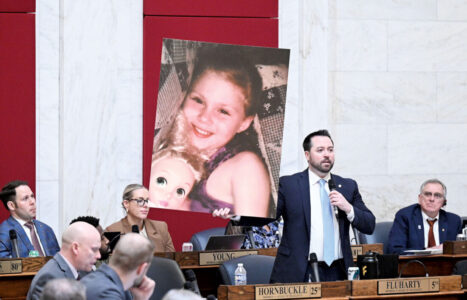
House Minority Whip Shawn Fluharty, D-Ohio, said he would once again push for Raylee’s Law, which would allow county boards of education to reject a request for homeschooling by a parent if there is a pending child abuse or neglect investigation against a parent, guardian and or a person serving as a child’s instructor.
The bill’s namesake, Raylee Jolynn Browning of Oak Hill, died in 2018 due to abuse from her father, Marty Browning. She had been pulled from public school by Marty Browning. He, along with his girlfriend and girlfriend’s sister, were sentenced in 2022 after being convicted for child neglect causing death. A version of Raylee’s law was amended last year into a homeschooling bill in the House, but it was never taken up by the state Senate.
“We have bipartisan support in the House,” Fluharty said. “For two years now, it has gone over (to the Senate). We’ve amended it and found common sense support … It’s fundamental malpractice, legislatively, by the Senate, who wouldn’t put Raylee’s Law on the agenda. If it sits for another year, how many more children are we going to read about who are being taken advantage of by abusers who are using the system with this loophole to do their acts?”
Democratic lawmakers are also awaiting the presentation of the fiscal year 2027 general revenue budget by Gov. Patrick Morrisey when he gives his second State of the State address 7 p.m. Wednesday.
Del. Mike Pushkin, D-Kanawha, criticized the Morrisey administration for not being forthcoming with the effects of last summer’s federal One Big Beautiful Bill Act, the legislation supported by President Donald Trump that could see up to $1 billion in federal funding cuts to the state when fully implemented.
“If there was good news for West Virginia in the One Big Beautiful Bill or whatever they call it … they’d be popping the balloons and dropping confetti over every Culture Center,” said Pushkin, who also chairs the West Virginia Democratic Party. “The reason they’re not releasing (the effects) is because we know we all know that it’s bad news for West Virginia.”
Top Headlines

Neal McCoy to headline Dutton Ranch Night
Ohio County Schools Back Online
WHEELING – Facilities within Ohio County Schools were back online Monday after spending nearly a week without ...
Raylee’s Law Gets Attention As Crossover Day Deadline Looms
New Trained K-9 for Wheeling Police Department Eyed
WHEELING – The city of Wheeling is moving forward with action to acquire a new K-9 for the Wheeling Police ...

U.S. Says Attacks On Iran To Last For Weeks And Intensify