EPA Review of Former Austin Master Site in Martins Ferry Slated for Spring
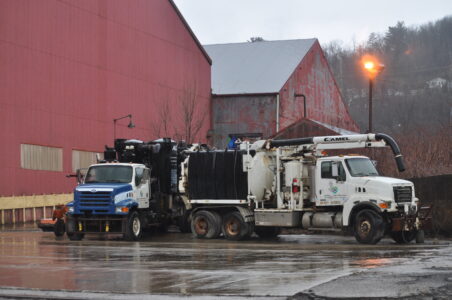
photo by: Stephanie Elverd
Trucks bearing the logo of Austin Master Services still sit at the site of the former oilfield waste company at the 4K Industrial Park.
MARTINS FERRY — Nearly three years after the U.S. Environmental Protection Agency identified the former Austin Master Services (AMS) facility in Martins Ferry as a potential Superfund site, the federal review process remains ongoing.
The Region 5 EPA recently said that a site inspection of the AMS facility and other areas at the 4K Industrial Park is expected in the coming months.
“In 2023, EPA toured the site as part of its preliminary assessment. The next step in the process – and the current step for EPA – is the site investigation, a process which typically spans multiple years,” the agency said via email.
The EPA explained that ODNR’s cleanup and confirmatory sampling at the site needed to be completed before the agency could begin its investigation. The EPA has a work plan in place to conduct sampling at the site and “anticipates sampling to take place in the Spring of 2026.”
The Ohio Division of Natural Resources led the clean-up at the site where Austin Master Services, a Pennsylvania-based oilfield waste company, operated a processing facility inside a former steel mill at the industrial park along First Street, near the Ohio River and the city’s water well field. The company stored waste generated by oil and gas drilling operations, including hydraulic fracturing byproducts that can contain radioactive materials such as radium.
State records indicate the company was permitted to store only 600 tons of material but had accumulated more than 10,000 tons of waste at the site.
The EPA said Austin Master “was permitted to process technologically enhanced naturally occurring radioactive material from oil and gas wells under the jurisdiction of the ODNR” and because of that “ODNR remained the lead agency for the cleanup and subsequent confirmation sampling.”
ODNR announced in April that cleanup was underway at the building and that most of the waste and debris had been removed. The cleanup involved power washing by a third-party contractor and extensive testing to determine whether contamination remained. According to ODNR Press Secretary Karina Cheung on Friday, that cleanup is now complete.
“The contractor performed a radiological final status survey of the building, the equipment, structures and of the property,” Cheung said. “As of May 28, 2025, all oil and gas waste at the site has been eradicated and the site is clean.”
But clean does not necessarily mean the site is free of lingering or even legacy contamination. That’s where the EPA comes in.
“ODNR’s post-cleanup data and EPA’s site inspection will help determine if contamination remains at the site,” the agency said.
The EPA stated it “does not have any testing data from the ODNR” to release, but once the site inspection sampling and report are completed by its team, that data will be made available to the public.
While the site investigation could potentially lead to the EPA designating the Austin Master facility as a Superfund site, the EPA investigation could also lead to the Austin Master facility being designated a Brownfield site – an abandoned or underused property where contamination complicates redevelopment, often requiring cleanup before reuse as part of community revitalization.
And if the Austin Master facility meets the criteria of a Superfund site, the owners – who were already slapped with more than $34 million in penalties last week in a ruling handed down by Belmont County Common Pleas Court Judge John Vavra – could be on the hook for millions more.
A Superfund site is designated under the Comprehensive Environmental Response, Compensation, and Liability Act (CERCLA) – a federal law enacted in 1980 to address hazardous waste contamination. The program allows the EPA to investigate sites where toxic substances may pose a risk to human health or the environment. If contamination is confirmed, the EPA can compel responsible parties to pay for cleanup or use federal funds to remediate the site.
“The AMS facility is not considered a Brownfield site,” the EPA said. “EPA is investigating hazardous waste at the site and will determine whether any potential future remediation under either program [Superfund or Brownfield] is necessary.”
As for concerns of the location of Austin Master facility to the municipal water supply, the EPA said that, while sentinel wells were not installed following the discovery of radioactive waste, safeguards were already in place and that jurisdiction rests with the state EPA.
“The city of Martins Ferry has several production wells north of the site – one well is a part of Ohio EPA’s Ambient Ground Water Quality Monitoring Program and is regularly sampled,” It said. “The groundwater data for this well does not indicate that there has been an impact to groundwater.
“Additionally, under Ohio EPA, the former AMS facility is in a source-water protection area. A source water protection area is a component of a drinking source water assessment and protection report. Concerns about potential impacts to the municipal aquifer would be addressed in the report with Ohio EPA.”
Martins Ferry Service Director Andy Sutak said the federal EPA has not contacted city officials regarding the pending site investigation.
Top Headlines
U.S. Military Carries Out First Known Strike on Alleged Drug Boat Since Maduro’s Capture

12-15 Inches of Snow in the Forecast for Wheeling Area

Bills on the Move in the West Virginia Legislature

Vance Touts Administration’s Record Against Abortion at March for Life
EPA Review of Former Austin Master Site in Martins Ferry Slated for Spring