
Local Leaders Strongly Opposed to Partisan Municipal Elections
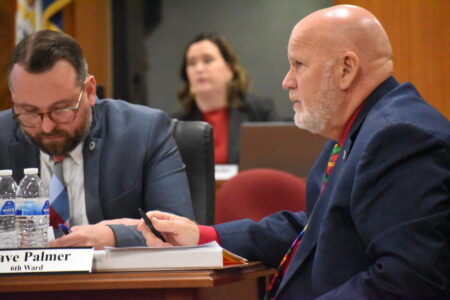
WHEELING — City leaders in Wheeling and Moundsville voiced universal opposition to proposed legislation that would force West Virginia municipalities to hold partisan elections.
“House Bill 4080 is simply a bad piece of legislation,” said Wheeling Councilman Dave Palmer. “This bill is being pushed by the national Republican Party as a way to interject itself and take away local autonomy, and quite frankly, it’s disgusting.”
The city of Wheeling holds its municipal election every four years, typically in May, when seats for the mayor and all council members are up for grabs in non-partisan races.
“Local issues are just that and should not be decided by whether you have an ‘R’ or a ‘D’ next to your name,” Palmer said. “We as city council members are responsible for our streets, our water, our sewage and our public safety, and we do not need to be dragged into national issues.”
While local leaders may have their own personal political affiliations, they should not be a factor in how local governments operate for the good of the community, Palmer noted.
“For the last 10 years, I myself as a Republican, have sat next to councilor Ty Thorngate, who is a registered Democrat,” Palmer said. “We have been on different sides of the vote from time to time, but it has never been about Republican or Democrat. I believe that we, as city council members, all look out for our constituents no matter what letter is behind their name. This bill should not be passed, and local autonomy shall remain.”
Wheeling Vice Mayor Jerry Sklavounakis added that this is another example of state legislators attempting to supersede local authority.
“Based upon my experience, cities, counties and towns are best situated to determine the appropriate structure for their elections,” Sklavounakis said. “I still believe in the principle of local control, which means I do not support passage of that bill. Unfortunately, it’s just another attempt to strip local control from our residents.”
Local officials said such legislation would unnecessarily introduce political rifts into hometown government bodies that are simply trying to get things done for their constituents.
“I am against this bill,” Wheeling Councilman Tony Assaro said. “Making municipal elections partisan would only create unnecessary division.”
Wheeling City Councilman Ty Thorngate said he “strongly” opposes HB 4080.
“City council is where government is the most hands-on,” Thorngate said. “We’re dealing with the basics that impact people every single day: roads and paving, water and sewer lines, police and fire protection, budgets, and quality-of-life issues in our neighborhoods. These are practical problems that need practical solutions, not party labels.”
Thorngate added that the lingering cultural divide and seemingly incessant political bickering is getting tiresome for many people.
“Honestly, aren’t most people worn out by partisan politics? I know I am,” Thorngate said. “Bringing that kind of division into city government doesn’t help anyone. Whether a street gets fixed or a fire department gets the resources it needs shouldn’t depend on whether someone has a ‘D’ or an ‘R’ next to their name.”
Municipal government works because it is local, personal and focused on getting things done, Thorngate added.
“Forcing partisan elections won’t make city councils more effective or more accountable,” he said. “It just creates division where it doesn’t belong and distracts from the real work of serving residents.
“I also find it ironic that the party that most often talks about limited government and local control is the one pushing a mandate that tells us how we should govern ourselves. Cities and towns across West Virginia have different histories, sizes and needs. A one-size-fits-all approach from Charleston undermines local decision-making rather than strengthening it. At the end of the day, this bill offers no real benefit to our community. It won’t fix roads, improve public safety, or make life better for residents. All it does is drag partisan politics into places where they’ve never been needed and where most people don’t want them!”
Wheeling Mayor Denny Magruder noted that the legislation would force municipalities to have two separate elections – one to elect a party nominee and another to have each party’s candidates face off, unless the actual intention of the bill is to simply have all candidates declare their political preferences.
“If enacted, it would require a primary election so that each party can choose their candidate for the general election,” Magruder said. “If the purpose is for the public to know each candidate’s party affiliation, that could be accomplished by showing their affiliation on the ballot by plaing a ‘D,’ an ‘R,’ or an ‘I’ next to their name.
“The system is fine in Wheeling as is.”
Wheeling City Councilwoman Connie Cain agreed.
“I am opposed to the bill because people should be voting for the person who represents all people, not just a party,” Cain said. “If it is not broken, then don’t try to change the system.”
Most people look to city leaders to take care of things like paving, trash pickup, beautification, economic development and public safety, Wheeling City Councilman Ben Seidler said.
“We work hard to bring people together for the common good of making our city a better place,” Seidler said. “I’d rather bring people together than divide and alienate 45% of our population. It’s exhausting. That kind of stuff belongs at the state and federal levels. We are just here to serve our residents. We don’t even have the authority to effectively legislate partisan issues at the city level.”
Seidler added that state legislators need to let local officials handle local issues.
“The state needs to be the state — get out of the way, and let us manage our cities the way we know best, not what Charleston knows best. That certainly doesn’t involve us further dividing our residents. They should stay in their construction cone-filled lanes.”
Moundsville Mayor Randy Chamberlain is not in favor of House Bill 4080, which calls for municipalities to hold partisan elections for council, mayor and other seats.
“I’ve been on city council off and on for half a century, serving five different terms dating back to 1975, and it’s always been non-partisan,” he said.
“I’ve worked with Democrats and, of course, Republicans. I, myself, am a Republican. I tend to lean conservative, if you will. But I know I have served with others whose views are different, but we have always tried to do the right thing for the people of Moundsville. Those decisions are not made on the basis of political views, partisan politics and I would prefer to keep it that way.”
He added that another portion of the bill regarding elections of mayors instead of appointments is fine with him.
“But I would prefer the municipal elections to remain non-partisan,” he said. “If we’re focused on the needs of the people, we should be focused on those needs regardless of political views or partisan politics,” he said. “The needs are the needs and that’s what we’ve always tried to address as a council. I would hope that this bill in the present form doesn’t pass.”
Moundsville City Manager Rick Healy is also not in favor of the bill.
“No one reached out to Moundsville to see what our opinion of it was. But I think overall it’s a bad bill,” Healy said. “It takes us back 75 years to old time, small-town politics. There’s no place for political affiliations at the municipal level.”
Healy said more gets done because it is non-partisan.
“I think the Legislature could be working on things that have a lot more significance and a lot more problems in the state than something like that,” he added. “I personally, as city manager in Moundsville, would be against that bill.”
Healy said if approved the bill would not take effect for several years. However, it would result in additional cost for the city – about $7,000 per additional election.
“It would probably require the city of Moundsville to have a primary election as well as a general election. That’s a huge additional cost every year,” he said. “Once you open up a charter anything can happen. Requiring a city to change a charter because the state says you need to do it is just not the right way. If citizens are asking for this. If the cities are asking for this, that’s one thing. But that’s never happened. I’m not sure why it’s out there, but it’s just not a good bill for cities.”
Top Headlines

Kessler Announces Bid for U.S. Senate
Local Leaders Strongly Opposed to Partisan Municipal Elections
Bill Requiring Partisan Municipal Elections Stalls in West Virginia House of Delegates
Fluharty To Make State Senate Run
ICE Agents Arrest 3 In Marshall County
United States Immigration and Customs Enforcement agents in Marshall County on Friday arrested three people, ...