
Morrisey Urges West Virginians To Be Ready for Frigid Temperatures After Snowstorm
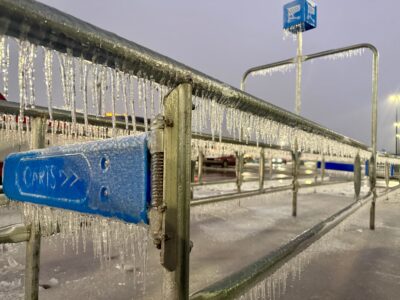
Icicles form during a winter storm at a grocery store parking lot Sunday, Jan. 25, 2026, in Nitro, West Virginia. (AP Photo/John Raby)
CHARLESTON — With Winter Storm Fern dumping several inches to nearly a foot of snow in some parts of West Virginia, along with freezing rain coating cars, streets, trees, and power lines, Gov. Patrick Morrisey urged residents to take precautions as temperatures dip into the single digits this week.
Morrisey held an in-person press conference at the State Capitol Building on Monday afternoon to ask state residents to stay home and avoid unnecessary travel as Divisions of Highways crews attempt to cut through the ice and clear roads.
“It’s been a very difficult couple days,” Morrisey said. “We know the conditions across the state remain hazardous, and I want all West Virginians to do everything they can to stay safe.
“My message to folks becomes very clear: Please stay at home,” Morrisey continued. “Please stay off the road. You can only go out if you have to. I know that there are a lot of people that may look and see that the snow has really come to an end, and they may want to get out, but the road conditions are still slippery. And when you’re out on the roads, it’s more difficult for our highways team to get out and do their work.”
Winter Storm Fern began hitting part of the mid-South and Northeast Saturday evening, continuing through Sunday, dumping several inches of snow in the northern part of West Virginia.
While the southern half of the state received some snow, much of the precipitation Sunday was freezing rain, coating everything and weighing down trees and power lines.
Many homes and businesses were either without power or shutdown Monday due to the treacherous road conditions. But temperatures were predicted to begin dropping down to the single digits beginning Monday night and through the remainder of the week, slowing the ability of ice to melt.
“I think everyone knows West Virginia is dealing with a very dangerous cocktail of snow, of sleet, and ice, and then a lot of cold, cold temperatures that will be lasting a number of days,” Morrisey said. “When I woke up this morning and saw the weather report, I know a lot of the temperatures that are forecast over the next five days in many parts of the state are expected to be at zero at 6 a.m.
“It is going to be really, really cold, and whenever you have precipitation and very cold weather, that creates one of the most dangerous conditions of all, which is a lot of ice,” Morrisey continued.
To prepare for Winter Storm Fern, the Division of Highways began treating roads and bridges with a kind of beet juice concentrate as an environmentally friendly de-icing agent. The beet juice, combined with salt brine, acts as a coating meant to lower the freezing point of roads and provides better traction through the coating’s stickiness.
“Our transportation folks tell us it is very, very effective,” Morrisey said. “They’ve applied almost 41,000 tons of salt and abrasive mix, and 390,000 gallons of this brine and beet juice mixture, which is really designed to be applied when the weather conditions go down a lot lower … I don’t know how many states across the country are using beet juice and brine, but I think it’s a pretty, pretty good thing that we’re ahead of the curve.”
As of Monday afternoon, there were nearly 15,000 Appalachian Power customers without electricity, and more than 1,000 FirstEnergy customers. Morrisey said at one point, there were more than 40,000 West Virginians without power.
“Through the night, people worked really, really hard,” Morrisey said. “That’s really a great credit to the linemen and the people out there working, a lot of them working through the night.”
Morrisey said DOH crews have logged nearly 44,000 equipment hours and more than 68,000 manpower hours. West Virginia remains under a state of emergency, with a federal emergency declaration issued by President Donald Trump on Saturday.
“We’ve been in close contact with FEMA and folks at the national level in an effort to try to make sure that everyone is properly coordinated,” Morrisey said. “I want to thank the Trump administration for the very swift emergency declaration that we were able to get, and we continue to work and wait and evaluate to protect our people.”
Emergency management systems remain activated. Morrisey said hospitals and health care systems remain stable. State officials are monitoring critical infrastructure in case those systems fail due to the cold or electrical outages. Morrisey urged the public to use 211 and wv211.org to seek assistance, such as locating warming stations or access to food and other resources.
“I want to thank everyone for really staying off the roads and for following the preparation that we outlined a number of days ago,” Morrisey said. “I think it makes a big difference.”
Top Headlines

Israel Recovers Remains of Last Hostage in Gaza as Ceasefire Enters Tricky New Phase

Trump Softens Tone as Some Federal Agents Prepare To Leave Minneapolis

Vote on Human Smuggling Bill in West Virginia Possible This Week
6 Killed When Business Jet Crashes During Takeoff in Maine
PORTLAND, Maine (AP) — Six people died when a business jet crashed during takeoff as a snowstorm moved in and ...
Schools Watch as Winter Weather Impacts Classes, Activities
WHEELING — Local school districts are keeping an eye on the weather and on predicted temperatures as they ...