
Senate sends Small Business Growth Act to Gov. Morrisey’s desk
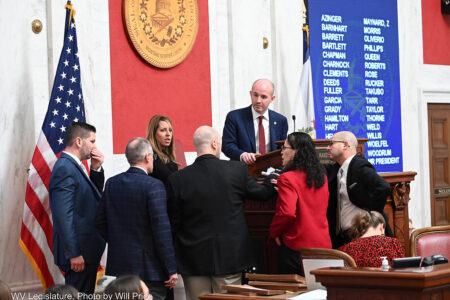
State Senate leadership confers at the podium Monday after state Sen. Eric Tarr offered an amendment to Senate Bill 1, the Small Business Growth Act. (Photo Courtesy/ WV Legislative Photography)
CHARLESTON – A bipartisan bill supported by both the West Virginia House of Delegates and state Senate meant to help small businesses gain access to investment dollars will now be the first bill to complete the legislative process.
The Senate voted Monday to concur with changes made by the House to Senate Bill 1, the Small Business Growth Act, and passed the bill in a 29-2 vote with three absent or not voting. The bill will make its way to the desk of Gov. Patrick Morrisey, who has five days to sign or veto the bill once he formally receives it. He can also let the bill become law without his signature.
SB 1 would establish the West Virginia First Small Business Growth Program, under which specialized growth funds collect capital from investors to provide financing to eligible small businesses that maintain the majority of their operations and workforce within the state. In exchange for these investments, growth investors receive non-refundable tax credits that can be applied against their state tax liabilities starting in 2029.
The bill is a priority of Senate President Randy Smith, R-Preston. The House amended the bill to include provisions of House Bill 4003, creating the West Virginia First Small Business Growth Act. Hb 4003 was one of several bills under the House Republican caucus’ Jobs First – Opportunity Everywhere economic agenda first announced in December.
“The House made technical corrections and also clarified the effective date,” explained Senate Assistant Majority Leader Patricia Rucker, R-Jefferson. “The House added language that clarifies that there will be no credit claimed until 2029.”
SB 1 mandates that the growth funds meet specific benchmarks for job creation and capital retention. If a fund fails to maintain its investment levels or violates program rules, the state reserves the right to recapture the issued tax credits. The Department of Commerce will oversee the application process to ensure compliance by participants.
While the bill had overwhelming bipartisan support Monday, the motion to concur and pass SB 1 was opposed by state Sen. Craig Hart, R-Mingo, and state Sen. Eric Tarr, R-Putnam.
Tarr proposed an amendment to the House amendments to SB 1 to allow small business owners to receive the same tax credits if they invested their own funds, such as through bank loans or personal cash, into their own businesses.
“The problem is … that doesn’t reach across to all small businesses in West Virginia,” Tarr said. “There’s a lot of small businesses in West Virginia here who’ve been through generations of their family. There are some that are brand new that fund their businesses through ways other than venture capital groups.”
“What this does is creates a fairness across all small businesses instead of saying, hey, these small businesses, we’re going to give you an advantage over these other small businesses, which is typically what tax credits do,” Tarr continued.
Senate Finance Committee Chairman Jason Barrett, R-Berkeley, spoke in opposition to Tarr’s amendment, saying that it went against the intent of the bill.
“The intent is to help small businesses that don’t have access to capital,” Barrett said. “I know many of you, when you talk to small business owners across the state and in your districts, one of the biggest impediments they have to make further investment or to grow their business is access to capital. And that’s what this is about.”
“If (Tarr) wants to do his own bill to do what he’s claiming, there is still time in the legislative session to do so, but this amendment fundamentally changes what this bill is about,” Rucker agreed.
Tarr’s amendment failed in a 6-26 vote with two absent or not voting.
Top Headlines
Senate Finance Committee Moves Budget Bill
Senate sends Small Business Growth Act to Gov. Morrisey’s desk
Guthrie Kidnapping Investigators Work With Walmart After Identifying Suspect’s Backpack
Investigators working on the disappearance of “Today” show host Savannah Guthrie’s mother are consulting with ...

NAACP Asks Judge To Protect Against ‘Misuse’ of Voter Data Seized by FBI
Textured Expo Set for Feb. 25 at Bridge Street Middle School
WHEELING – Students and their families who need extra help with taming and styling their hair will get the ...
Late Filings by Municipalities Costing Ohio Taxpayers Millions
Fees for late payments are often grouped with the “junk fees” that add strain to already precarious consumer ...