Our Lady Of Perpetual Help Prepares For Lenten Season
Eastern Catholic Lent Begins Monday
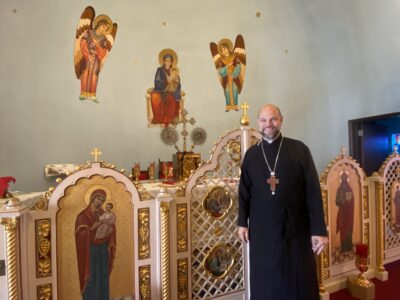
Father Jason Charron, pastor at both Our Lady of Perpetual Help in Wheeling, West Virginia, and Holy Trinity Ukrainian Catholic Church in Carnegie, Pennsylvania, is preparing his congregations for the Eastern Catholic Lenten season, which begins Monday. (Photo by Derek Redd)
St. John Paul II, Pope of the Catholic Church from 1978 until his death in 2005, once said “the Church must breathe with her two lungs.” Those two lungs, the Eastern Catholic Church and the Roman Catholic Church, both contribute to the health and vitality of the Catholic Church as a whole.
Our Lady of Perpetual Help, an Eastern Catholic Church located on Jacob Street in Wheeling, is preparing for its Lenten season starting Monday. That day, compared to the Roman Catholic Church’s Ash Wednesday start to Lent, is an example of the things that make the churches unique. Those who lead and worship at Our Lady of Perpetual Help say those differences add to the beauty of the entire Catholic Church.
Father Jason Charron is pastor at both Our Lady of Perpetual Help and Holy Trinity Ukrainian Catholic Church in Carnegie, Pennsylvania. In describing what makes Eastern Catholicism special, he offered the analogy of universities. Every university, he said, has a strong suit. Some are well known for their math and science curriculum. Others are better known for their great arts programs.
“As Eastern Catholics, we are part of that body of Christ which would, I guess, more easily associate with the artistic side as opposed to the scientific side,” he said. “We would identify more with, let’s say, the mystical side.
“That isn’t to say that one aspect of the church is better than the other,” he continued. “It’s simply to say that these are the gifts that God gave us, and when weighed against the talents, which are considerable, of the Latin Church, we get the full complement, the full 3-D vision of what God’s kingdom is like here on Earth.”
The Eastern Catholic Church’s mysticism, Charron said, comes from “allowing the things of God to overwhelm our senses,” such as the Church’s icons, the incense used during services and the prostrations, the physical act of prayer and deep reverence by falling to one’s knees and bowing one’s head to the floor.
That mysticism is what drew Charron into the Eastern Catholic Church. Born and raised outside of Toronto, Ontario, Canada, he originally went to seminary in the Roman Catholic Church, but when he went to Ukraine to teach English to seminarians, he said he was “gobsmacked by the beauty and faith of the people.”
Charron met his wife there – another difference between Eastern and Roman Catholicism is that Eastern Catholic priests can marry – lived there for three years and eventually joined the Ukrainian Catholic Church and went to seminary in Eastern Catholicism.
“For me, it was that the prayer wasn’t forced,” he said of Eastern Catholicism. “In my own life, I felt like I always had to compel myself to make it happen. And then when I encountered the prayer of the Eastern Church, I was entered into prayer. I wasn’t trying to call the birds to come near me. The flock of geese came and they lifted me up.”
Along with the mysticism of the Eastern Catholic Church comes the respect and devotion to the faith’s martyrs. The unique gift that God gave the Ukrainian Catholic Church in the 20th century, Charron said, is to be an icon to the love of Christ to the point of death, such as in the gulags of Siberia and the bombings in Ukraine’s war with Russia.
That, Charron said, is a central aspect of the faith.
“Without Good Friday, you can never have Easter Sunday,” he said. “Christianity, for the first large chunk of its existence, was one of constant companionship with Jesus on the cross. It’s not through comfort and ease that’s going to convert the hardened hearts of sinners. It’s through our being able to love in the midst of sorrow that brings people to want to be with Jesus.”
The Eastern Catholic Lenten season takes its cue from that belief. Charron said the season is about “decreasing so that He may increase,” and doing that in both body and spirit. For the next 40 days starting Monday, the congregants at Our Lady of Perpetual Help will forgo meat and dairy. They’ll attend more services. They’ll be generous with their money. They’ll speak less and listen more.
The fasting isn’t about suffering, congregant Peter Leigh said, but honing one’s spirit.
“If we can’t control what we put in our mouths, we can’t control what comes out of it,” he said. “We don’t fast because we like to suffer; we fast because it sharpens us. It brings prayer and focus.”
The message Charron wants to offer the faithful this Lenten season is to always practice dying to be born again, to understand the hard times so you can rejoice in the rebirth.
“You can’t celebrate the Resurrection unless you’ve been bound to the cross,” he said. “You don’t know the joy of water until you’ve thirsted. This is a call to prepare yourself for the Resurrection by going into the valley of death.”
The Most Rev. Mark Brennan, Bishop of the Wheeling-Charleston Diocese, said prayer, fasting and alms giving are pillars of the Roman Catholic Lenten season as well.
“Make time for God,” he said. “Just sit in quiet. Your prime time is God time. Sit down, be quiet with the Scriptures, be quiet with God and pray.”
Brennan said the relationship between the Eastern Catholic and Roman Catholic churches allow for both to thrive. Priests within the Wheeling-Charleston Diocese are able to celebrate Mass in Eastern Catholic Churches.
“Catholic unity has always allowed for profound diversity,” Brennan said. “There’s no division between the rites or conflict on who is ‘more Catholic.’ Our difference is in how faith is expressed – both of which are rich in tradition and our love of God and our belief that his only son Jesus Christ came among us to defeat the two enemies we cannot, sin and death.”
Charron also celebrates that diversity. Bread, he said, has the same basic ingredients – water, flour, yeast, salt. Yet bread in Ukraine tastes different from bread in Germany, which tastes different from bread in Italy, which is different from bread in Lebanon.
“It’s the same with faith,” he said. “The faith is one in the same, delivered once for all. But when it goes into a culture, God takes whatever is good, true and beautiful in those cultures and it just takes on its own taste and its own pizzazz.
“And that’s the beauty of the Church,” he continued. “It elevates and ennobles everything that’s good and true in a people.”
Top Headlines
Our Lady Of Perpetual Help Prepares For Lenten Season
Rep. Moore Brings $2M Check For Wheeling Gateway Center Project

Trump: Power Change in Iran ‘Would Be the Best Thing That Could Happen’
What To Know About the Homeland Security Shutdown That’s Set To Begin Saturday
Another shutdown for parts of the federal government is expected this weekend as lawmakers debate new restrictions ...

65 Years And Counting