
School Aid Formula Reform In The Spotlight
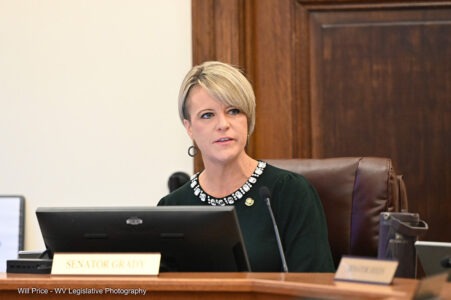
Senate Education Committee Chairwoman Amy Grady hopes that her fellow lawmakers give full consideration to several bills discussed in her committee Tuesday that will make changes to the state school aid formula. (Photo Courtesy/WV Legislative Photography)
CHARLESTON – With funding for West Virginia’s 55 county school systems in the spotlight, the Senate Education Committee began looking at bills to make reforms to the state’s complicated school aid formula.
The Senate Education Committee recommended Senate Bill 801, increasing each school district’s basic foundation program for passage Tuesday morning. The bill’s next stop is the Senate Finance Committee.
SB 801 increases the ratio of professional educators per 1,000 students and the ratio of service personnel per 1,000 students by three, which results in an increase in each county school district’s basic foundation program. The bill also prohibits a county from being penalized for not meeting the applicable minimum ratio of professional instructional personnel for state aid funded professional educators for the 2026-27 school year.
If approved by the Legislature and signed into law, the bill would add approximately 721 professional educators statewide and 715 service personnel statewide with a cost of $86.6 million.
Senate Education Committee Chairwoman Amy Grady, R-Mason, is the lead sponsor of SB 801. She said the bill stems from recommendations from county school superintendents presented to lawmakers last December.
“We had five superintendents from the top 10 school districts across the state back in December present to (the Joint Standing Committee on Education) on some things they thought could really move the needle on public education. This was one of them,” Grady said. “They feel that increasing the ratio would really help counties in general.”
“This was an item that really came about as a way to try to increase the funding formula to help counties with personnel, because the personnel cost is the bulk of what we spend money on,” explained Cabell County Schools Superintendent Tim Hardesty during testimony before the committee Tuesday.
“The state aid formula … it already takes into account the population density across the state, and adding the three professional and three service positions would increase what goes to the counties as far as paying for the employees that they have,” Hardesty continued.
Hardesty pointed out that an area of growing concern for school systems is paying for the growing demand for special education services. County school systems are spending approximately $200 million above what the state and federal government are providing for special education students.
“One of the things that the regular state aid formula does not account for is our special education costs, which are astronomical across the state,” Hardesty said.
Another bill discussed by the committee Tuesday was Senate Bill 437, creating the Fair State Aid Formula Act of 2026, though the committee delayed action on the bill as a new committee substitute is drafted.
SB 437 proposes transitioning from a traditional foundation school aid formula program to a weighted-student model designed to provide equitable support based on specific student needs and geographic challenges. The bill introduces additional funding weights for special education students, categorized into three distinct levels of need.
Beyond special education, the bill incorporates factors for low-income status, English language learners, and rural isolation while establishing safeguards to ensure that small counties are not penalized by net enrollment caps. The proposed committee substitute carries a fiscal note of approximately $45.9 million.
This measure aims to address a statewide special education population that has grown to over 50,000 students–roughly 20% of total enrollment–and to alleviate the financial and instructional strain on counties and teachers.
“We’re hearing from all the counties that that’s the big driver,” said Grady. “It costs more to educate students who have special needs. And so, this would apply a weight to those students … this would give counties a little extra funding towards that.”
Both bills would require the state to pony up more general revenue fund dollars for the school aid formula in order to make both bills a reality. Grady is aware of that but hopes the finance committees in both chambers and the Governor’s Office will give the bills full consideration.
“These small changes, which don’t take very much, can make a big difference. They just cost a little bit of money,” said Grady. “We want to make sure we have one that everybody’s happy with the fiscal impact. And I want to make sure that it’s something that moves the needle and is very helpful, but also has a minimum impact to make sure that it passes the Legislature.”
Steven Allen Adams can be reached at sadams@newsandsentinel.com
Top Headlines
Google, Meta Push Back on Addiction Claims in Social Media Lawsuit
LOS ANGELES (AP) — Jurors in a landmark social media case that seeks to hold tech companies responsible for harms ...
Magruder: Wheeling Must Lay Groundwork for Growth, Opportunity

ICE Chief Defends His Officers’ Actions Before Congress

Trump EPA Set To Repeal Scientific Finding That Serves as Basis for U.S. Climate Change Policy
School Aid Formula Reform In The Spotlight
Bill Passes Narrowing Window For Clerks To Receive Absentee Ballots
CHARLESTON - A bill to move up the deadline for West Virginia's county clerks to receive absentee ballots in time ...